
The End of the Old Order: A New Playbook for Organisational Governance, AI, and Human Capital
Abstract (TL;DR)
Artificial intelligence is often discussed as a technological phenomenon. Yet a review of recent literature across geopolitics, economics, technology, governance, complexity science, psychology, and human behaviour suggests something far larger is occurring.
The traditional assumptions that shaped organisations during the past seventy-five years are being challenged simultaneously.
Globalisation is fragmenting. Economic measures are becoming less useful. Technology is accelerating exponentially. Information systems are reshaping human cognition. Governance structures are struggling to keep pace. Organisational complexity is increasing. Human connection is becoming more valuable. Emotional resilience is emerging as a strategic capability.
Taken together, these trends suggest that we are witnessing not merely a technological transition but the quiet collapse of an old organisational order.
This article reviews the literature underpinning these changes and proposes a new organisational playbook for navigating what I call the Silent AI Revolution.
🎙️ Episode 4: The Silent AI Revolution Podcast:
Podcast Title: Building Your AI Alignment Operating Architecture: The End of the Old Order
Listen to a bite-sized podcast episode directly on your preferred streaming platform
Spotify | Amazon Music | Apple Podcasts | Castbox | Goodpods | iHeartRadio
1. Introduction: More Than an AI Revolution
Most discussions about artificial intelligence focus on:
- new tools,
- new models,
- new capabilities, and
- new risks.
Yet the literature increasingly suggests that AI is only one element of a much larger transformation.
Across multiple disciplines, scholars are independently arriving at remarkably similar conclusions.
The world is becoming less predictable.
Complexity is increasing.
Traditional assumptions are failing.
Human capability is becoming more important rather than less.
The map leaders have relied upon for decades is being redrawn. The assumptions that shaped the modern world are being rewritten.
This raises an important question:
What kind of organisations are required to thrive in this new environment?
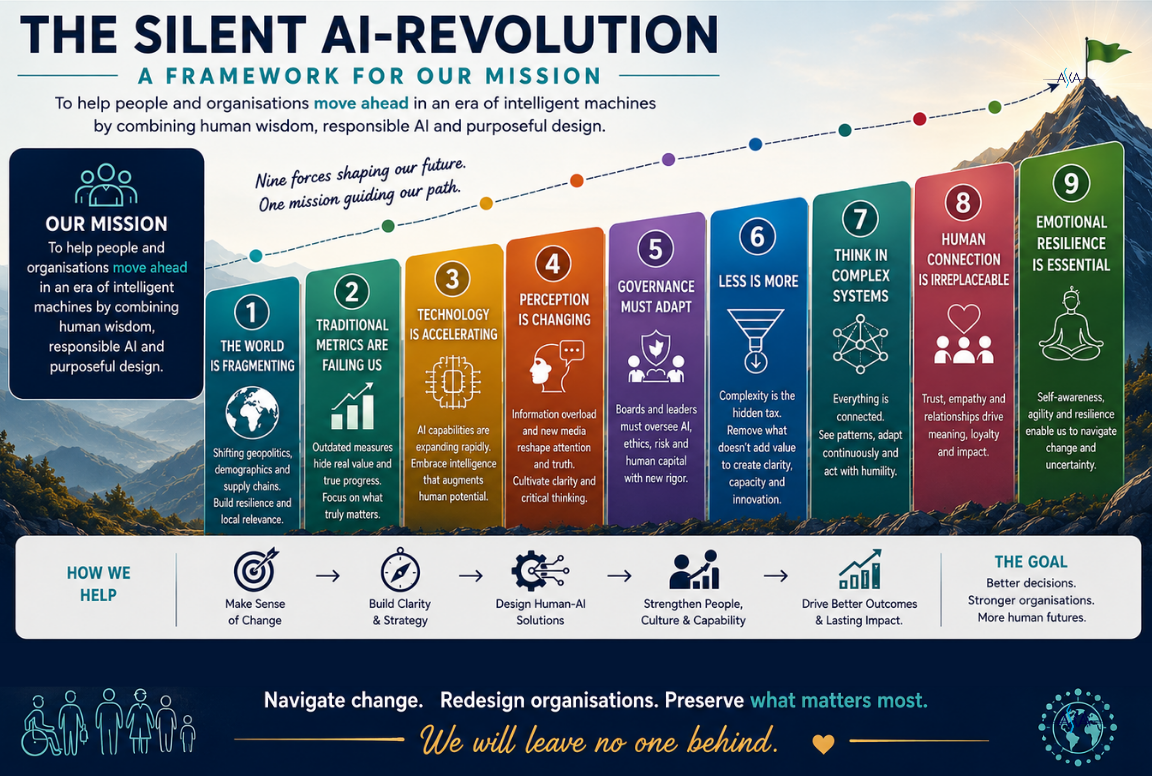
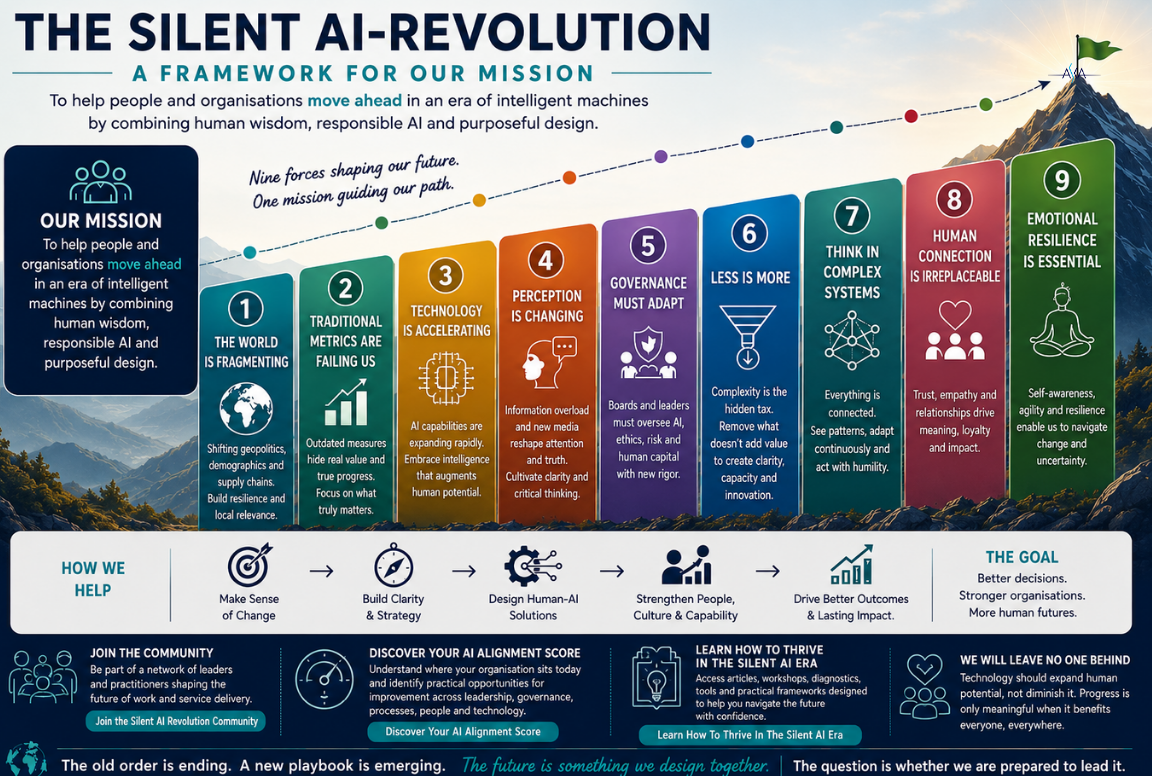
2. Nine Forces Reshaping Organisations
A review of contemporary literature reveals nine converging forces.
Individually, each force is significant.
Collectively, they represent a fundamental shift in how organisations must be designed and governed.
2.1. Force 1: The World Is Fragmenting
Peter Zeihan argues that the conditions that enabled modern globalisation are breaking down.
Demographic decline, geopolitical instability, and the weakening of the post-war security architecture are producing a more fragmented world.
Supply chains are shortening.
Nations are seeking resilience and self-sufficiency.
Economic and political power is becoming increasingly regional.
The implication is profound.
For decades, organisations optimised for scale and efficiency.
The future may increasingly reward resilience, optionality, and local adaptability.
The strategic question is no longer:
“How do we optimise efficiency?”
It is increasingly:
“How do we build resilience?”
2.2. Force 2: Traditional Metrics Are Failing Us
Diane Coyle argues that many of our economic measurement systems were designed for an industrial economy that no longer exists.
GDP measures transactions.
It struggles to measure:
- knowledge,
- trust,
- digital services,
- human capital,
- environmental sustainability, and
- intangible value creation.
Increasingly, the most valuable assets of organisations remain largely invisible to traditional accounting frameworks.
What gets measured still matters.
But increasingly, what matters most is not being measured.
Organisations require broader definitions of value.
2.3. Force 3: Technology Is Accelerating
Mustafa Suleyman describes artificial intelligence as an exponentially accelerating, omni-use technology capable of transforming every industry simultaneously.
AI is:
- asymmetric,
- hyper-evolving,
- general purpose,
- and increasingly autonomous.
- Unlike previous technologies, AI is not simply another tool.
It is becoming a new layer of organisational intelligence.
Its impact will extend across:
- healthcare,
- education,
- government,
- law,
- finance,
- manufacturing,
- and professional services.
The implication is clear.
The organisations that succeed will not merely implement AI tools.
They will redesign work itself.
2.4. Force 4: Perception Is Changing
Marshall McLuhan argued that technologies reshape not merely behaviour but human consciousness itself.
The medium changes the message.
The internet transformed information access.
Artificial intelligence is beginning to transform cognition.
Questions that once required specialists can now be explored instantly.
Information abundance creates new challenges:
- attention fragmentation,
- information overload,
- algorithmic influence, and
- declining cognitive clarity.
The new leadership challenge is not information management.
It is attention management.
In an age of infinite information, clarity becomes a competitive advantage.
2.5. Force 5: Governance Must Adapt
Dambisa Moyo argues that corporate governance faces an existential challenge.
Boards were largely designed for a slower, more stable environment.
Today, they must govern:
- technological risk,
- ethics,
- data,
- AI,
- human capital,
- social expectations, and
- long-term resilience.
Governance can no longer focus solely on financial compliance.
Boards must become strategic, adaptive, and future-oriented.
The governance challenge of the AI era is not technological.
It is organisational.
2.6. Force 6: Less Is More
Leidy Klotz demonstrates that humans systematically suffer from “subtraction neglect” (i.e. Less is More)
When faced with problems, we instinctively add:
- more policies,
- more reports,
- more meetings,
- more systems,
- more processes.
- Over time, complexity accumulates.
Complexity becomes a hidden tax on organisational performance.
Many organisations are suffering from administrative obesity.
Yet some of history’s most successful innovations came from taking things away.
The new question becomes:
“What can we remove?”
The goal is not simply to do less.
The goal is to create more value with less complexity.
Simplicity creates clarity.
Clarity creates capacity.
Capacity creates innovation.
2.7. Force 7: Think in Complex Systems
Jeremy Narby challenges our assumptions about intelligence itself.
Nature routinely solves complex problems through decentralised, adaptive networks.
Slime moulds can solve spatial problems.
Plants process information.
Cells coordinate highly sophisticated activities.
Complex intelligence often emerges without central control.
Modern organisations increasingly resemble ecosystems rather than machines.
Outcomes emerge from countless interactions between people, technologies, incentives, and cultures.
The implication is significant.
Future organisations may need to become:
- more adaptive,
- more distributed,
- and more resilient.
Systems thinking becomes a core leadership capability.
2.8. Force 8: Human Connection Is Irreplaceable
Allison Pugh argues that society is experiencing a depersonalisation crisis.
Increasing efficiency pressures have pushed professionals onto a hamster wheel of scripts, processes, and administrative burden.
Yet human connection remains fundamental.
People seek:
- trust,
- empathy,
- belonging,
- meaning, and
- understanding.
These are not technical outputs.
They are profoundly human experiences.
Artificial intelligence may automate information processing.
It cannot fully automate human connection.
Paradoxically, as machines become more capable, human relationships may become even more valuable.
2.9. Force 9: Emotional Resilience Is Essential
Mel Robbins argues that emotional resilience increasingly determines how effectively individuals respond to uncertainty and change.
Periods of disruption generate:
- stress,
- fear,
- ambiguity, and
- cognitive overload.
Yet resilient individuals recognise an important truth:
- they cannot control external events,
- but they can control their responses.
The same principle applies to organisations.
Resilience is no longer merely a personal capability.
It is becoming an organisational capability.
The future belongs to organisations that can remain adaptive while preserving psychological safety and purpose.
3. Discussion: Architecting Alignment in the Silent AI Revolution
Viewed independently, these nine forces appear unrelated.
Together, they reveal a coherent picture.
The old order was built on:
- globalisation,
- scale,
- efficiency,
- hierarchy,
- control, and
- predictability.
The emerging order appears to be built upon:
- resilience,
- adaptability,
- distributed intelligence,
- human-AI collaboration,
- systems thinking, and
- purposeful leadership.
This transition is what I describe as the Silent AI Revolution.
The revolution is silent because it rarely arrives as a single disruptive event.
Instead, it unfolds gradually.
- Workflows change.
- Decision-making changes.
- Customer expectations change.
- Professional identities change.
- Organisational structures change.
The danger for leaders is not that AI arrives.
The danger is assuming that nothing fundamental needs to change.
Survival in this new environment requires more than adopting technology. It requires alignment.
Alignment between:
- technology and purpose,
- governance and innovation,
- human capability and machine capability,
- efficiency and resilience,
- systems and relationships.
The challenge of leadership in the AI era is therefore not simply implementing artificial intelligence.
It is architecting alignment across increasingly complex systems.
4. Conclusion: A New Playbook Is Emerging
The literature reviewed in this article points toward a remarkably consistent conclusion.
The assumptions that shaped the industrial age are being rewritten.
A new organisational playbook is emerging.
The organisations that thrive over the next decade will not necessarily be the largest, richest, or most technologically advanced.
They will be those that successfully combine:
- intelligent machines,
- adaptive governance,
- systems thinking,
- human connection,
- and emotional resilience.
The future does not belong to technology alone.
Nor does it belong solely to human capability.
The future belongs to organisations that learn how to combine intelligent machines with deeply human capabilities.
And as we navigate this transformation, one principle should remain central:
We will leave no one behind.
Selected References and Further Reading
- Coyle, D. (2024). The Measure of Progress: Counting What Really Matters. Princeton University Press.
- Klotz, L. (2021). Subtract: The Untapped Science of Less. Flatiron Books.
- McLuhan, M. (1964). Understanding Media: The Extensions of Man. McGraw-Hill.
- Moyo, D. (2021). How Boards Work: And How They Can Work Better in a Chaotic World. Basic Books.
- Narby, J. (2025). The Intelligence of Life: How Cells, Plants, and Animals Create Our Collective Future. Crown.
- Pugh, A. J. (2024). The Last Human Job: The Work of Connecting in a Disconnected World. Princeton University Press.
- Robbins, M. (2024). The Let Them Theory: A Life-Changing Tool That Millions of People Can’t Stop Talking About. Hay House.
- Suleyman, M., & Bhaskar, M. (2023). The Coming Wave: Technology, Power, and the Twenty-First Century’s Greatest Dilemma. Crown.
- Zeihan, P. (2022). The End of the World Is Just the Beginning: Mapping the Collapse of Globalization. Harper Business.
Reflection Exercise: Designing Your New Playbook.
Which assumptions about your organisation, profession, or industry still belong to the old order—and what must change if you are to thrive in the new one?
Take five minutes.
Write down three assumptions you hold today.
- Keep one.
- Adapt one.
- Let one go.
Then ask yourself:
What is one small action I can take this month to begin designing my new playbook?
Because the Silent AI Revolution is not simply about adopting new technologies.
It is about intentionally redesigning how we think, lead, and work together.
The future is not something that happens to us. The future is something we design together.
Join the Community
Become part of a growing network of leaders, practitioners, and organisations exploring how to thrive in an AI-enabled world.
Discover Your AI Alignment Score
Understand where your organisation sits today and identify practical opportunities for improvement across leadership, governance, processes, people, and technology.
🎙️ Episode 4: The Silent AI Revolution Podcast:
Podcast Title: Building Your AI Alignment Operating Architecture: The End of the Old Order
Listen to a bite-sized podcast episode directly on your preferred streaming platform
Spotify | Amazon Music | Apple Podcasts | Castbox | Goodpods | iHeartRadio
#AILeadership #DigitalTransformation #FutureOfWork #AligningForExcellence #LeadershipDevelopment #SilentAIRevolution

Leave A Comment