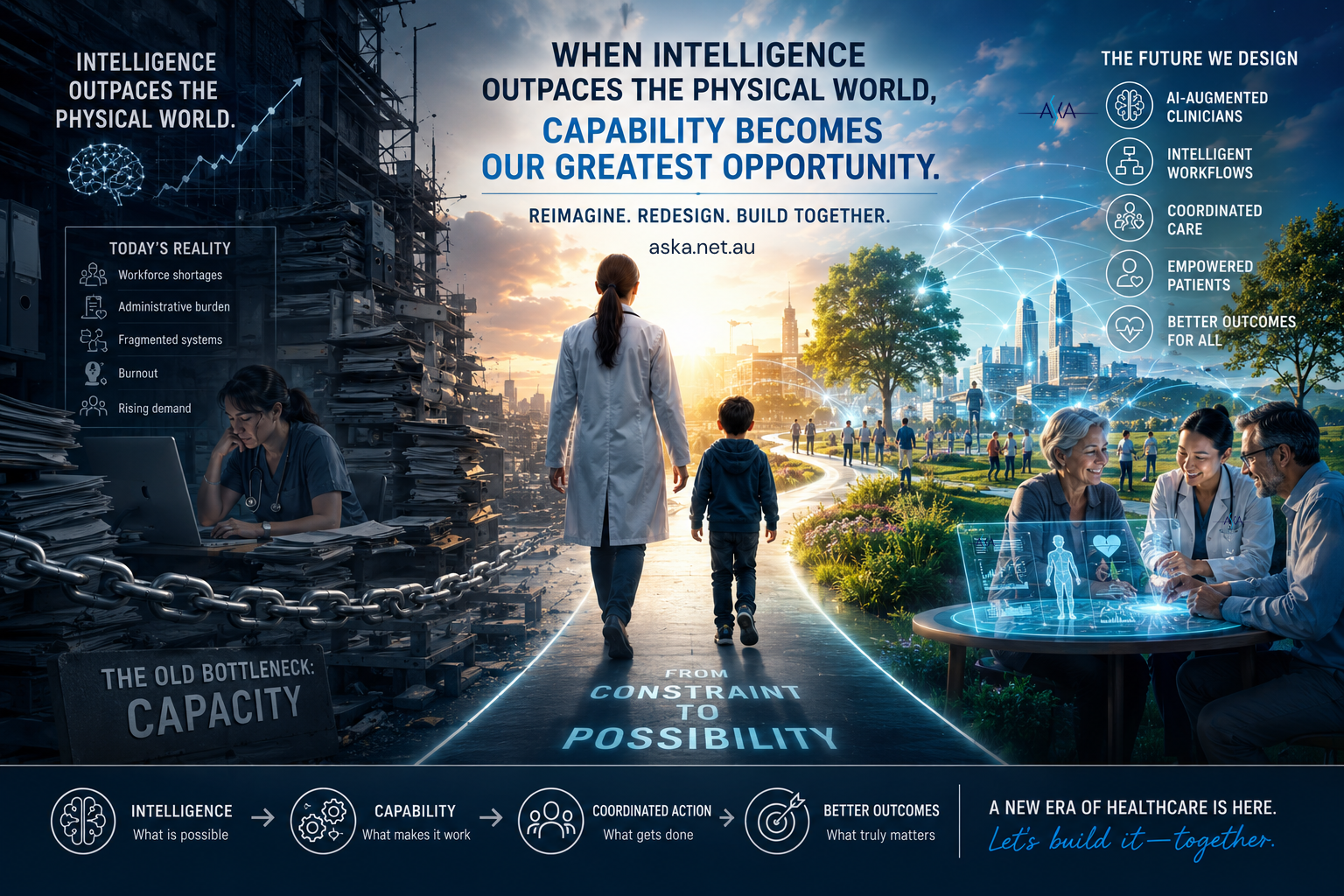
When Intelligence Outpaces the Physical World
Key Insight
Every era has been defined by its scarcest resource.
- The Industrial Revolution was constrained by physical labour.
- The Information Age was constrained by access to knowledge.
- The emerging Intelligence Age may be constrained by something entirely different.
- Not intelligence itself.
- But our collective capability to convert intelligence into coordinated action.
Introduction
This article forms part of an ongoing series exploring the future of healthcare in the Intelligence Age. It brings together ideas emerging from the Curious Minds Discussion Series, conversations within the Living Healthcare Innovation Laboratory™, and discussions with practising clinicians, healthcare leaders and visionary medical practitioners who are actively exploring how artificial intelligence may reshape healthcare over the coming decade.
Rather than presenting definitive answers, these articles are intended to stimulate thoughtful discussion and collaborative exploration. They represent an evolving body of work that combines systems thinking, clinical experience and emerging technologies to examine how healthcare can become more intelligent, more coordinated and, ultimately, more human.
The future described here is not intended as a prediction of what will happen. It is a vision of what could become possible if clinicians, patients, researchers and innovators work together to redesign healthcare for the Intelligence Age.
The End of an Old Assumption
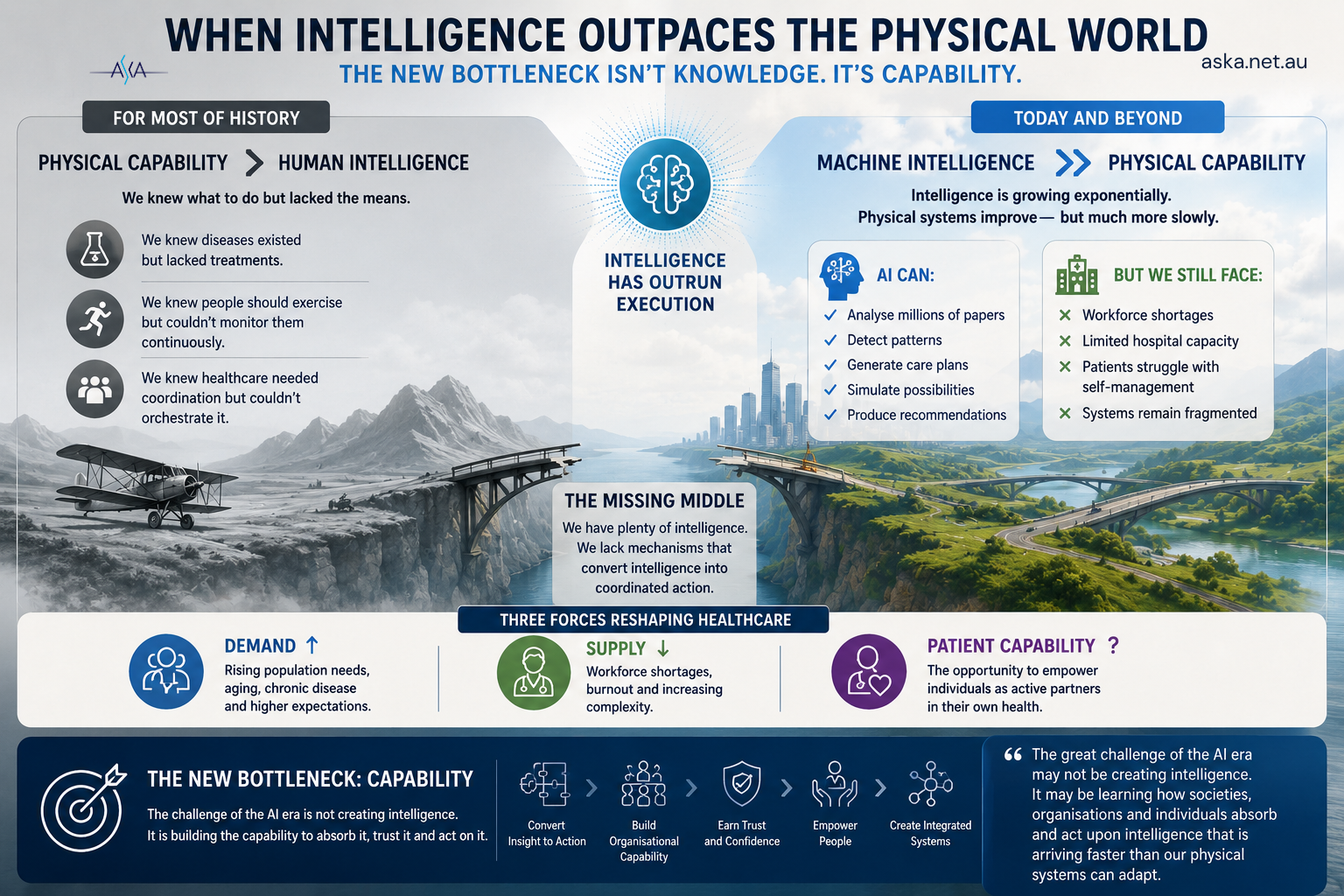
For most of human history, progress was limited by what we did not know. For example…
- We knew disease existed but had no antibiotics.
- We understood the importance of sanitation long before we possessed the engineering capability to deliver it at scale.
- We recognised the value of prevention but lacked practical ways to continuously monitor health or support people beyond the walls of hospitals and clinics.
Even when knowledge existed, execution remained difficult.
The defining challenge of previous generations was straightforward.
We knew what needed to be done.
We simply lacked the means to do it.
Progress was constrained by physical capability.
Knowledge was valuable because it was scarce.
Expertise was concentrated.
Information travelled slowly.
Healthcare, education, government and business were all designed around this reality.
That world is beginning to disappear.
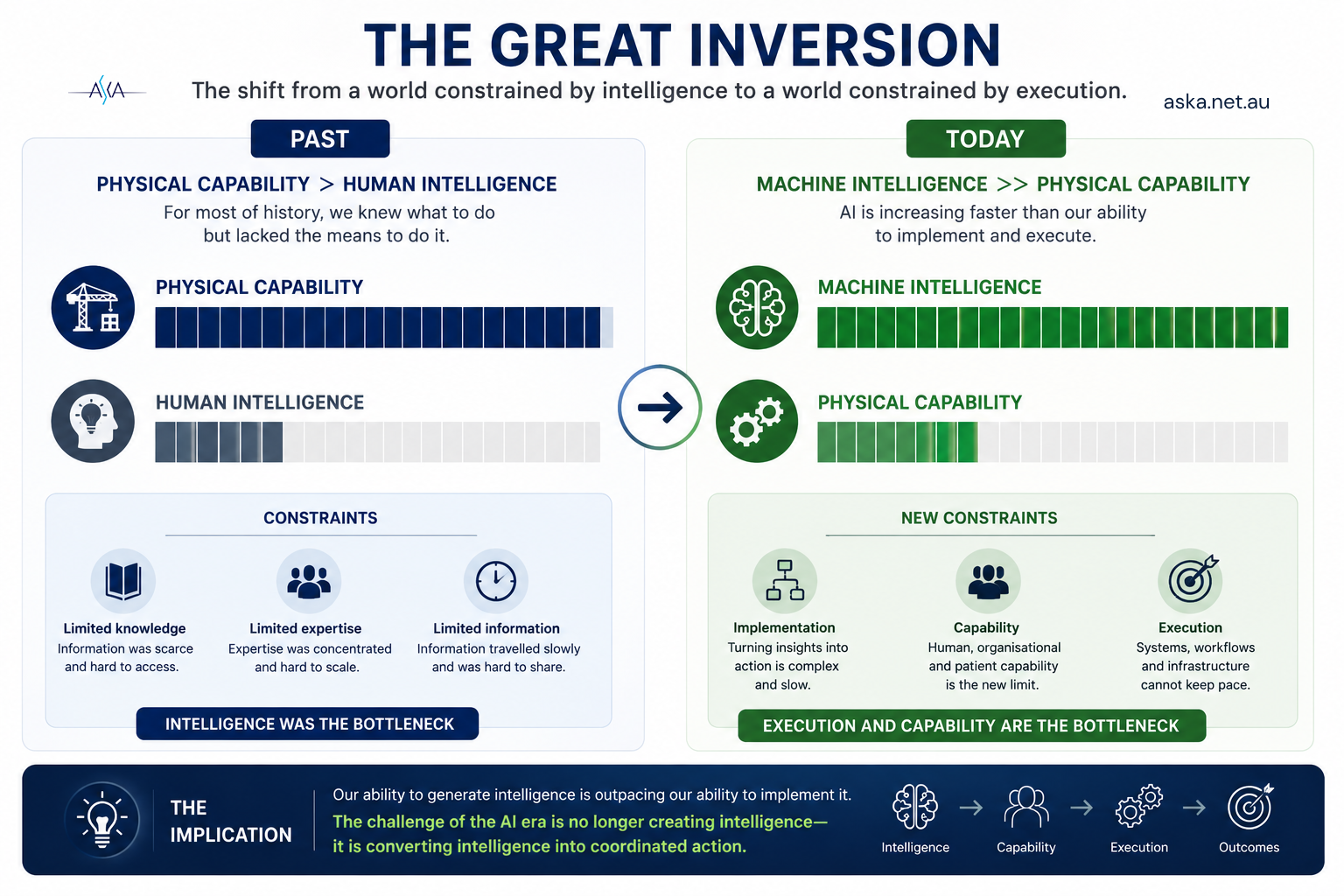
The Great Inversion
For the first time in history, intelligence itself is becoming abundant.
- Artificial intelligence can analyse millions of scientific papers in seconds.
- It can identify subtle clinical patterns across enormous datasets.
- It can generate differential diagnoses.
- Summarise evidence.
- Recommend treatment options.
- Simulate possible futures.
- Explain complex concepts.
And increasingly, it can do these things almost instantly. The constraint has shifted.
For much of history, the relationship looked like this:
Physical Capability > Human Intelligence
Today, the relationship is rapidly reversing.
Machine Intelligence >> Physical Capability
This may prove to be one of the most significant transitions of the twenty-first century.
Our ability to generate intelligence is beginning to outpace our ability to implement it.
Intelligence has started to outrun execution.
Healthcare: A System Designed for Scarcity
Healthcare illustrates this transition more clearly than almost any other industry.
For generations, healthcare has been organised around scarcity.
- Scarcity of doctors.
- Scarcity of specialists.
- Scarcity of knowledge.
- Scarcity of clinical expertise.
This explains why healthcare evolved around referrals, appointments, specialist hierarchies and episodic care.
These were not design flaws.
They were rational responses to a world in which expertise was expensive and difficult to access.
Artificial intelligence fundamentally changes one of those assumptions: Knowledge is no longer the primary constraint.
Yet almost everything else about healthcare continues to operate as though it is.
- Hospitals remain full.
- Clinicians remain overwhelmed.
- Patients still struggle to navigate fragmented systems.
- Workforce shortages continue to grow.
- Waiting lists continue to lengthen.
Healthcare has changed its tools. It has not yet redesigned its architecture.
The New Bottleneck
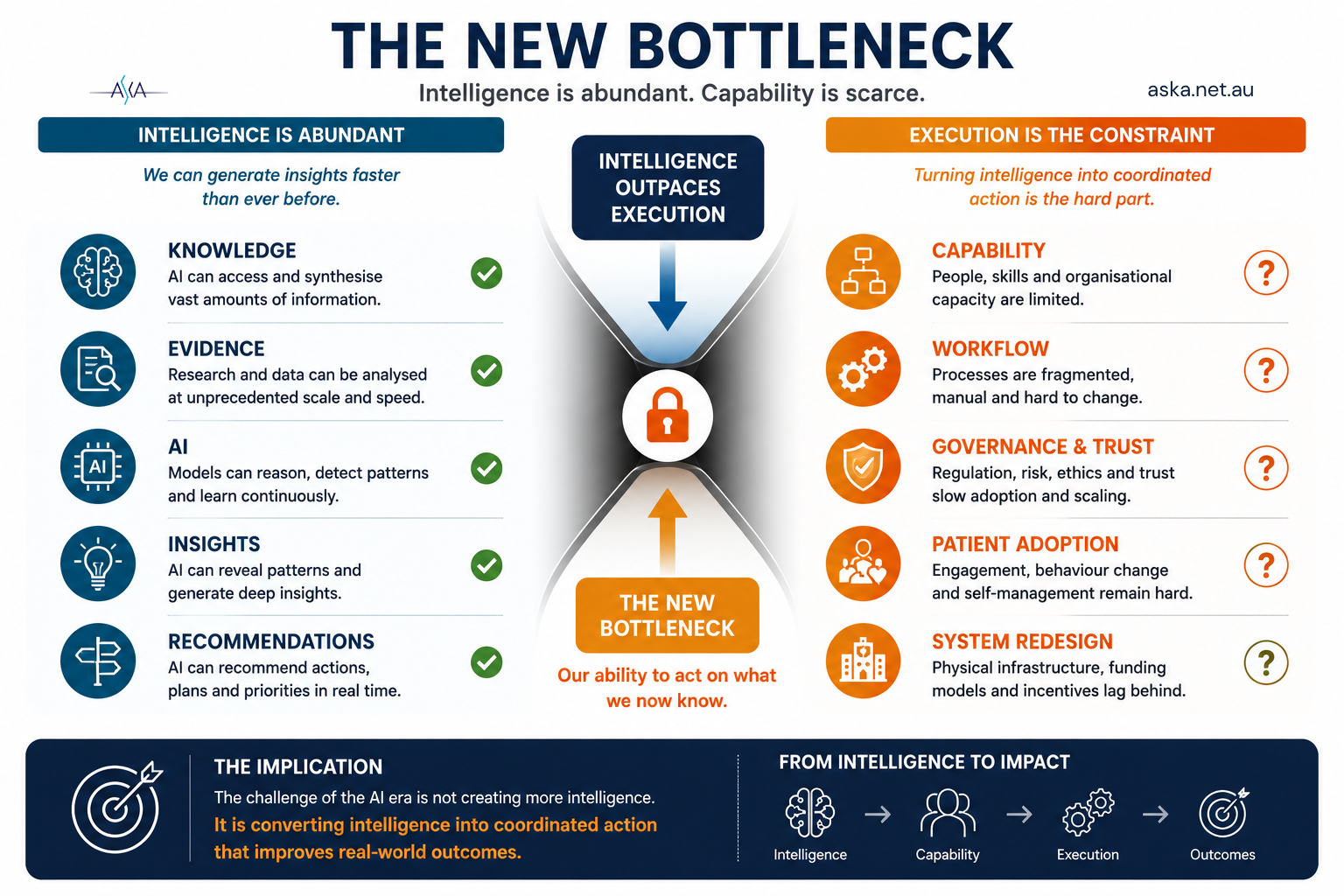
This changes the question healthcare leaders need to ask.
For decades, we asked: “How do we generate more knowledge?”
Today, a more important question is emerging: “How do we translate abundant intelligence into coordinated action?”
This is an entirely different challenge.
- Artificial intelligence can recommend. But recommendations do not redesign workflows.
- Artificial intelligence can identify risks. But risk identification alone does not improve outcomes.
- Artificial intelligence can produce remarkable insights. But insight without implementation changes very little.
- Knowledge has become increasingly abundant. Capability has become increasingly scarce.
The new bottleneck is no longer intelligence. It is our ability to absorb intelligence, trust it appropriately and act upon it consistently.
The Three Forces Reshaping Healthcare
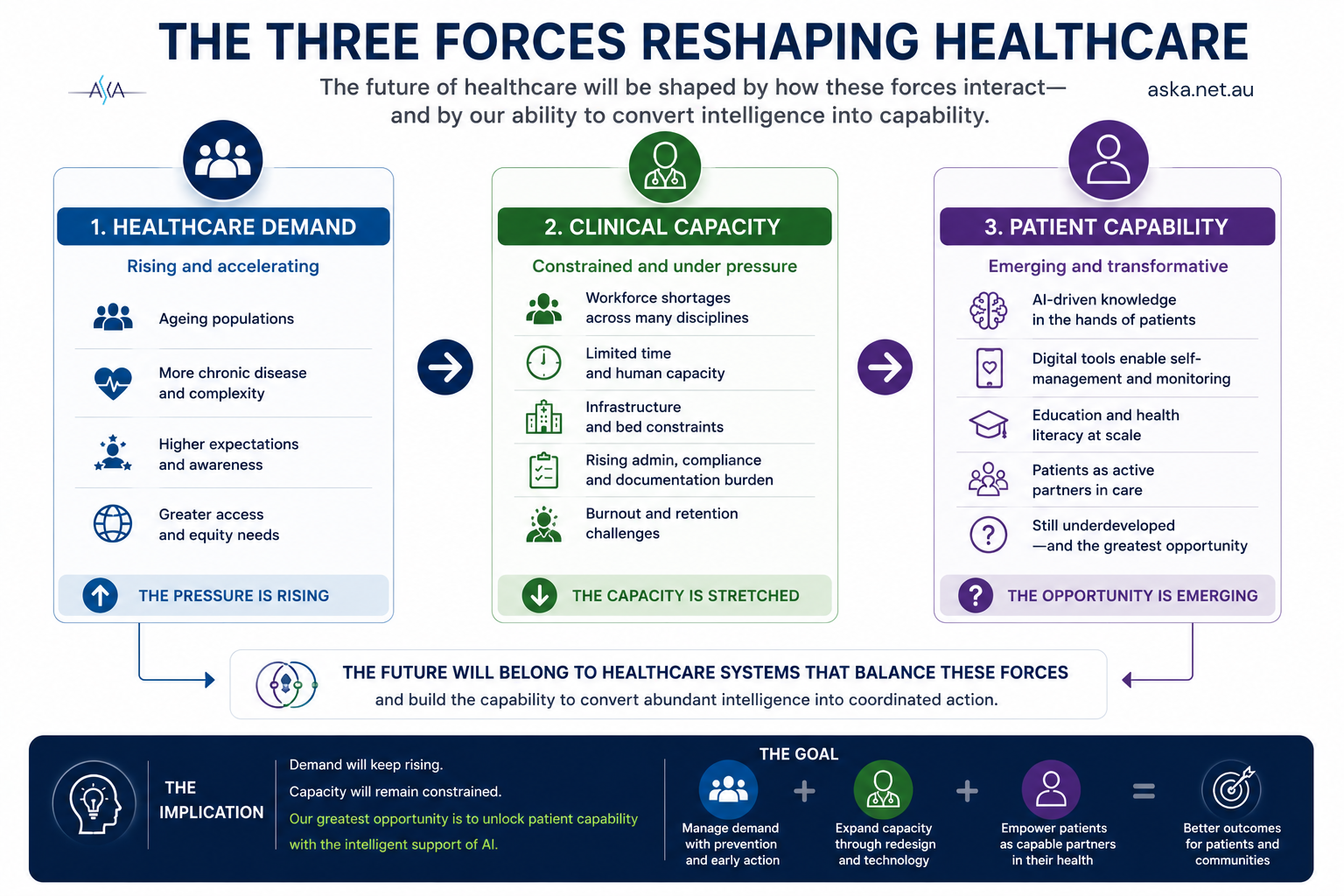
This transition can be understood through three interacting forces.
Healthcare Demand is Increasing.
Ageing populations, chronic disease and rising expectations continue to place pressure on healthcare systems.
Clinical Supply is Constrained.
Workforce shortages, increasing complexity and finite human capacity limit what traditional healthcare models can deliver.
Patient Capability is Emerging.
Artificial intelligence now creates the possibility of progressively transferring knowledge, reasoning and decision support closer to patients themselves.
This third force has received far less attention than the first two. Yet it may become the most transformative. Because when patients become more capable, the mathematics of healthcare begins to change.
Healthcare shifts from doing more work for patients towards building greater capability with patients.
Healthcare’s Missing Middle
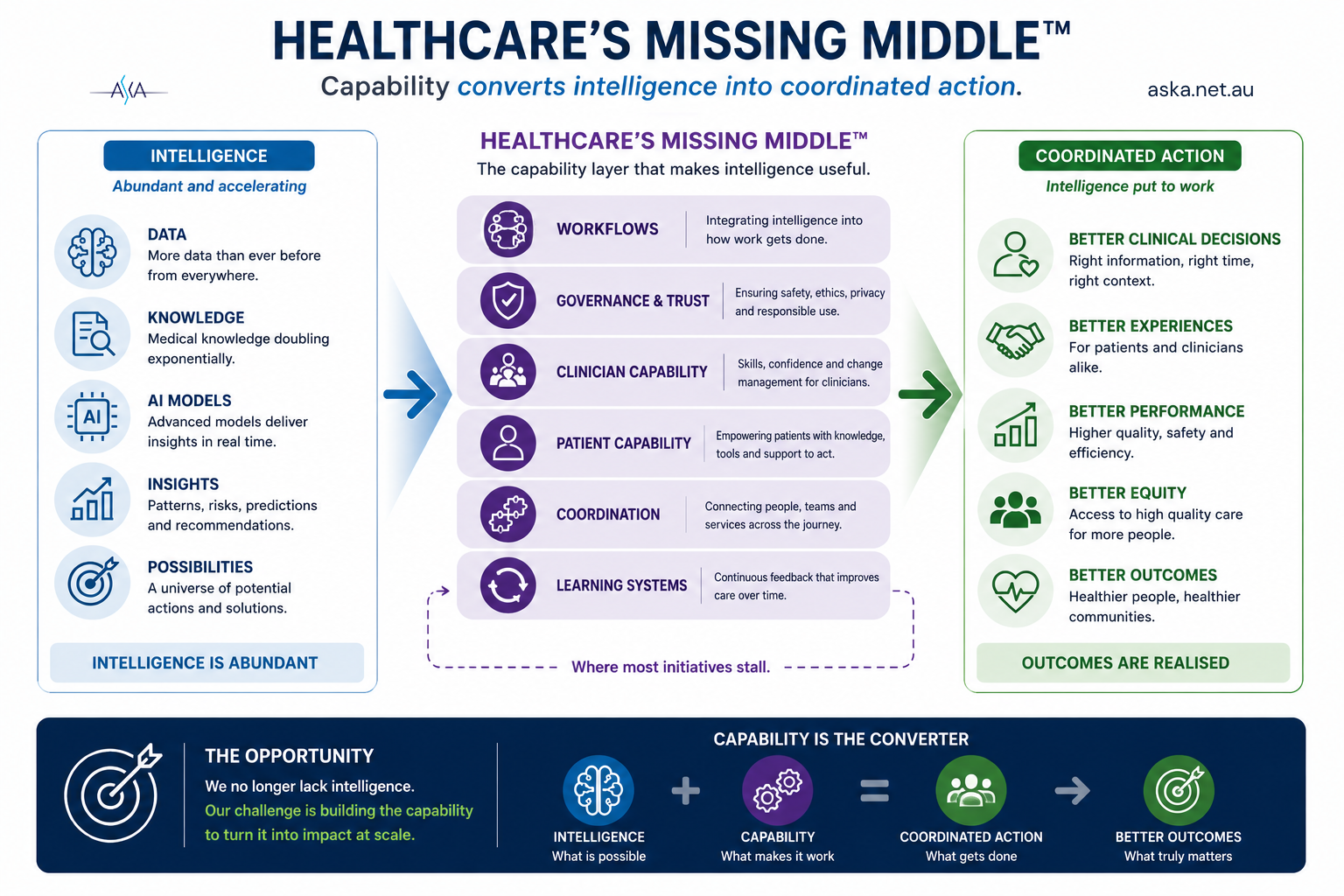
This also explains why so many promising AI initiatives fail to transform healthcare.
- Most conversations focus on intelligence.
- New models.
- New software.
- New algorithms.
- Others focus on outcomes.
- Better care.
- Lower costs.
- Improved efficiency.
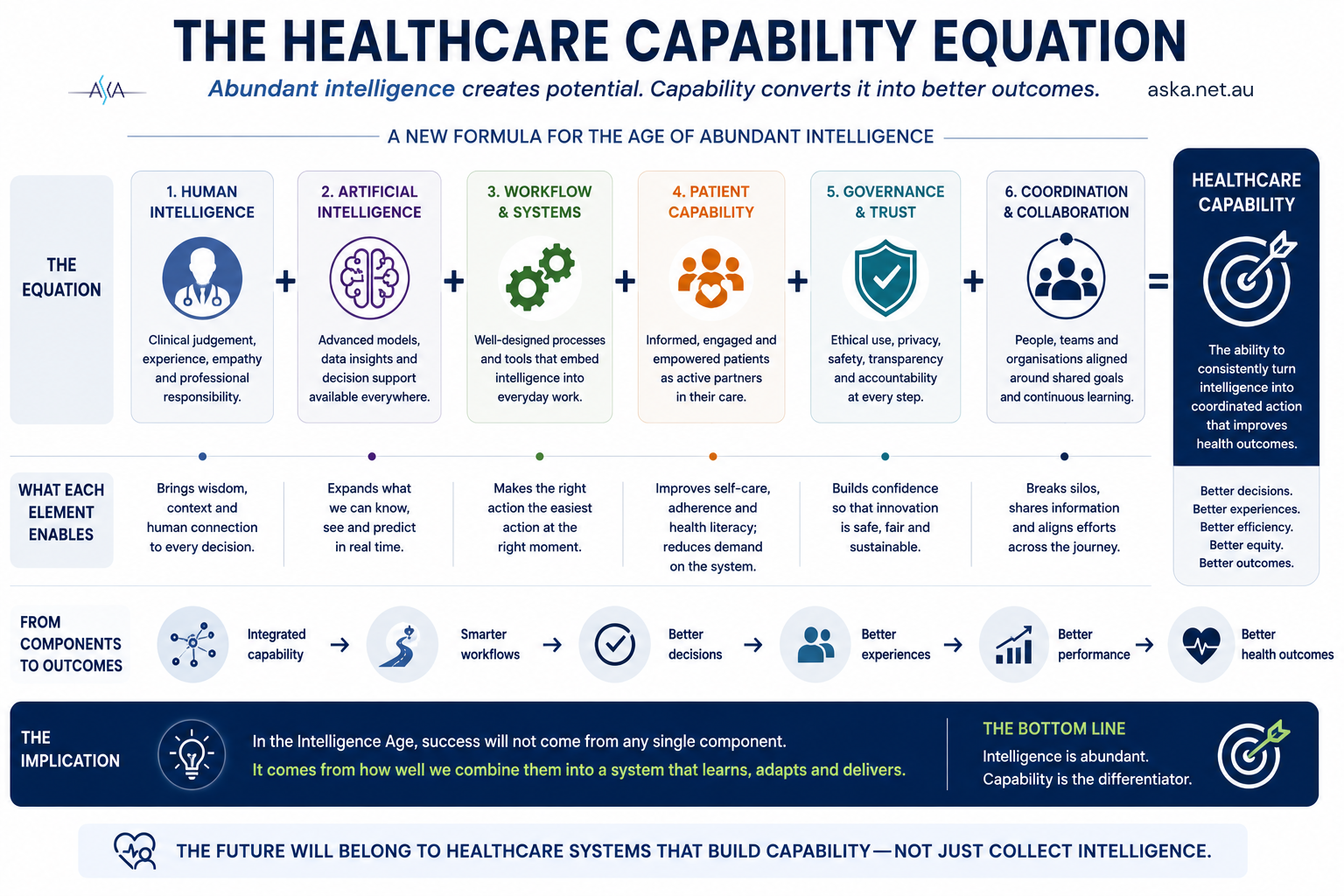
But something important sits between these two worlds. This is what we call The Capability. It encompasses
- The workflows.
- The governance.
- The trust.
- The education.
- The redesign of care.
- The organisational learning.
- The patient engagement.
These are the mechanisms that convert intelligence into coordinated action. The Capability is the healthcare’s missing middle.
Without capability, intelligence remains potential rather than progress.
Designing for the Intelligence Age
The next decade is unlikely to be defined by who develops the most sophisticated artificial intelligence. It will be defined by who redesigns healthcare most effectively around it.
The organisations that succeed will ask different questions.
Not:
“Which AI platform should we purchase?”
But:
“How should we redesign healthcare when intelligence is no longer the scarce resource?”
That question changes everything.
It shifts our attention away from technology and towards capability.
Away from automation and towards redesign.
Away from isolated innovation and towards system transformation.
The Capability Challenge
This is why healthcare transformation cannot happen overnight. Not because intelligent technologies are unavailable.
In many respects, the intelligence already exists. What takes time is:
- Redesigning systems.
- Developing new capabilities.
- Building trust.
- Changing professional roles.
- Supporting patients.
- Creating new models of coordinated care.
Changing physical systems has always taken longer than changing ideas. The next decade will not primarily be limited by advances in artificial intelligence.
It will be limited by how quickly healthcare systems can absorb that intelligence and convert it into better care.
Conclusion
Artificial intelligence will undoubtedly change healthcare. But its greatest contribution may not be that machines become more intelligent.
Its greatest contribution may be forcing us to rethink how healthcare itself should be designed.
The defining challenge of the AI era is no longer creating intelligence.
It is building the human, organisational and societal capabilities required to use that intelligence wisely.
Because the future will belong not to those who possess the most intelligence.
It will belong to those who become most capable of turning intelligence into coordinated action.
That may become the defining capability challenge of our generation.
A Conversation Worth Starting
The future of healthcare will not be designed by artificial intelligence alone. Nor will it be designed by governments, hospitals or technology companies working in isolation.
It will be shaped by clinicians, patients, researchers, innovators and healthcare leaders who are willing to rethink long-held assumptions and collaboratively design new models of care for the Intelligence Age.
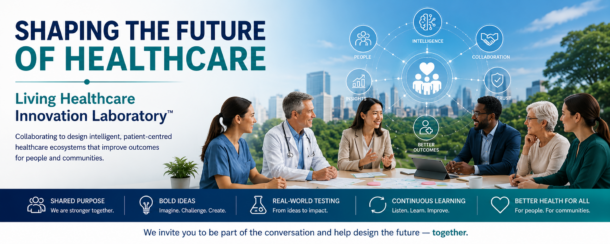
That is precisely why we created the Living Healthcare Innovation Laboratory™
The Laboratory is not simply a community to discuss ideas. It is a collaborative environment where clinicians, healthcare professionals and patients work together to explore emerging concepts, test new models of care, prototype AI-enabled services and collectively redesign healthcare for the Intelligence Age. Together, we are building the next generation of intelligent, patient-centred healthcare ecosystems.
If this article has challenged your thinking or sparked new questions, we invite you to become part of that conversation.
Because the future of healthcare will not be built by watching change happen.
It will be built by those willing to help shape it.
Next in the Series
If intelligence is no longer the scarce resource, what might healthcare actually look like?
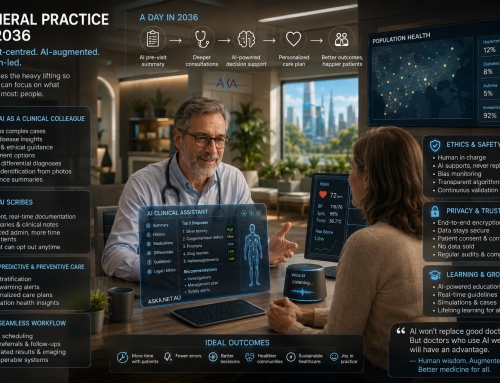
Our next article moves from theory to practice by imagining a typical morning in a general practice in 2036.
Not as science fiction.
But as a design vision grounded in the technologies that already exist today and the capabilities we are beginning to build.
Because before we can redesign healthcare, we first need to imagine what better could look like.
Next Article
General Practice in 2036: Patient-Centred. AI-Augmented. Human-Led.
Connect Me with Living Healthcare Innovation Laboratory™.