AI in Healthcare: From Documentation to Decision Support
Why healthcare’s greatest AI opportunity lies not in automating documentation, but in augmenting decisions and building more capable systems.
Key Insight
This essay is the companion piece to this episode of The Silent AI Revolution:
Healthcare systems around the world are under extraordinary pressure.
Demand is rising as populations age and chronic disease becomes increasingly prevalent. Clinical work is becoming more complex. Administrative requirements continue to expand. Meanwhile, workforce shortages and burnout are stretching healthcare professionals beyond sustainable limits.
The instinctive response has largely been to focus on supply. More doctors. More nurses. More funding. More hospitals.
While these investments remain necessary, they may no longer be sufficient. The uncomfortable reality is that healthcare demand is growing faster than healthcare capacity. The gap between what society needs and what healthcare systems can deliver is widening.
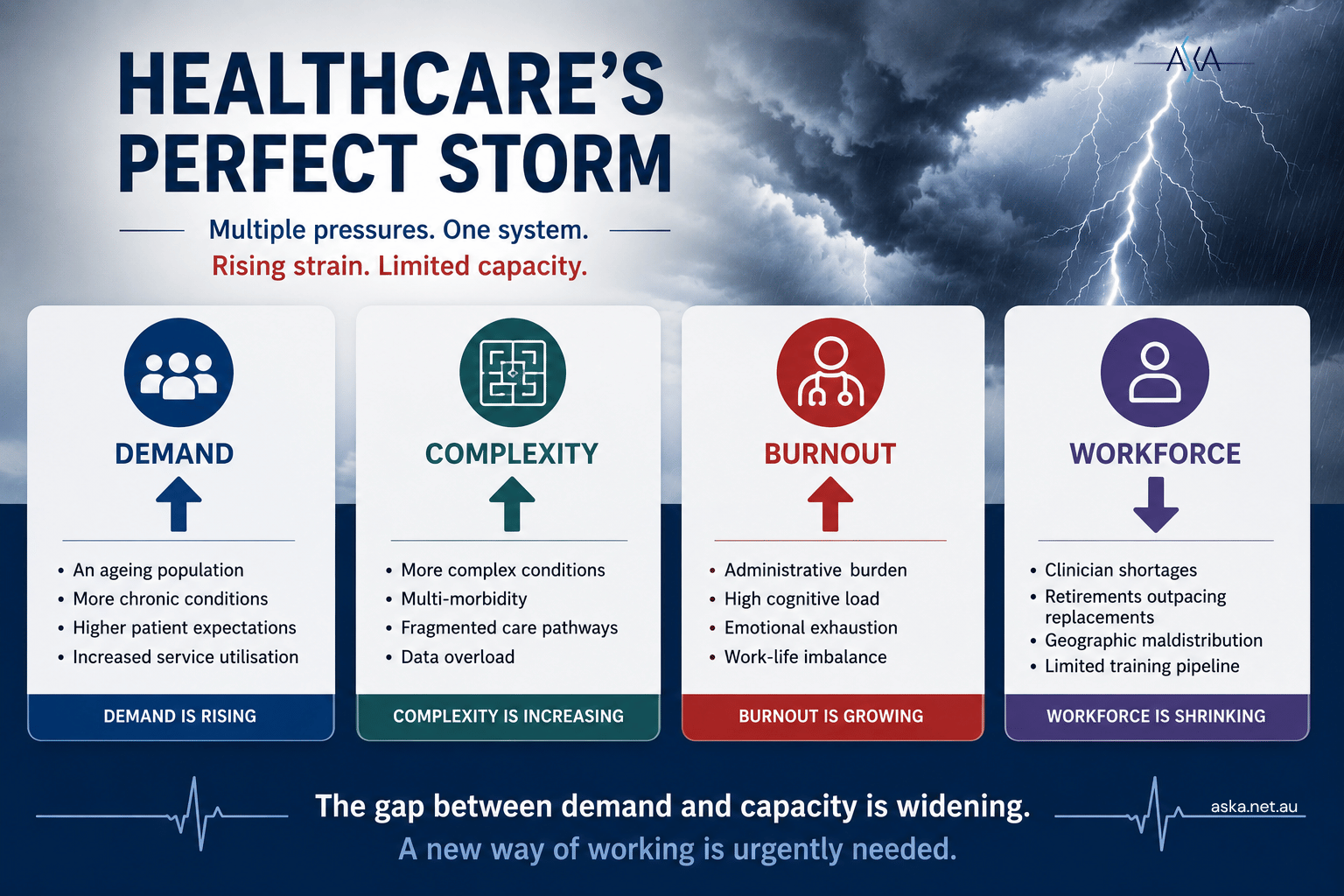
This widening gap raises a fundamental question: can healthcare continue to meet future demand simply by adding more resources?
The answer increasingly appears to be no. Healthcare needs not simply more resources, but new ways of working. Artificial intelligence is often presented as the solution. Yet the real opportunity may be far more profound than most current discussions suggest.
The great misunderstanding about AI in healthcare
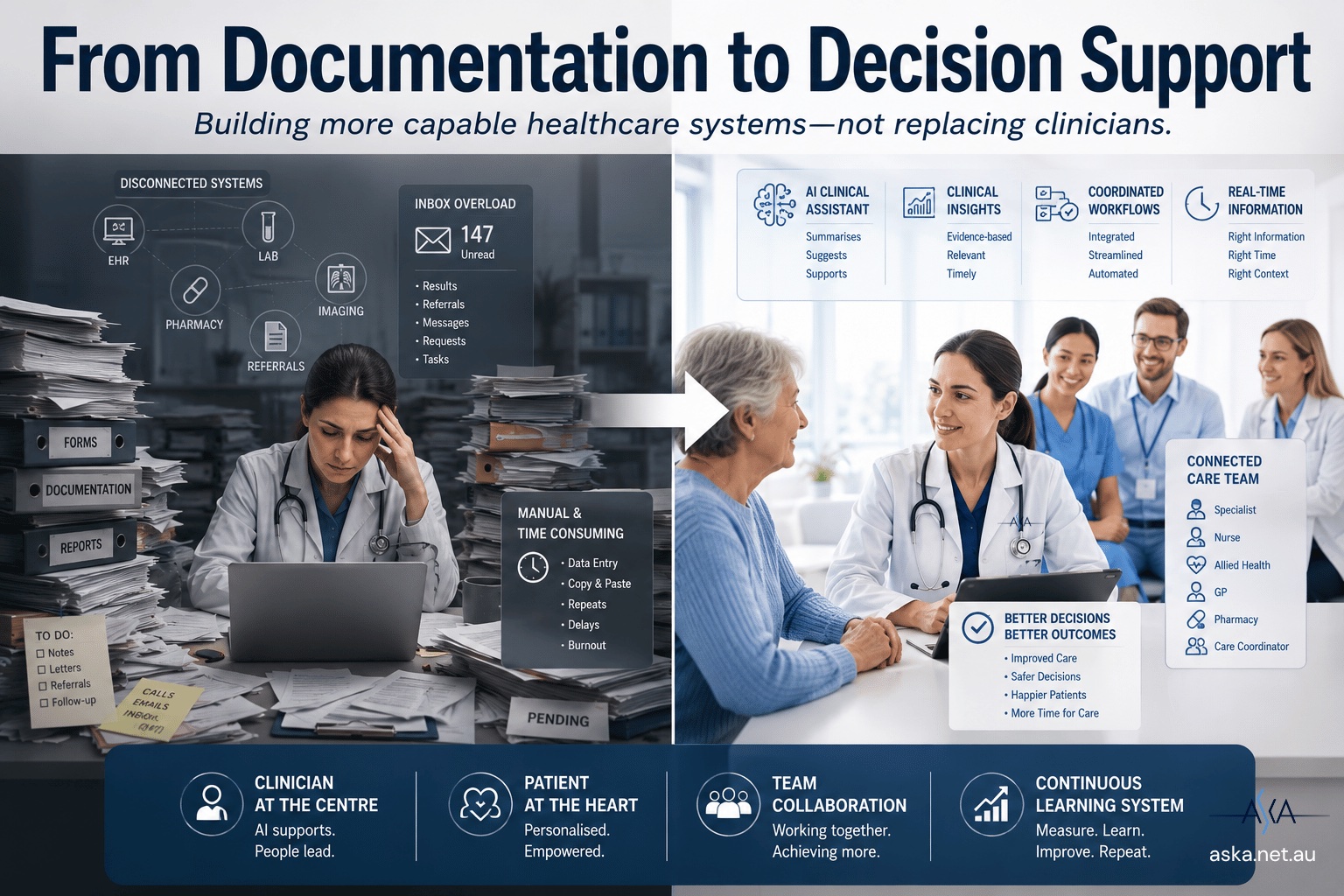
Much of today’s conversation about AI in healthcare revolves around documentation. Can AI transcribe consultations? Can it generate clinical notes? Can it summarise patient records? Can it automate administrative tasks?
These applications undoubtedly create value. Every hour saved from documentation is an hour that can potentially be redirected toward patient care.
But focusing exclusively on documentation risks missing the larger opportunity. Documentation is work. Decisions create value.
Healthcare’s future will not be determined by who documents information more efficiently. It will be determined by who makes better decisions, coordinates care more effectively, and builds more capable healthcare systems.
Not “How can AI write our notes?”
How can AI help us deliver better decisions and better care?
Healthcare has been solving the wrong equation
Most healthcare discussions revolve around two forces: demand and supply. Demand continues to increase. Supply struggles to keep pace. Consequently, healthcare debates often become discussions about increasing capacity.
However, there may be a third force that has received remarkably little attention: patient capability.
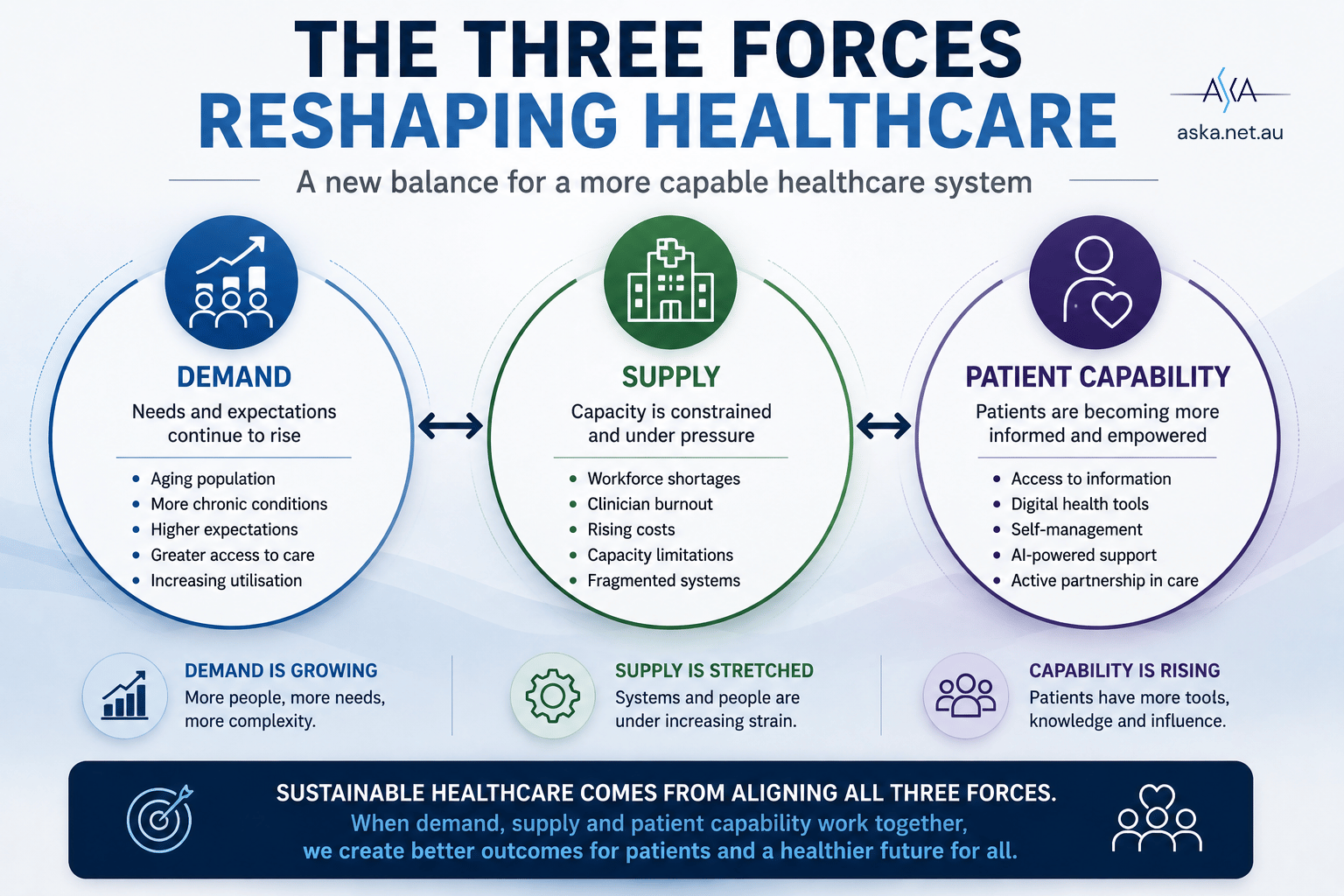
Patients today have access to unprecedented amounts of information, digital technologies, and AI-powered assistance. Increasingly, patients can learn about their conditions, monitor symptoms, manage aspects of chronic disease, prepare for consultations, coordinate elements of their care, and participate more actively in decision-making.
Historically, capability resided primarily within healthcare institutions. Today, capability is becoming distributed. This does not diminish the importance of clinicians. Rather, it fundamentally changes the nature of healthcare delivery.
Patient capability may become one of the most important variables in healthcare capacity planning during the next decade.
The silent AI revolution in healthcare
Artificial intelligence is not arriving all at once. Healthcare is evolving gradually through stages of maturity.
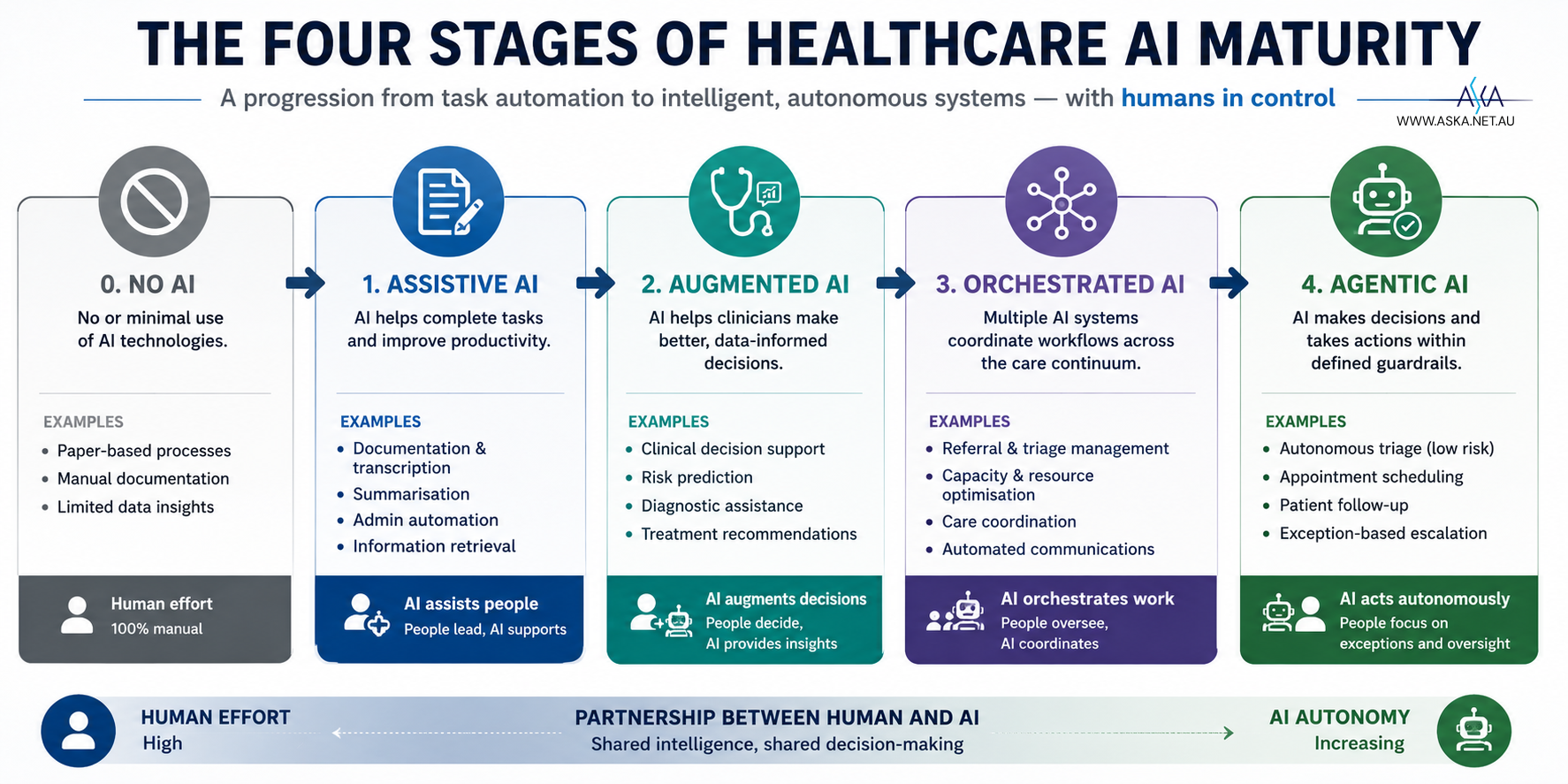
Stage one: Assistive AI. AI helps complete tasks — documentation, summarisation, information retrieval, administrative automation.
Stage two: Augmented AI. AI helps clinicians make better decisions — clinical decision support, risk prediction, diagnostic assistance, treatment recommendations.
Stage three: Orchestrated AI. Multiple AI systems coordinate workflows — referral management, capacity optimisation, care coordination, automated communication.
Stage four: Agentic AI. AI makes decisions and executes actions within defined guardrails — routine triage, appointment allocation, follow-up pathways, exception-based escalation.
Importantly, these stages do not represent replacement of clinicians. They represent increasing capability. The future of healthcare is unlikely to be doctors versus AI. It is far more likely to be doctors, patients, and AI working together in new ways.
Three shifts that matter more than technology
Technology alone will not transform healthcare. Healthcare transformation requires redesigning decisions and workflows.
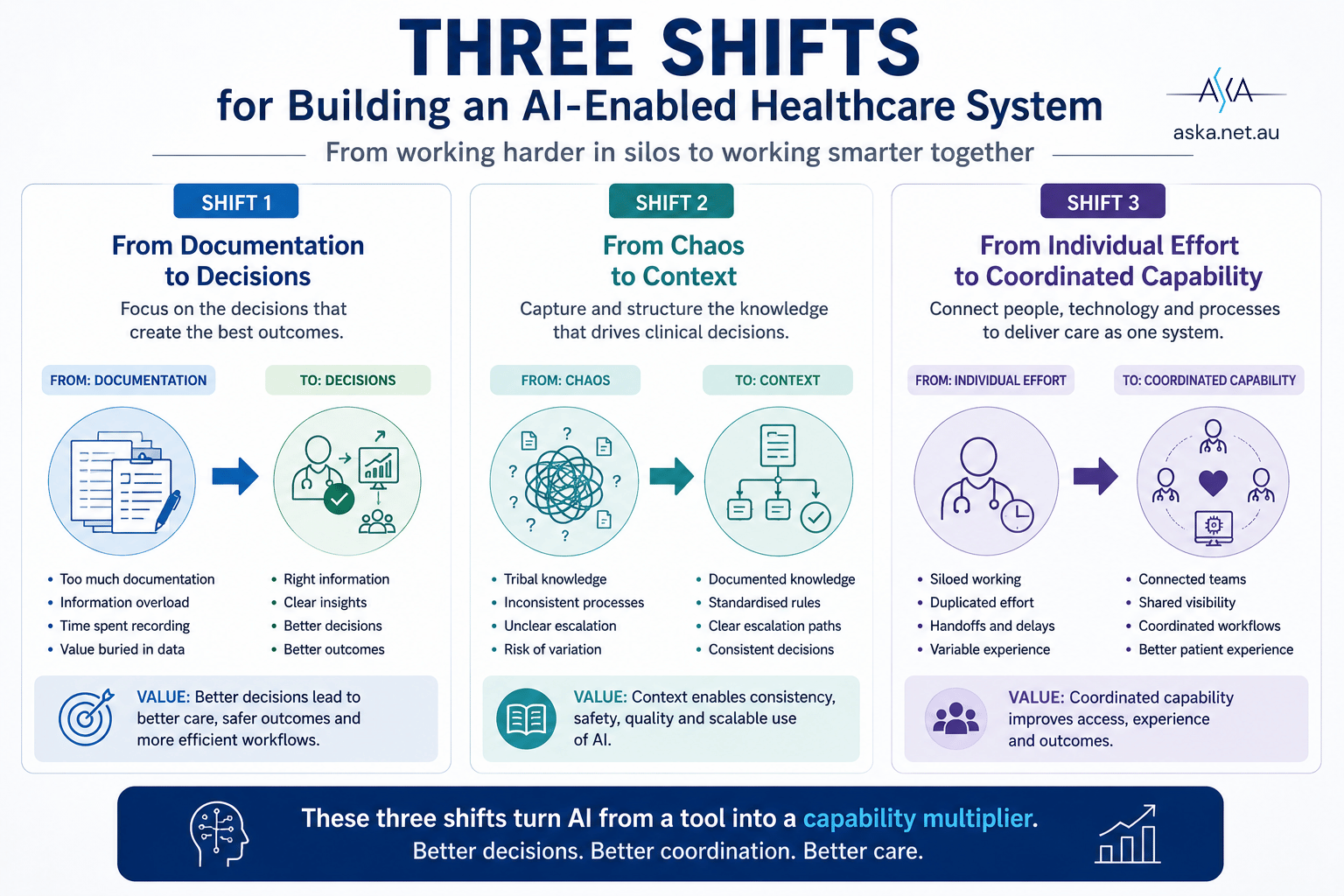
Shift one: from documentation to decisions
Healthcare generates enormous quantities of information. Yet the real value lies in decisions — which patients require urgent review, which intervention should be prioritised, which care pathway is appropriate, which patients require follow-up.
The greatest opportunities for AI may not lie in producing documents faster but in helping clinicians make better decisions.
Shift two: from chaos to context
Much healthcare expertise remains undocumented. Clinical reasoning frequently resides inside the minds of experienced professionals. AI cannot scale knowledge that only exists in someone’s head. Neither can organisations.
Capturing context becomes essential: decision triggers, escalation rules, governance principles, clinical pathways, coordination protocols. Documented context allows both people and AI systems to operate more consistently.
Shift three: from individual effort to coordinated capability
Healthcare remains heavily dependent on individual effort. Yet modern care increasingly requires coordination.
Not doctor versus AI. Doctor + patient + AI + care team. Capability becomes distributed. Decisions become shared. Workflows become orchestrated. Outcomes improve.
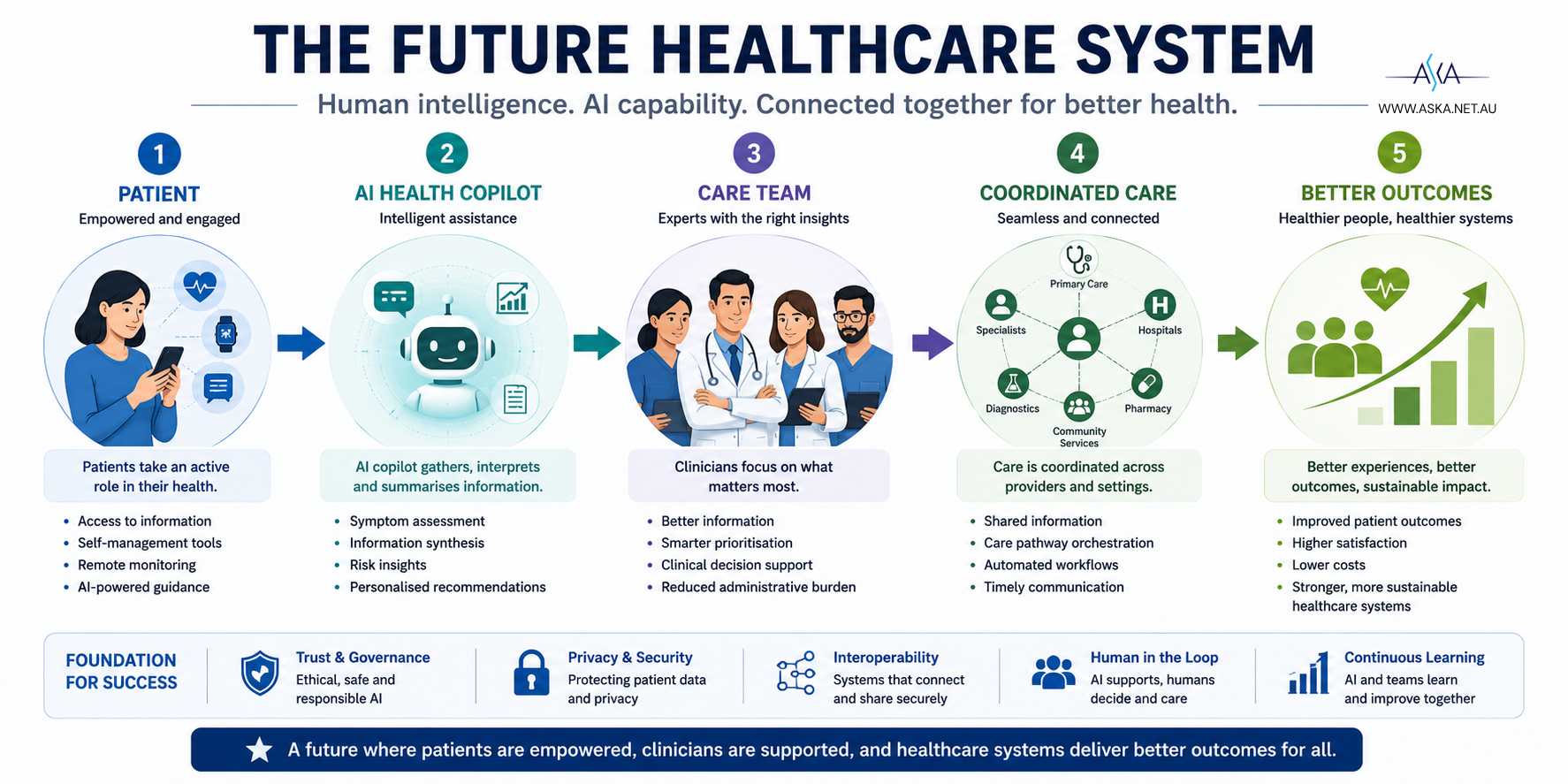
A different future is emerging
Imagine a patient developing symptoms. An AI health copilot assists the patient in organising information. Referral information is assembled. AI-assisted triage identifies priorities. Clinicians review recommendations. Care teams coordinate interventions. Follow-up and monitoring occur continuously. Patients receive personalised education and support.
Clinicians focus their attention on the moments where human judgement creates the greatest value.
This future may sound ambitious. Yet most of its components already exist. The challenge is not technological feasibility. The challenge is integration, governance, and capability building.
Use the Healthcare Capability Reflection™ to turn this into action
Reading about the shift from documentation to decision support is one thing. Working out what it means for your team is another.
To help healthcare leaders and clinical teams apply these ideas, Aska Consulting Group has developed the Healthcare Capability Reflection™ Workbook, a practical guide built around one core question: what capability are we trying to create?
Work through it with your team and you will:
- Identify what consumes the most clinician time today, and which of those tasks are worth protecting versus redesigning
- Pinpoint the one activity that would create the greatest value for patients if it improved
- Locate where AI could make a genuinely meaningful difference, not just where it is easiest to deploy
- Place your organisation on a five-level maturity path, from documentation-focused to a learning healthcare system
- Leave the session with one committed action for the next 30 days, an owner, and a signal for success
Bring it to your next leadership or clinical governance meeting. The goal is not a better-documented healthcare system. It is a more capable one.
Building more capable healthcare systems
Healthcare’s future will not be determined by who deploys the most AI. It will be determined by who best combines human judgement, patient capability, organisational knowledge, and responsible AI.
The greatest opportunity may not be replacing clinicians with machines. It may be making clinicians, patients, and healthcare systems more capable together.
The silent revolution in healthcare is not simply about technology. It is about redesigning how healthcare decisions are made, how capability is distributed, and how care is coordinated.
Not “How do we automate healthcare?”
How do we build healthcare systems where humans and AI become more capable together?
Healthcare’s greatest AI opportunity lies not in automating documentation, but in augmenting decisions, improving coordination, and building more capable healthcare systems.