General Practice in 2036: A Vision for Patient-Centred, AI-Augmented, Human-Led Healthcare
A design hypothesis for general practice a decade from now, where artificial intelligence works quietly in the background so clinicians can give patients their full attention again.
Key Insight
This essay is the companion piece to this episode of The Silent AI Revolution:
Healthcare is entering a period in which the possibilities created by artificial intelligence are advancing faster than our ability to redesign the systems around them.
That raises a question far more interesting than whether AI will become capable enough to transform medicine. What kind of healthcare do we want to build with it?
This article brings together ideas emerging from the Curious Minds Discussion Series, conversations associated with the Living Healthcare Innovation Laboratory™, and discussions with practising clinicians and healthcare leaders exploring how care may evolve over the coming decade.
These conversations have rarely been about technology alone. They have been about the future of medicine. How might artificial intelligence reshape the consultation without diminishing it? How might clinicians regain time for judgement, conversation and care? How might patients become better informed and more capable participants in their own health?
The ideas that follow are therefore not presented as a prediction. They are a design hypothesis. Some elements may arrive sooner. Others may take considerably longer. The precise timing matters less than the direction of travel — because before we can redesign healthcare, we first need a destination worth designing.
A vision worth designing
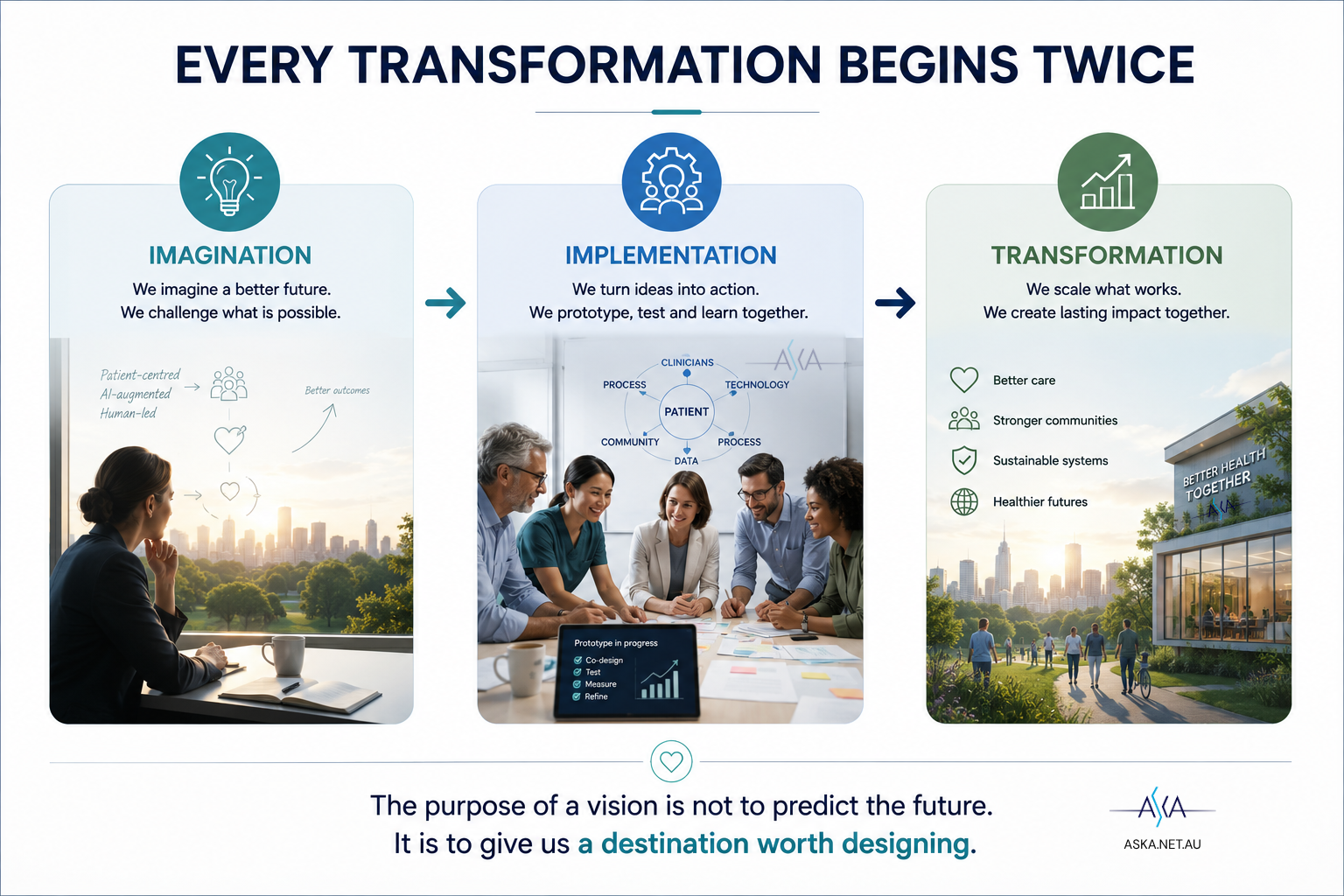
Every transformation begins twice. First as imagination. Then as implementation.
A forecast asks what is likely to happen. A vision asks what could become possible if we choose to build differently.
The future described here represents one such destination: a healthcare system in which intelligence becomes increasingly available, technology becomes less intrusive, and human judgement, relationships and trust remain central. Whether every detail arrives exactly as imagined is almost beside the point. The important question is whether the destination is worth pursuing.
So let us imagine that future together.
The story
It is 8:30 on a Tuesday morning in 2036.
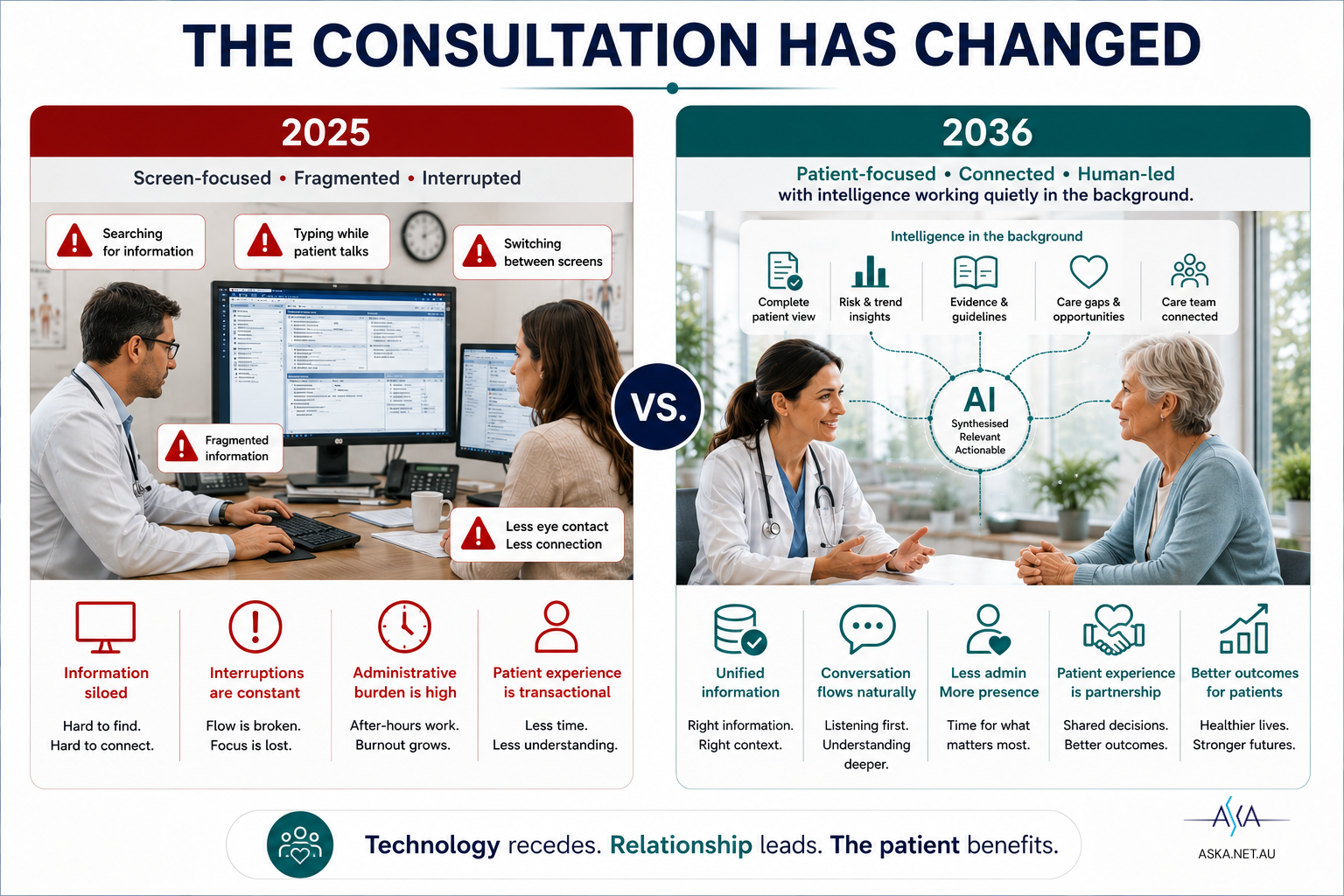
The waiting room is calm. Patients are arriving, but there is little sense of the quiet administrative chaos that once defined the beginning of a clinic. No overflowing inboxes requiring immediate attention. No frantic searches for missing results before the first consultation begins. Long before the practice doors opened, the day’s clinical preparation had already started.
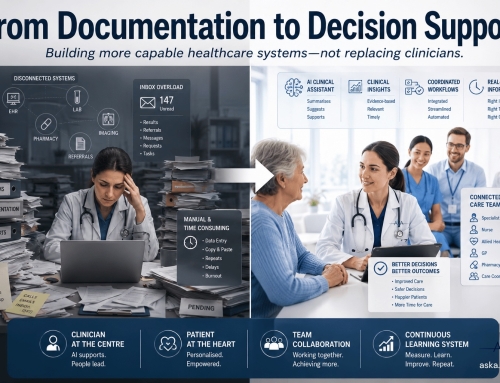
As the first patient enters the consulting room, the doctor glances briefly at a concise summary quietly prepared in the background. Relevant hospital correspondence has been reviewed. Recent pathology and imaging incorporated. Medication interactions checked. Preventive care requirements updated. Important trends and emerging risks highlighted. The computer has already done much of the searching.
The doctor can begin with something more important. They turn towards the patient. Smile. And ask: “How have you been?”
The patient pauses. Then begins to tell their story. They talk about their health, certainly. But also their partner’s illness. Their concerns about work. The holiday they have just returned from. Their intention to become more active.
The computer screen no longer dominates the encounter. Neither does the keyboard. Eye contact replaces data entry. Attention replaces administration. Presence replaces distraction.
When clinical questions arise, relevant information becomes available quietly when needed. Guidelines, previous investigations, medications and current evidence can be explored without breaking the rhythm of the conversation. The technology never takes over. It simply supports.
Together, doctor and patient consider the possibilities. Potential benefits. Possible risks. Personal preferences. What matters most to the patient. By the end of the consultation, an agreed care plan has already taken shape. Referrals are prepared. Patient education is personalised. Follow-up is coordinated. The patient leaves knowing not only what happens next, but why.
The doctor pauses before welcoming the next patient. No pile of consultation notes waits to be completed after hours. No growing backlog of administrative work competes for attention. There is time. Time to think. Time to prepare. Time to care.
At first glance, it may appear that technology has transformed general practice. Something more important has happened. Technology has become almost invisible. And in doing so, it has allowed the relationship between doctor and patient to become visible again.
What if this became normal? Not the technology. Not the artificial intelligence. The consultation.
Imagine a healthcare system in which clinicians can give patients their full attention because information, administration and coordination are quietly supported in the background. Where the patient’s story matters as much as the data. Where technology strengthens judgement rather than distracting from it.
Perhaps the greatest promise of artificial intelligence is not that machines become more intelligent. Perhaps it is that healthcare becomes more human.
That future is not inevitable. But it is increasingly possible. And meaningful transformation begins by asking what better could look like before deciding how to build it.
Healthcare’s next inflection point
This vision does not emerge from wishful thinking. It emerges from necessity.
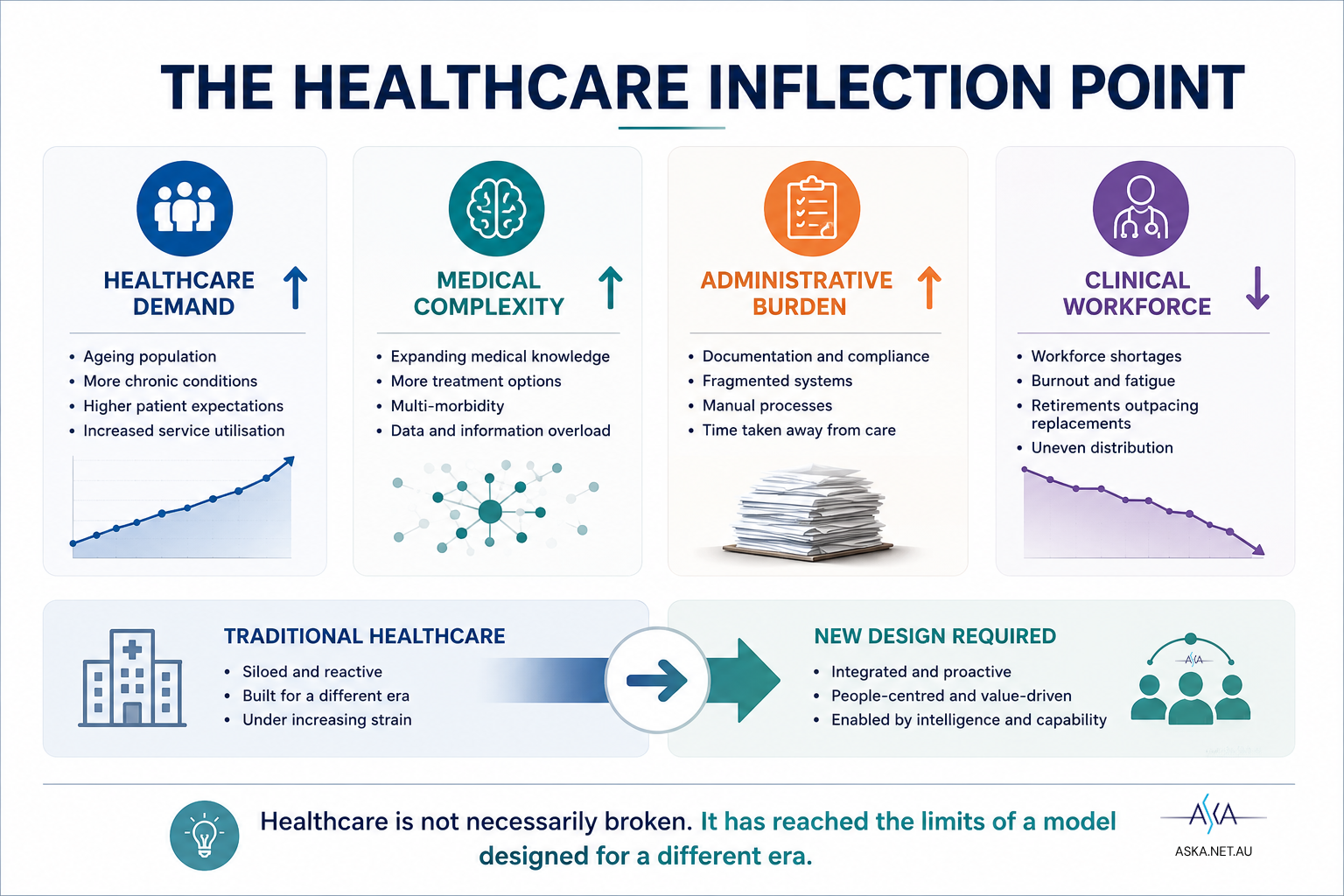
Demand continues to rise as populations age and chronic disease becomes more prevalent. Medical complexity continues to increase as knowledge, treatments, diagnostics and data expand beyond what any individual clinician can continuously absorb. Administrative burden continues to grow as documentation, compliance and coordination requirements consume increasing portions of clinical time. And the workforce expected to carry this growing burden is increasingly constrained — shortages, burnout, retention challenges, finite human capacity.
For decades, healthcare has responded to these pressures by asking clinicians to work harder. See more patients. Process more information. Complete more documentation. The mathematics no longer works. The answer is not simply more effort. It is better design.
The question before us is therefore not simply “How can AI make doctors more productive?” It is more fundamental:
If we were designing general practice for the first time today, knowing what is now possible, would we design it the same way?
Perhaps the future of healthcare is not about doing more. Perhaps it is about designing differently.
Invisible intelligence
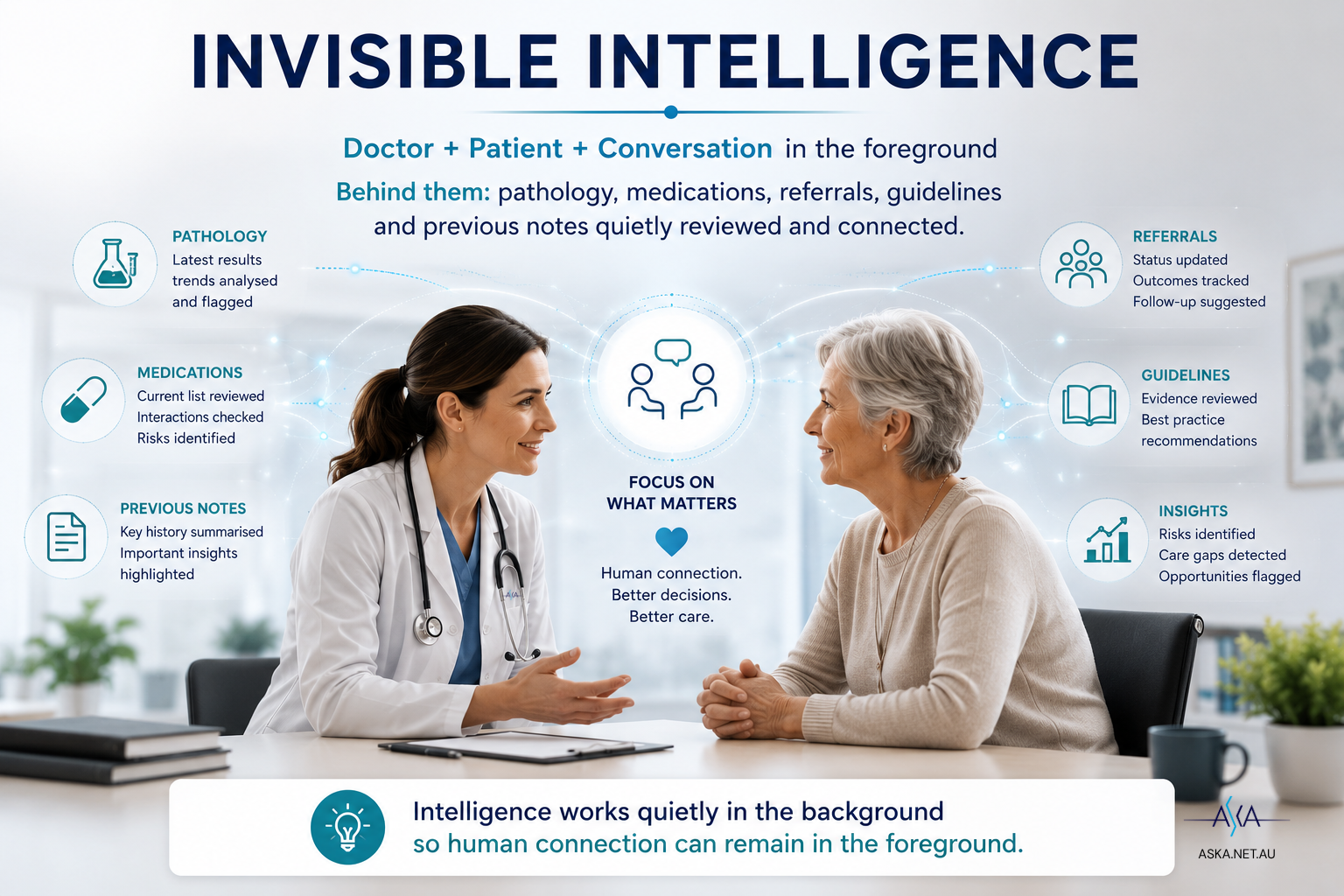
When people imagine artificial intelligence in healthcare, they often picture sophisticated software, robots or clinicians continuously interacting with digital systems. Ironically, the most successful artificial intelligence may be the intelligence patients barely notice.
Great healthcare has never been defined by the visibility of its tools. It has been defined by the quality of care they enable.
Invisible intelligence works quietly around the consultation. Before the patient arrives, it assembles relevant clinical information, identifies missing data, reviews previous correspondence, detects trends and prepares an appropriate summary. During the consultation, it can surface relevant guidelines, evidence, risks and alternatives without requiring the clinician to leave the conversation and search manually. Afterwards, it can support documentation, patient communication, referrals, follow-up and monitoring.
The clinician remains in control. The intelligence reduces friction. And something remarkable happens when thousands of small administrative and cognitive tasks move into the background. Time reappears. Attention returns.
The return of human medicine
There is a paradox at the heart of healthcare AI. The more intelligent our technology becomes, the more human medicine may have the opportunity to become.
Much of the frustration experienced by clinicians today does not arise from medicine itself. It arises from everything surrounding medicine — searching, typing, documenting, navigating fragmented systems, chasing missing information, coordinating care manually. Each task may be necessary. Together, they compete with the clinician’s most valuable resource: undivided attention.
Every glance towards a computer is a moment not spent observing the patient’s expression. Every interruption to search for information interrupts the patient’s story.
The opportunity created by intelligent systems is therefore larger than efficiency. It is the opportunity to restore the consultation — to listen without interruption, to notice hesitation, to recognise uncertainty, to allow judgement, empathy and experience to operate together. Artificial intelligence cannot replace those qualities. Its role is to create the conditions in which they flourish.
The greatest gift of intelligent technology may not be time alone. It may be presence.
Human-led. AI-augmented. Patient-centred.
It would be easy to interpret this vision as another story about better software. It is not. Technology is the catalyst. The transformation is in the design of care.
Adding AI to today’s healthcare system may improve efficiency. Redesigning healthcare around abundant intelligence has the potential to change the patient experience itself. These are very different ambitions.
The question is no longer “How can AI help us perform today’s work faster?” It is: if intelligence is no longer the scarce resource, how should healthcare be redesigned?
Every healthcare system reflects a philosophy. The philosophy behind this vision is straightforward — human-led, AI-augmented, patient-centred. The order matters. Artificial intelligence should not become the centre of care. The patient should. Nor should AI substitute for professional judgement or responsibility. It should strengthen it.
Artificial intelligence is unusually capable at processing information, recognising patterns, recalling evidence and monitoring changes across large volumes of data. Clinicians contribute something fundamentally different:
- Context
- Judgement
- Ethical reasoning
- Nuance
- Experience
- Empathy
- Trust
The ability to interpret uncertainty and help another human being make a decision that fits not only the evidence, but their life.
These are not competing forms of intelligence. They are complementary. One expands what we can know. The other guides how that knowledge should be applied.
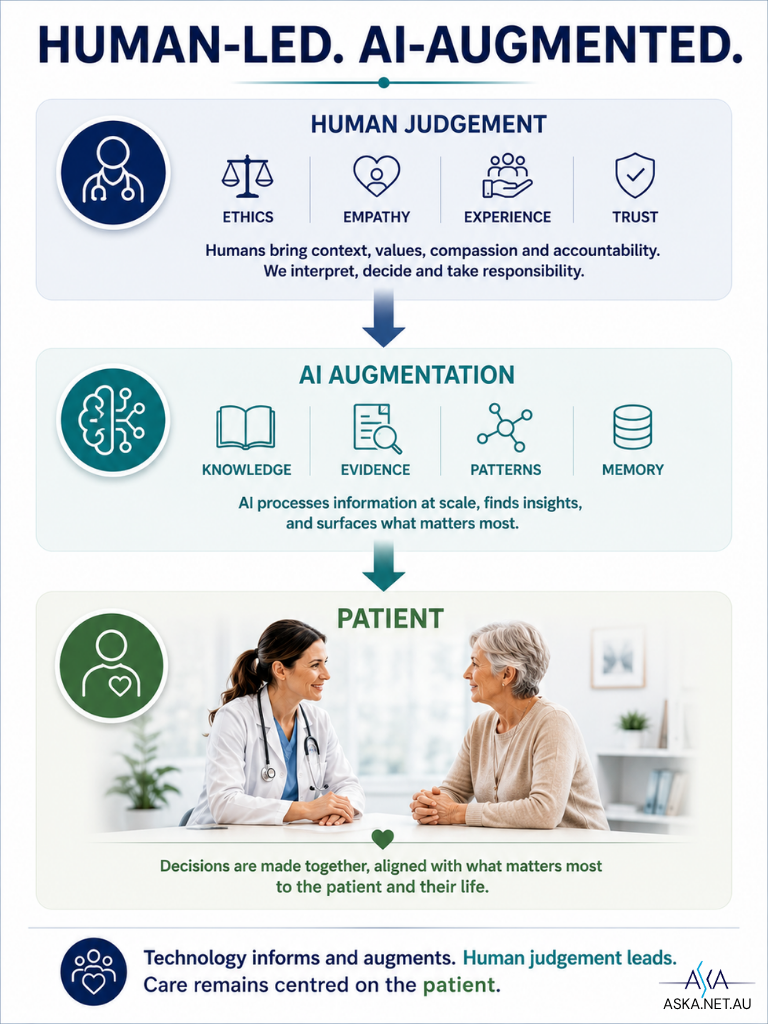
Artificial intelligence informs. Humans decide.
The rise of the AI-informed patient
One of the most significant consequences of abundant intelligence may be the ability to personalise care at a scale healthcare systems have historically struggled to achieve.
Healthcare has traditionally had to balance two ambitions: deeply personalised care for individuals, and consistent care across entire populations. Personalisation requires context and continuity. Scale has traditionally depended on standardisation. The Intelligence Age begins to change that equation — population-level knowledge can increasingly inform individual care, emerging risks can be identified earlier, and follow-up can become more continuous and responsive.
But something equally important is happening on the other side of the consultation. The patient is changing too.
Patients increasingly have access to forms of intelligence once available predominantly through healthcare professionals and institutions. They can use AI to understand terminology, explore symptoms, prepare questions, compare options and better understand their condition before arriving at the consultation. Wearables and home monitoring create streams of patient-generated information between visits.
This does not mean patients become their own doctors. Nor does access to more information automatically create better decisions. AI can be incomplete, misleading or wrong. Clinical expertise remains essential. But the relationship changes. The clinician increasingly becomes not simply the provider of information, but a trusted adviser, interpreter and partner in decision-making. The patient becomes an informed participant bringing observations, goals and preferences into the conversation.
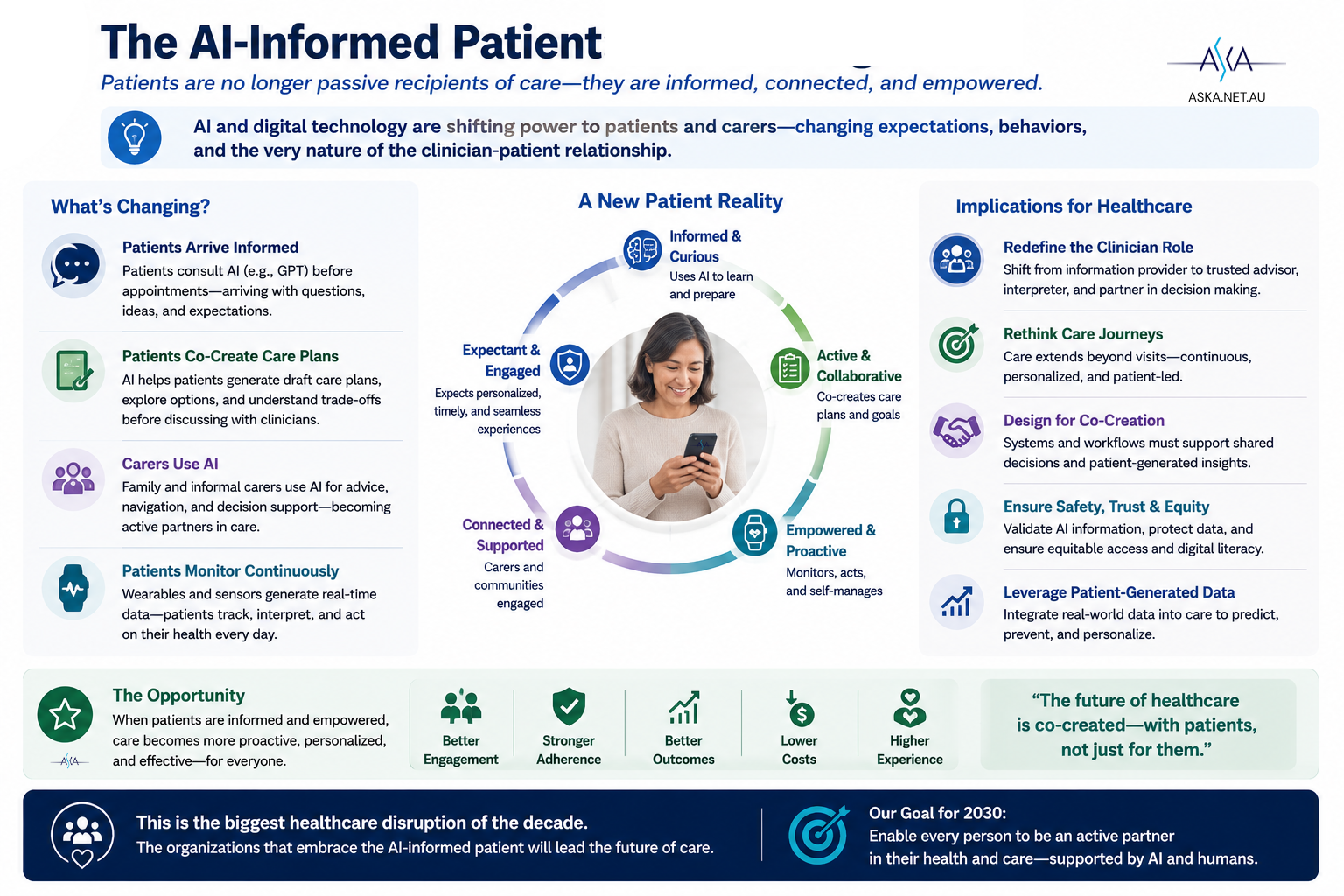
The AI-informed patient may become one of the most consequential forces reshaping healthcare over the next decade.
This changes more than the consultation. It changes the design assumptions of healthcare itself. Care plans can increasingly be co-created rather than simply prescribed. Care journeys can become continuous rather than episodic. And patient capability itself becomes an increasingly important healthcare resource.
This is not transferring clinical responsibility from clinicians to patients. It is expanding capability across the relationship. The clinician becomes more capable. The patient becomes more capable. The system becomes better able to connect the two.
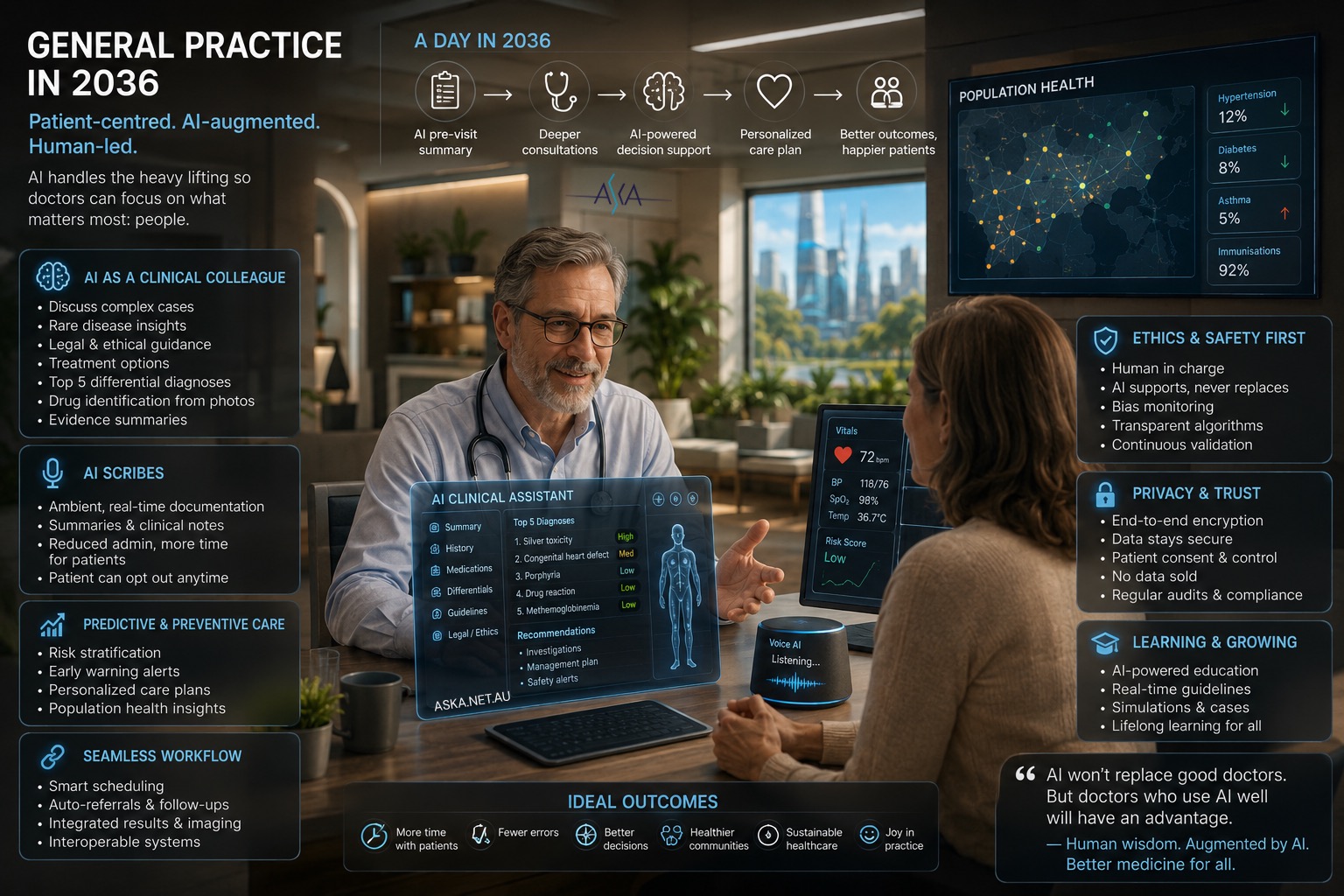
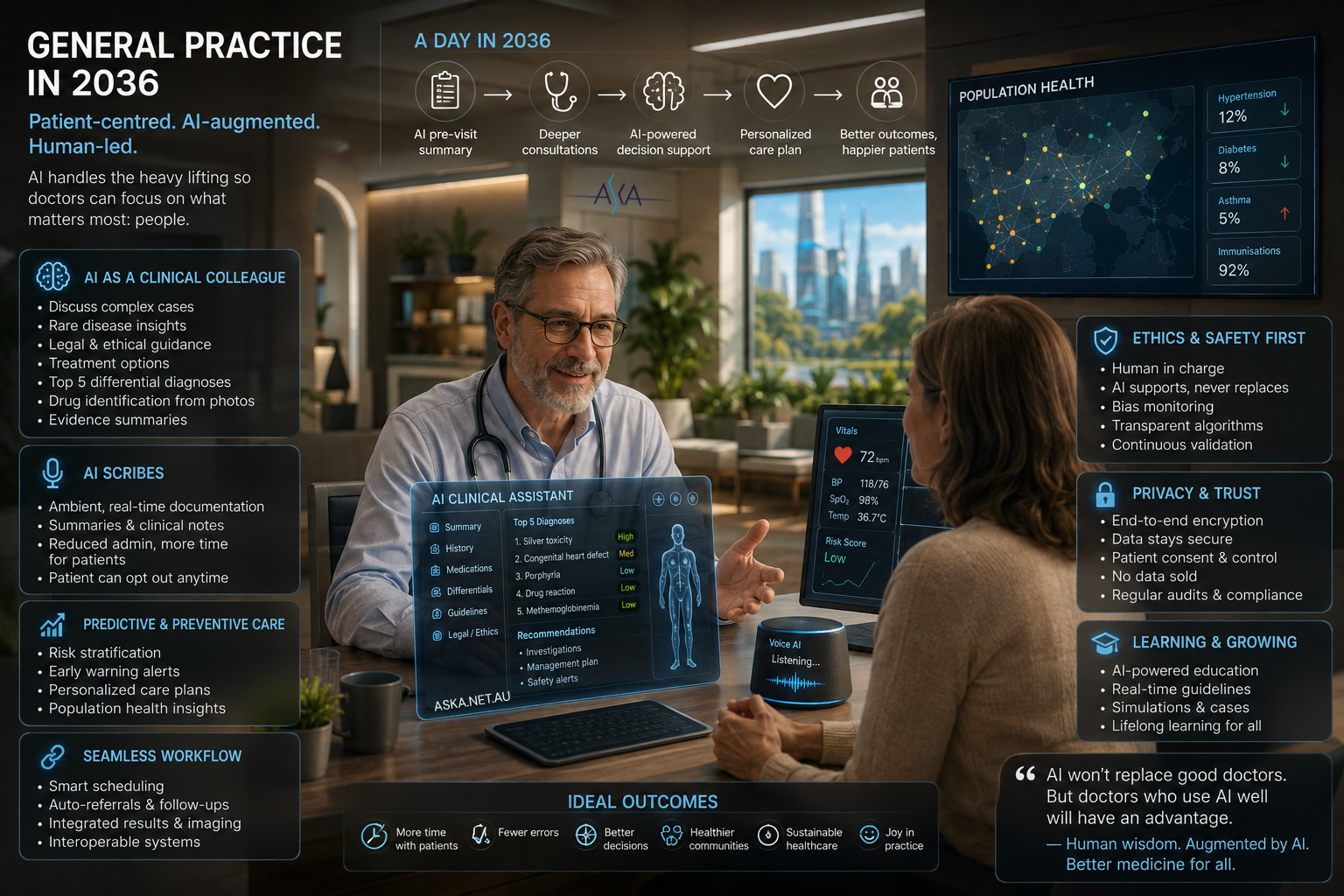
A day in general practice in 2036
So what does this redesigned model actually look like during an ordinary day in practice?
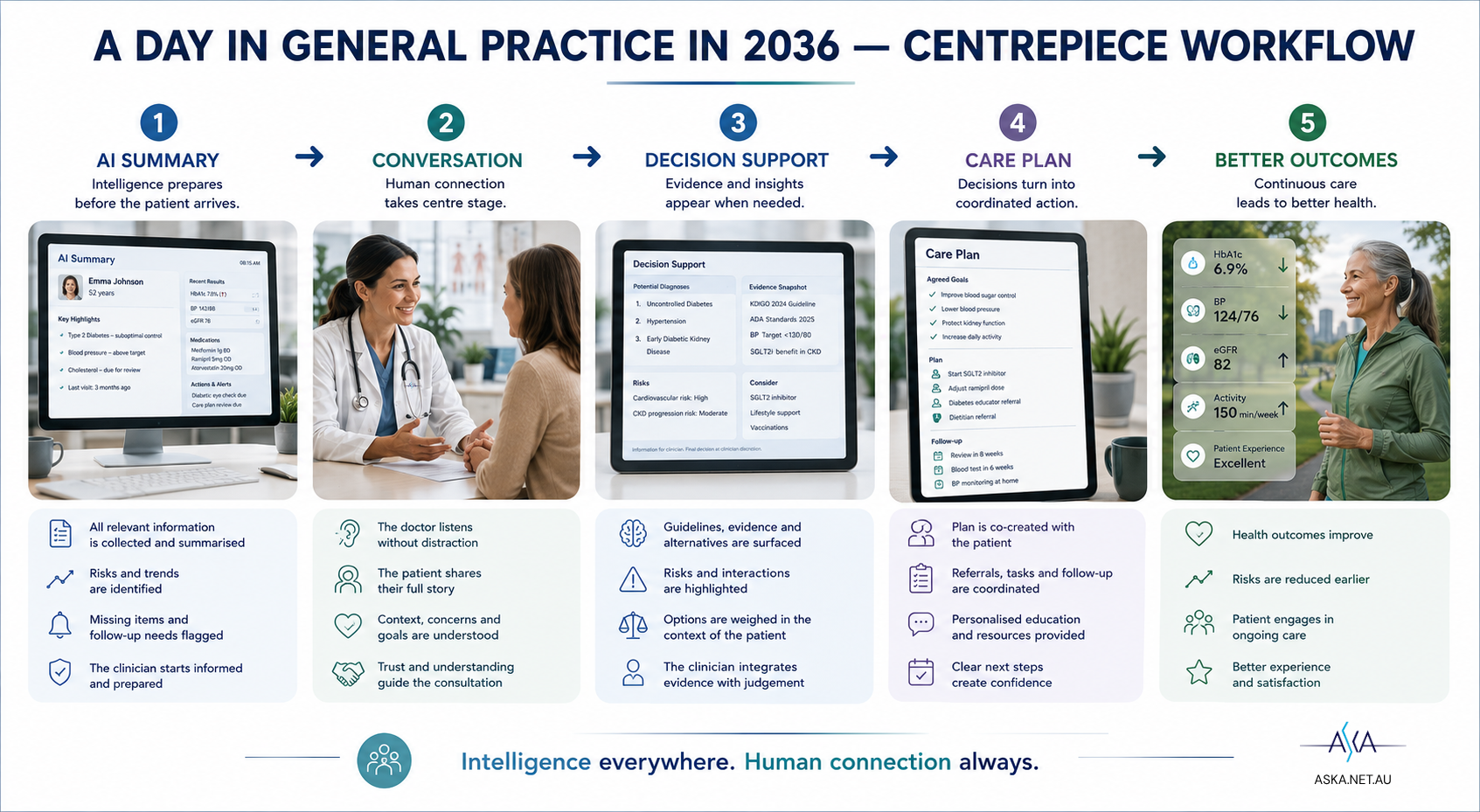
The workflow above is not intended as a technical architecture. It is a patient journey. Let us walk through it.
1. AI summary — the consultation begins before the patient arrives
Today, clinicians frequently spend the opening minutes of an appointment reconstructing the patient’s story: searching records, checking results, reviewing correspondence, identifying what has changed.
In 2036, much of this preparation happens quietly in advance. Relevant information from across the patient’s healthcare journey is assembled into a concise clinical briefing. The objective is not to overwhelm clinicians with more information. It is to prioritise what matters.
The result is deceptively simple. The clinician begins informed rather than interrupted. Instead of starting with the computer, they start with the patient.
2. The conversation — where human connection takes centre stage
If intelligence prepares the consultation, conversation is where medicine begins.
The doctor’s attention no longer needs to be divided between the patient and the screen. They can listen, observe, think, understand. The patient’s story unfolds naturally — not simply their symptoms, but their circumstances, their concerns, their aspirations. A hesitation. A change in tone. The anxiety behind an ordinary sentence.
These moments matter because medicine is not simply the interpretation of biological data. It is the interpretation of human experience. Technology cannot create that relationship. Its role is to create the space in which it can flourish.
3. Decision support — expanding clinical judgement
Once the patient’s story has been understood, the next question naturally follows: what is the best course of action?
Good decisions rarely result from simply having more information. They result from having the right information, at the right moment, in the right context — evidence, guidelines, medication interactions, alternative diagnoses, risks, recent research. Instead of requiring the clinician to leave the consultation and search manually, this information can be surfaced when it is most useful.
But it remains perspective, not authority. The clinician still integrates evidence with experience, uncertainty, patient preferences and professional judgement. One contributes knowledge. The other contributes judgement.
4. Care plan — turning decisions into coordinated action
A successful consultation is not defined by the diagnosis alone. Its real value is measured by what happens after the patient leaves.
In the redesigned consultation, the care plan begins to form during the conversation itself. Doctor and patient build it together. For one patient, success may mean returning to work. For another, remaining independent. For another, controlling pain well enough to spend time with grandchildren. The care plan becomes a living roadmap rather than a static document.
Great healthcare is not created by better decisions alone. It is created by better coordination.
5. Better outcomes — from episodic care to continuous health
Every stage of this journey serves one purpose: better outcomes. Not simply better clinical outcomes. Better human outcomes.
Better preparation creates better conversations. Better conversations create better understanding. Better understanding contributes to better decisions. Better decisions, when coordinated effectively, create better care. And when that care becomes continuous, healthcare begins to shift from responding to illness towards supporting health.
This is not a vision of doctors becoming obsolete. It is a vision of doctors becoming more effective.
Beyond technology
It would be easy to finish this article believing its central message is about artificial intelligence. It is not. Artificial intelligence is an enabler. The destination is better healthcare.
Throughout history, transformative technologies have opened new possibilities, but technology rarely transforms society by itself. Electricity did not simply improve candles — it changed cities, industries and everyday life. The internet did not merely speed up communication — it changed commerce, collaboration and access to knowledge.
Artificial intelligence presents healthcare with a similar opportunity. Its greatest contribution may not be performing existing clinical tasks faster. It may be forcing us to rethink how healthcare itself should be organised — away from automation and towards design, away from replacement and towards augmentation, away from technology adoption and towards capability building.
The practices that thrive over the coming decade may not be those with the most sophisticated AI. They may simply be those that redesign care most intelligently around the people they serve.
Technology enables. People transform.
Building capability
If artificial intelligence creates new possibilities, capability determines whether those possibilities become reality. Capability is more than knowledge. It is the ability to apply knowledge wisely, consistently and collaboratively in the real world.
The future described in this article depends upon building capability throughout the healthcare ecosystem:
- Clinician capability. AI should expand clinicians’ capacity to reason, communicate and care while reducing unnecessary cognitive and administrative burden.
- Patient capability. Patients become more informed, engaged and confident participants in their own health.
- Organisational capability. Practices and health services evolve into learning systems capable of coordinating people, information and technology around patient journeys.
- Community capability. Families, carers and communities become more capable of supporting prevention, wellbeing and healthier lives beyond the walls of healthcare organisations.
Viewed through this lens, healthcare becomes more than a collection of organisations. It becomes a network of capabilities. And those capabilities reinforce one another.
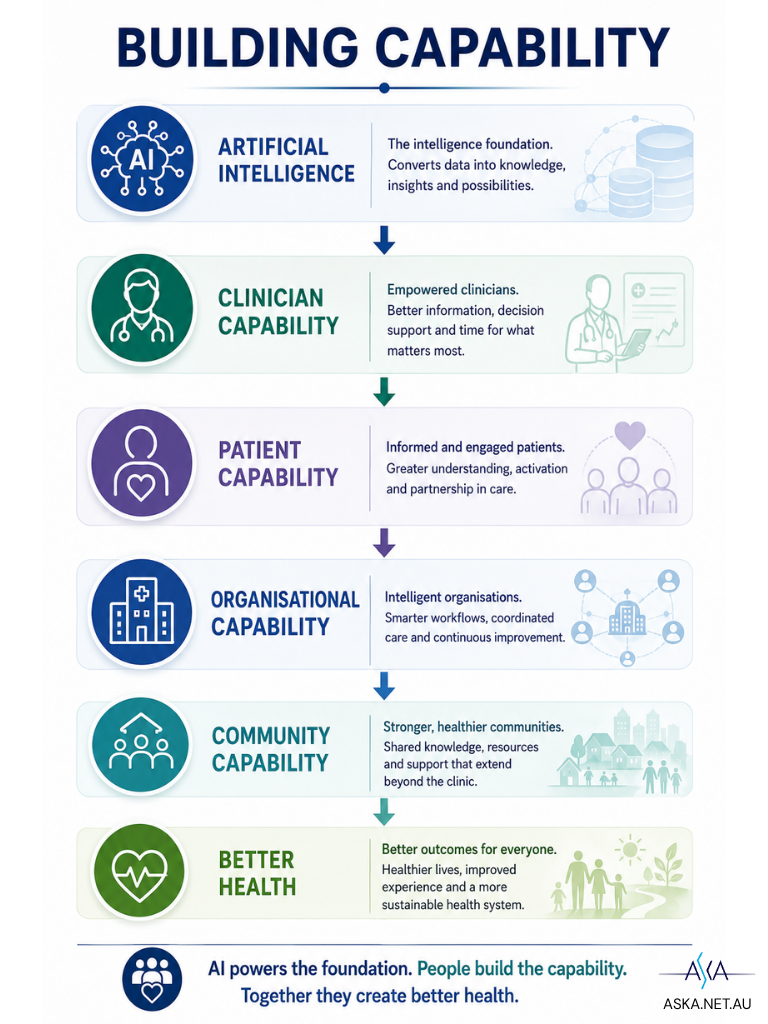
The ultimate measure of healthcare innovation is therefore not the sophistication of the technology introduced. It is the capability left behind.
Clinical leadership
Every transformation requires leadership. Healthcare is no exception.
Technology companies will build increasingly sophisticated systems. Governments will create policy and regulation. Researchers will expand knowledge. All have important roles. But none can define excellent healthcare on behalf of the profession and the people it serves.
Healthcare transformation must remain clinically led. Clinicians understand the realities of care. They carry professional responsibility. They see where workflows fail patients, and where technology helps and where it creates new risks. And they hold the trust upon which healthcare ultimately depends.
The role of clinicians is therefore expanding. They are not merely users of future healthcare systems. They must increasingly become architects of them — shaping workflows rather than merely working within them, redesigning patient journeys rather than simply adapting to historical processes.
This aligns with the philosophy of the physician-led medical home: clinically led, patient-centred, AI-enabled. The technology supports the system. It does not define its purpose.
Artificial intelligence can generate possibilities. Clinical leadership decides which possibilities are worth pursuing.
Designing the future together
Every vision eventually encounters the same question: how do we move from imagining a better future to actually building it?
Transformative ideas rarely emerge fully formed. They evolve through curiosity, experimentation, collaboration, testing, reflection and learning. Healthcare will be no different. The future described in this article cannot be designed by one profession, one organisation or one technology company working alone.
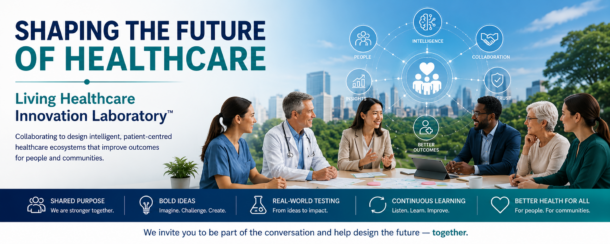
That is why we established the Living Healthcare Innovation Laboratory™. The Laboratory is not simply a discussion forum. It is not a technology showcase. And it is not a place where finished solutions are presented for adoption.
It is a living design environment. A place where ideas become prototypes. Where prototypes become practical experiments. Where experiments generate learning. Where learning strengthens capability. And where capability enables transformation.
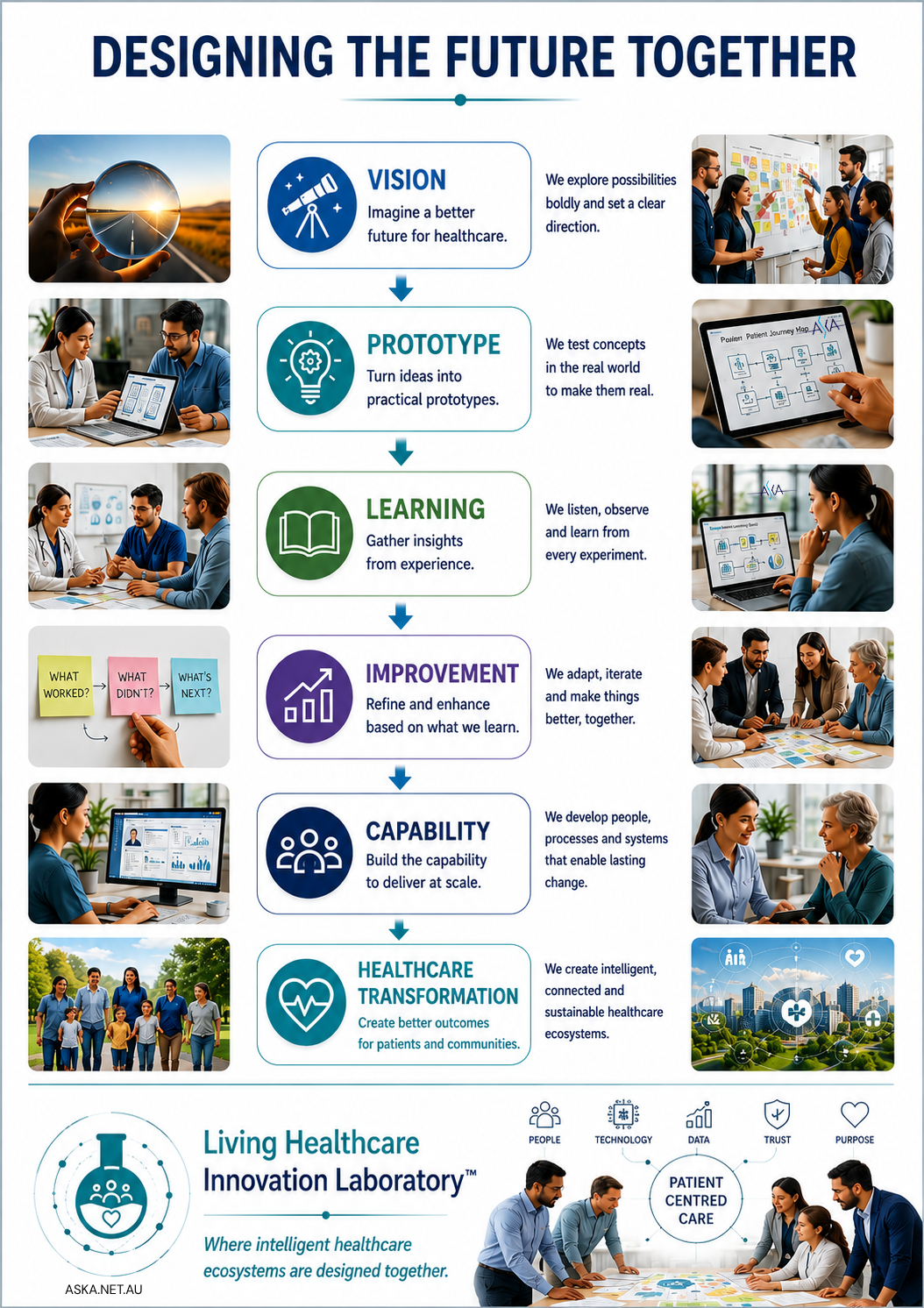
The Laboratory exists because no individual sees the entire system. No organisation possesses all the knowledge required to redesign it. And no technology can replace the collective intelligence that emerges when people with different experiences and perspectives work together around a meaningful problem.
The future of healthcare will not be designed behind closed doors. It will be co-created. One idea. One prototype. One patient journey. One learning cycle at a time.
The future is not a place we are travelling to. It is a system we are designing.
An invitation
Every generation inherits a healthcare system shaped by those who came before. Our generation has been given something rare — the opportunity not simply to improve healthcare, but to reimagine it.
The vision presented here is intentionally ambitious. Some parts will emerge sooner than expected. Others will take years of experimentation, redesign and trust-building. That is the nature of meaningful transformation.
The purpose of this article has never been to predict exactly what general practice will look like in 2036. It has been to give us a destination worth designing. The technologies are emerging. The clinical need is undeniable. What remains is the work of building it — work that cannot be undertaken by a single clinician, a single organisation, a technology company or a government alone.
It will require curious minds. Clinical leadership. Patient partnership. Trust. Experimentation. And a willingness to learn together.
Stay close to the work
If this is a future you would like to help shape, we invite you to stay connected with the Living Healthcare Innovation Laboratory™.
Leave your name and email and we will keep you informed as the work develops — from emerging ideas and conversations, to experiments, prototypes and opportunities to participate. There is no commitment to become involved. Simply stay close to the work and decide when something interests you.
Because the future of healthcare will not be created by artificial intelligence alone. It will be created by people with the imagination to envision a better system, and the courage to build it.
Coming next
This article has asked us to imagine the destination. The next article asks the harder question: how should we redesign healthcare when intelligence is no longer the scarce resource?
If artificial intelligence makes knowledge and reasoning increasingly abundant, where does the real constraint move? To workflow? Trust? Governance? Patient capability? Organisational capability? Coordination?
In the next article, we move from vision to architecture — exploring why simply adding AI to today’s healthcare system will not be enough, and why the Intelligence Age requires us to rethink the way healthcare itself is designed.
Because the central challenge ahead may no longer be creating intelligence. It may be building the capability to turn intelligence into coordinated action.