When AI Outpaces the Organisation
Why alignment, not technology, is becoming the real bottleneck to AI value.
Key Insight
Artificial intelligence is advancing rapidly. It can generate, analyse, synthesise, recommend and increasingly act. AI agents are beginning to move beyond isolated conversations towards participation in workflows, use of organisational tools and coordination of increasingly complex tasks.
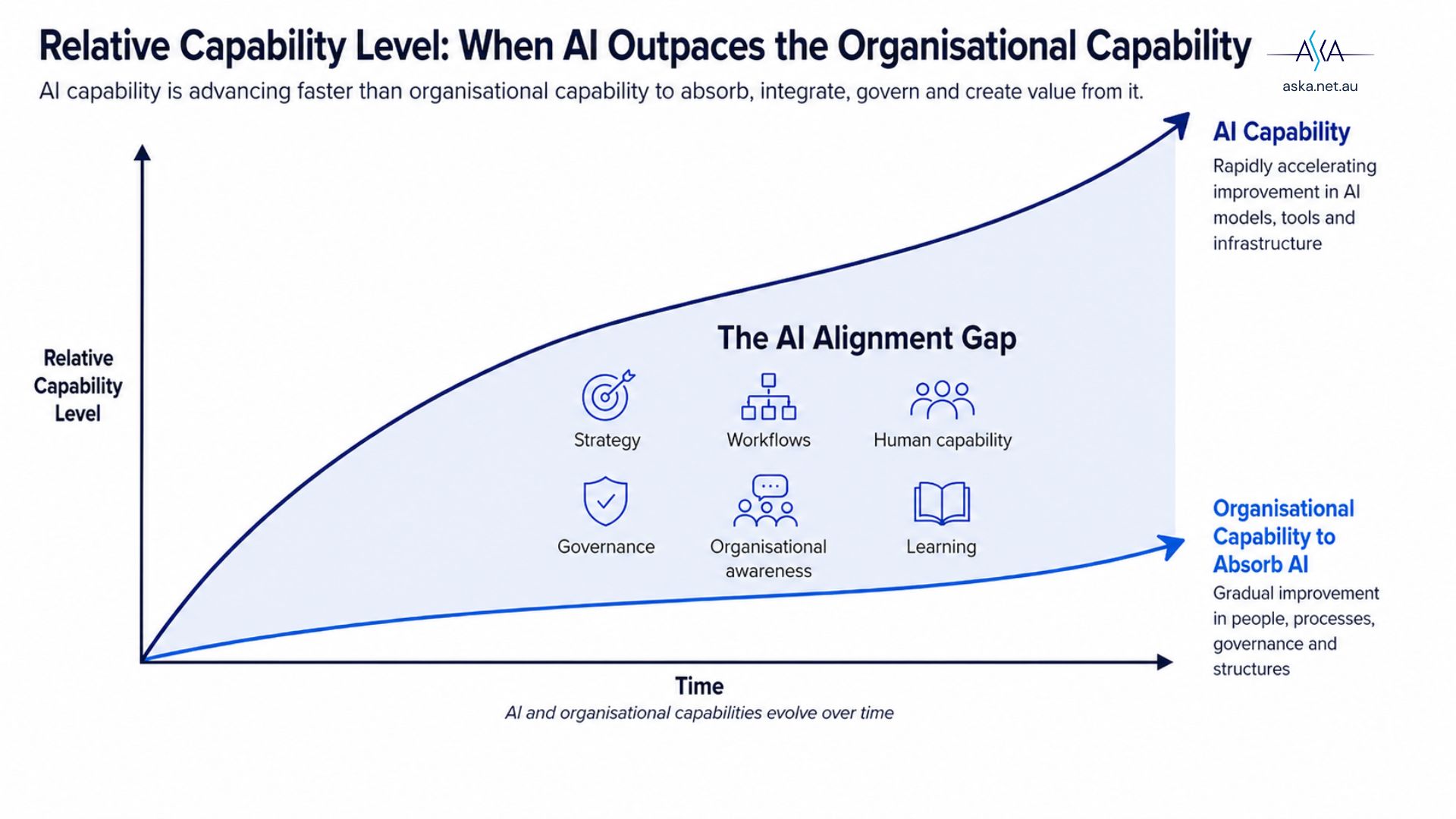
Yet most organisations still operate through structures, workflows, governance mechanisms and management assumptions created for a world in which intelligence was predominantly human, relatively scarce and difficult to scale.
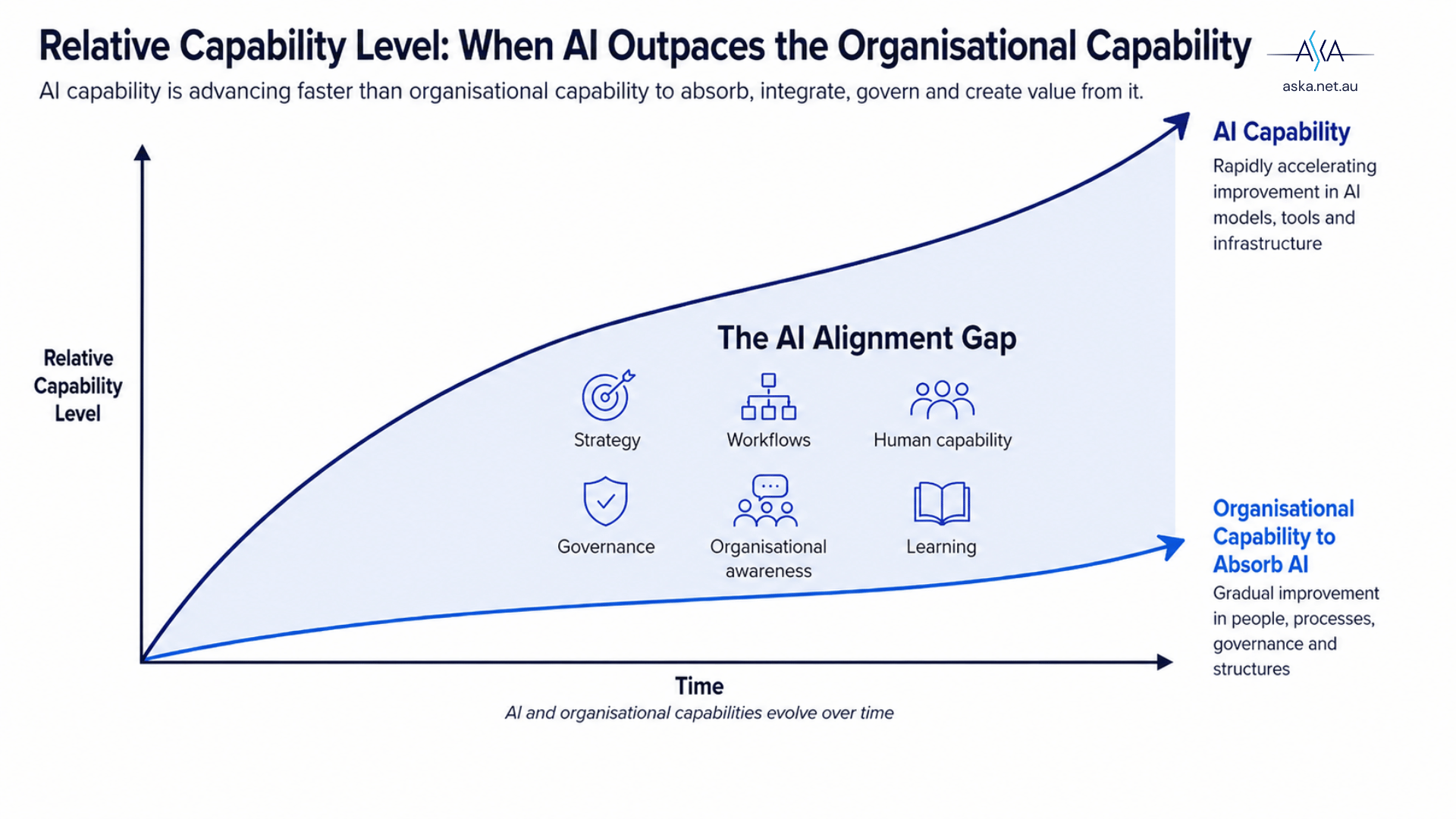
The resulting tension is becoming increasingly visible. We have more AI tools. More experimentation. More pilots. More activity. But not necessarily more alignment, and therefore not necessarily more value.
The evidence increasingly reflects this paradox. McKinsey’s July 2026 research observes that most organisations are still early in their AI journeys and are learning how to translate individual productivity gains into enterprise-level impact. BCG similarly reports that AI is changing jobs faster than companies are redesigning their operating models to keep pace.
The problem is not necessarily the technology. It may be that we have been asking the wrong question. Instead of asking only “What can AI do?” we should also be asking:
What must the organisation become capable of doing differently because AI now exists?
That is the AI alignment problem. And as AI becomes more capable, it may become one of the defining management challenges of the next decade.
The AI acceleration paradox
Consider the familiar story.
Someone sees an impressive AI demonstration. A leader says, we should be doing this. A licence is purchased. A pilot begins. A few enthusiasts become highly capable. Other employees remain uncertain. The workflow itself barely changes.
Then the questions begin. Who owns this? Can we trust the data? Is it safe? Are people actually using it? How much time have we saved? Has anything improved for the customer? Who is accountable when the AI is wrong? How will we measure the return?
Momentum slows. Then another, even more impressive AI tool appears. And the cycle begins again.
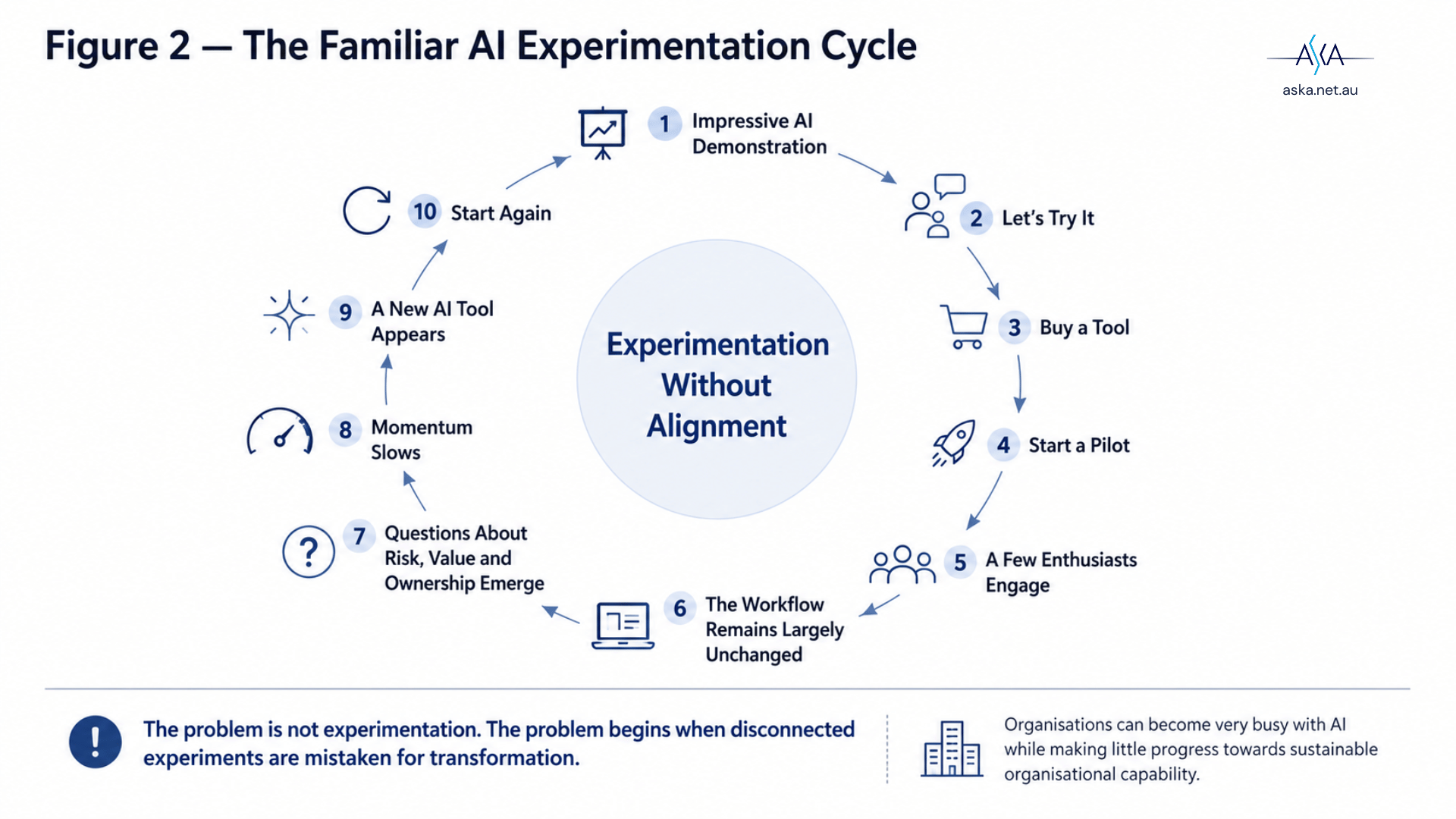
This does not mean experimentation is wrong. Quite the opposite. Experimentation is essential in a field evolving as rapidly as AI. The problem begins when disconnected experiments are mistaken for transformation.
Gartner reported in January 2026 that at least 50% of generative AI projects had been abandoned after proof of concept by the end of the previous year, citing poor data quality, inadequate risk controls, escalating costs and unclear business value. In a separate forecast, Gartner predicted that more than 40% of agentic AI projects would be cancelled by the end of 2027 for similar reasons.
These are not simply failures of artificial intelligence. They are frequently failures of alignment.
A sophisticated AI model cannot compensate for an unclear purpose. A brilliant pilot cannot transform a workflow that never changes. A powerful agent cannot create sustainable value if accountability is absent. Training people to use AI will achieve little if they are improving work that should have been redesigned altogether. And an ambitious AI strategy will remain largely theoretical if it never connects to the daily reality of how work gets done.
The central challenge, therefore, is not “How do we introduce more AI?” It is:
How do we align strategy, workflows, human capability, governance and organisational understanding around meaningful outcomes?
Most organisations do not have an AI problem. They have an alignment problem.
Walk through almost any organisation experimenting seriously with AI and you are likely to find activity everywhere. The technology team is testing tools. Employees are using ChatGPT or Copilot. Marketing is experimenting with content. Operations is exploring automation. Leadership is discussing strategy. Risk and compliance teams are developing policies. Human resources is considering training. Vendors are presenting increasingly sophisticated demonstrations.
Everything is happening. But is it connected?
- Does the training reflect the workflows the organisation most needs to redesign?
- Does governance help employees move safely, or simply tell them what they cannot do?
- Are pilots connected to strategic priorities?
- Are productivity gains flowing through to better customer outcomes, increased capacity, faster cycle times, improved quality or lower costs?
- Has anyone examined what happens downstream when one task suddenly becomes ten times faster?
- Are leaders measuring output, or are they measuring value?
These questions matter because adding AI to an organisation is not the same as transforming it.
Activity is not alignment. Adoption is not transformation. Productivity is not necessarily value.
This last distinction may be the most important of all.
Beware the AI productivity trap
Much of the early conversation about generative AI has focused on time saved. A report that previously took three hours can now be drafted in 30 minutes. A marketing professional can create ten variations instead of two. A developer can write code more quickly. A manager can summarise a meeting in seconds.
These gains are real and valuable. But they can also create a trap.
Imagine that an employee saves five hours per week using AI. What happens to those five hours? Does the organisation serve more customers, reduce delays, improve quality, increase revenue, lower cost, build new capability, solve a genuine bottleneck, or give employees more time for higher-value work?
Or does the organisation simply create more emails, presentations, reports, proposals and content?
An individual may become significantly more productive while the organisation itself barely improves. Worse still, faster output in one part of a system can create additional work elsewhere. A marketing team that produces five times more content may create more approval work. Faster analysis may generate more reports that nobody has time to read. More software code may increase testing, maintenance or integration requirements. More ideas may create a larger prioritisation problem. More AI-generated communication may simply add to everyone else’s information overload.
This is the productivity trap: AI makes a task faster, but the organisation fails to convert that improvement into a better outcome.
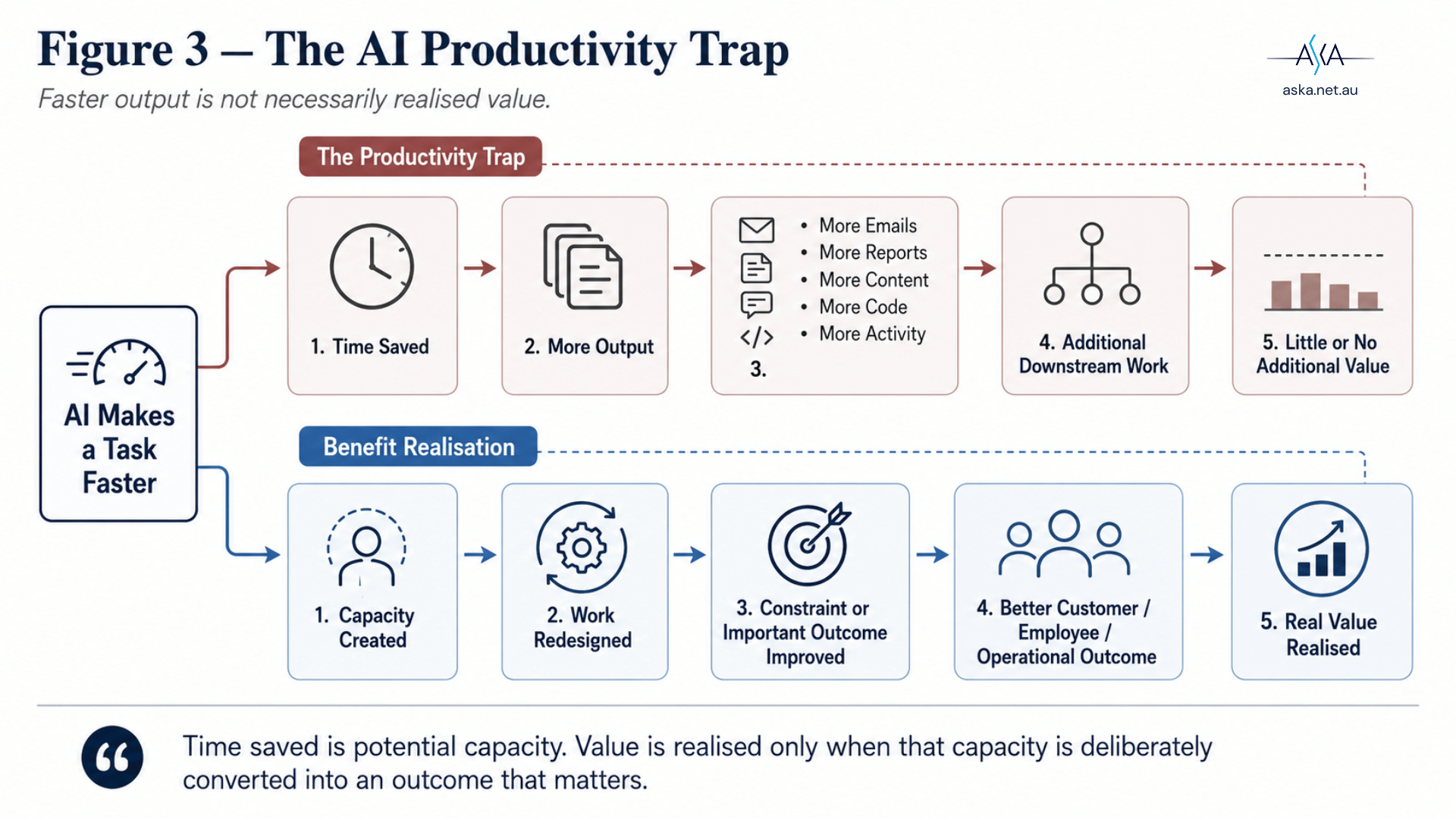
The mistake is to treat time saved as if it were automatically value created. It is not.
Time saved is potential capacity. Value is realised only when that capacity is deliberately converted into an outcome that matters.
That is why AI benefit realisation must go beyond “How many hours did we save?” It should also ask: What changed because we saved them?
Five questions reveal the alignment gap
Through my work on organisational transformation and AI adoption, I have increasingly come to see five recurring questions that help expose why apparently promising AI initiatives struggle. Together, they form the foundation of the AI Alignment Insight™ approach.
They are simple questions. But simple does not mean easy.
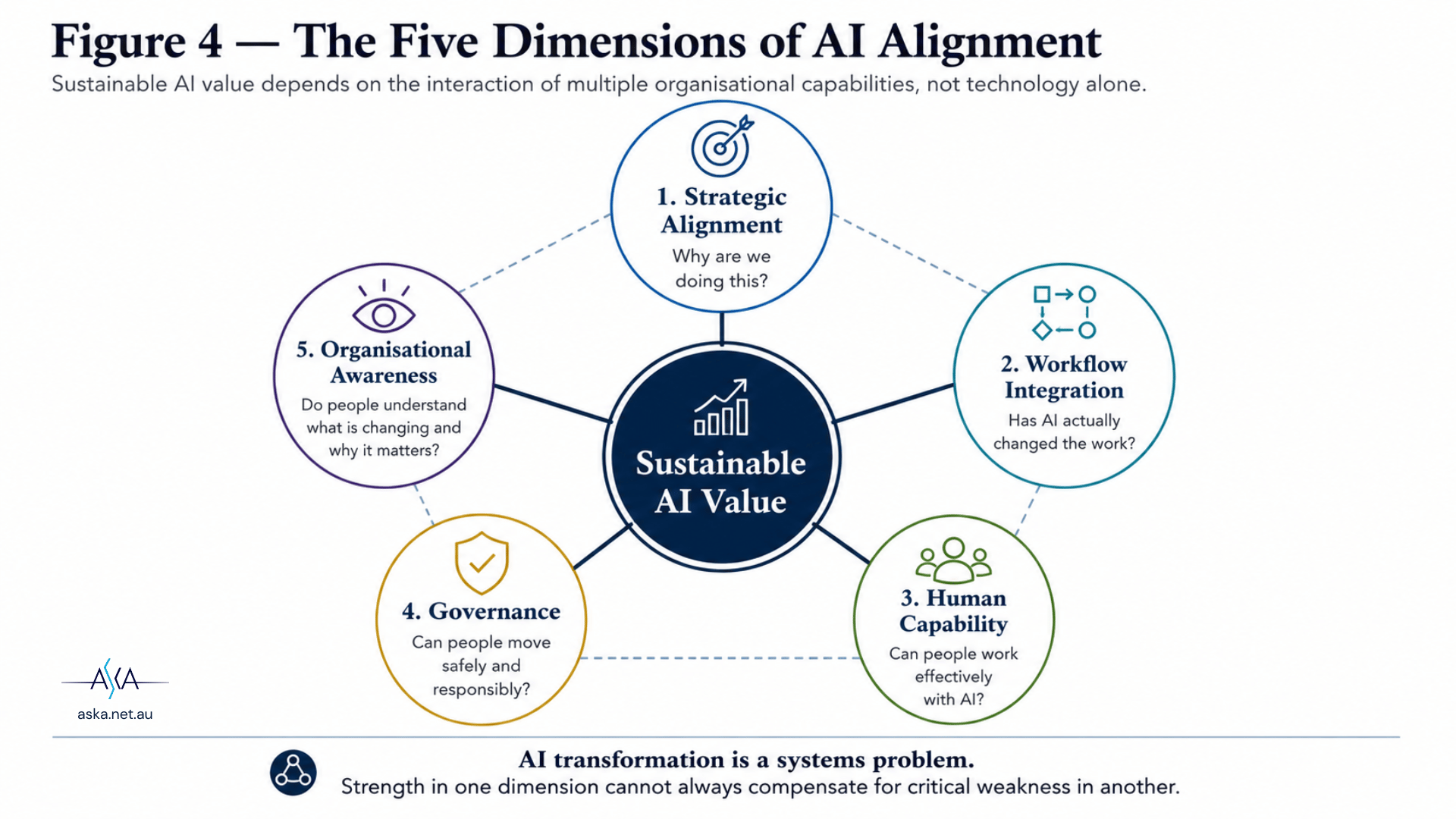
1. Strategic Alignment: Why are we doing this?
Ask ten people in an organisation why it is adopting AI and you may hear ten answers. To save time. To reduce costs. To improve service. To increase revenue. To automate administration. To keep up with competitors. To improve employee experience. Because the board wants an AI strategy. Because everyone else is doing it.
Each answer might be legitimate. But collectively, they may reveal a fundamental lack of alignment.
The strategic question is not merely “Where can we use AI?” It is: What important capability are we trying to create, for whom, and towards what meaningful outcome?
A useful AI initiative should have a line of sight from the technology to the work, from the work to an outcome, and from that outcome to a form of real value. Without that connection, organisations risk accumulating use cases without creating a coherent capability.
2. Workflow Integration: Has AI actually changed the work?
There are at least three distinct ways AI can interact with a workflow.
AI beside the workflow. An employee leaves the work they are doing, opens an AI tool, asks a question, copies the result and returns to the original process. This can be valuable. Much individual AI adoption currently happens this way.
AI within the workflow. AI becomes embedded in an existing process, assisting with specific steps such as summarisation, drafting, analysis, recommendation or decision support. This can improve speed and consistency.
AI-enabled workflow redesign. The organisation steps back and asks a more fundamental question: if this new intelligence had always been available, would we design the work this way at all? This is where transformation begins.
BCG’s 2026 research makes the distinction increasingly explicit: organisations that simply add AI to existing tasks may gain efficiency, but substantial value requires the redesign of end-to-end processes and the operating system of work. That leads to a crucial principle:
Putting AI into a broken workflow does not transform the workflow. It may simply make the broken workflow move faster.
Before automating a task, ask whether the task should exist. Before accelerating a hand-off, ask whether the hand-off is necessary. Before adding AI to a process, understand where value is created, where delays occur and where the real constraint lies.
The goal is not to make every activity faster. It is to improve the flow of value through the system.
3. Human Capability: Can people actually work effectively with AI?
Giving someone access to ChatGPT does not create AI capability. Nor does teaching a collection of prompts.
Effective AI capability includes the ability to frame problems; ask better questions; provide context; evaluate outputs; recognise uncertainty and error; challenge assumptions; exercise professional judgement; understand appropriate boundaries; redesign work; and learn continuously.
This is one of the central arguments I explored in The Silent AI Revolution: the consequences of AI will not be determined solely by access to technology. They will also depend on whether individuals and organisations develop the capability to use it purposefully.
The crucial distinction is: access is not capability.
An organisation can provide AI to thousands of employees and still have only a small number who know how to use it effectively. Conversely, a few highly capable enthusiasts can become dramatically more productive without the organisation learning anything from them.
The challenge is to convert isolated individual expertise into shared organisational capability.
4. Governance: Can people move safely without becoming paralysed?
Organisations often fall towards one of two extremes.
At one extreme: no guardrails. Employees use whatever tools they choose. Sensitive information may be exposed. Accountability is unclear. Nobody knows what is approved. Risks remain invisible until something goes wrong.
At the other extreme: no movement. Policies become so restrictive that responsible experimentation becomes almost impossible. Employees become fearful. Innovators work around formal systems. Shadow AI grows. The organisation becomes safely stagnant while the outside world continues to change.
Neither extreme is sustainable. The goal should be intelligent, proportionate guardrails that reflect the risk of the use case and enable responsible movement.
This becomes increasingly important as AI moves from generating information towards recommending decisions, taking actions and participating directly in workflows. McKinsey’s 2026 work on AI trust warns that as systems become more autonomous and embedded in critical workflows, weaknesses in governance and risk management become increasingly costly.
Good governance should not merely prevent action. Good governance should enable responsible action.
5. Organisational Awareness: Do people understand what is changing and why it matters?
Many organisations have three simultaneous realities: hype at the top. Fear at the bottom. Experimentation in the middle.
Leaders may be excited by transformation. Employees may be concerned about jobs. Early adopters quietly build remarkable capabilities. Managers struggle to understand what is officially allowed. Different parts of the organisation form completely different views of what AI means.
This is not shared awareness. It is fragmented sense-making.
Not everyone needs to become an AI expert. But organisations do need enough common understanding to have meaningful conversations about what AI can and cannot do; where it may create value; where human judgement remains essential; what risks need to be managed; how roles and workflows may change; and why the organisation is pursuing AI at all.
Without this, alignment is almost impossible.
Think of AI value as a multiplier, not a shopping list
It is tempting to think about these five dimensions additively. We have a strategy. We have training. We have governance. We have a tool. We have a pilot. Tick, tick, tick.
But AI value may be better understood as a multiplier:
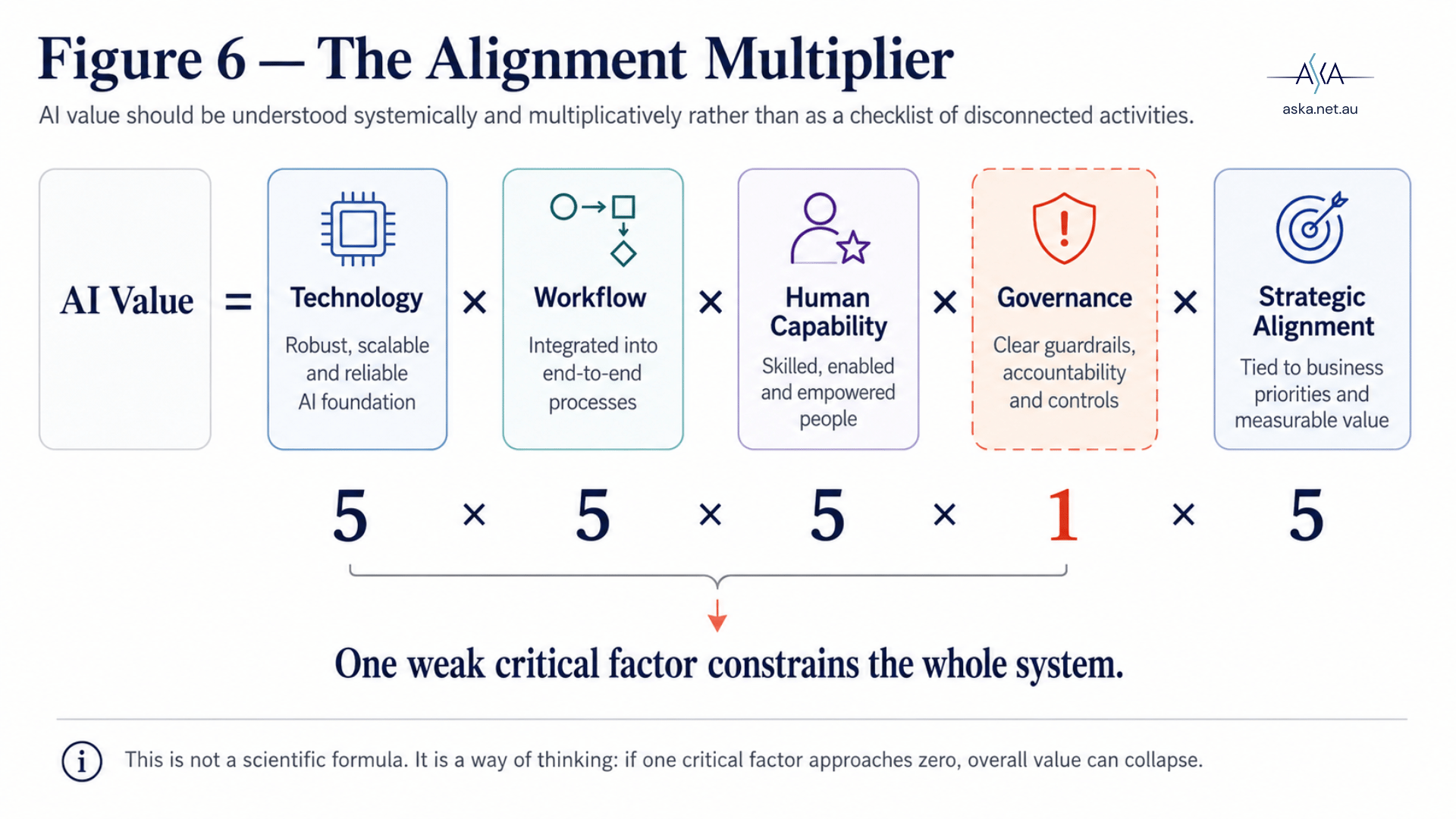
AI Value = Technology × Workflow × Human Capability × Governance × Strategic Alignment
This is not a scientific formula. It is a way of thinking. If one critical factor approaches zero, the value of the entire initiative can collapse.
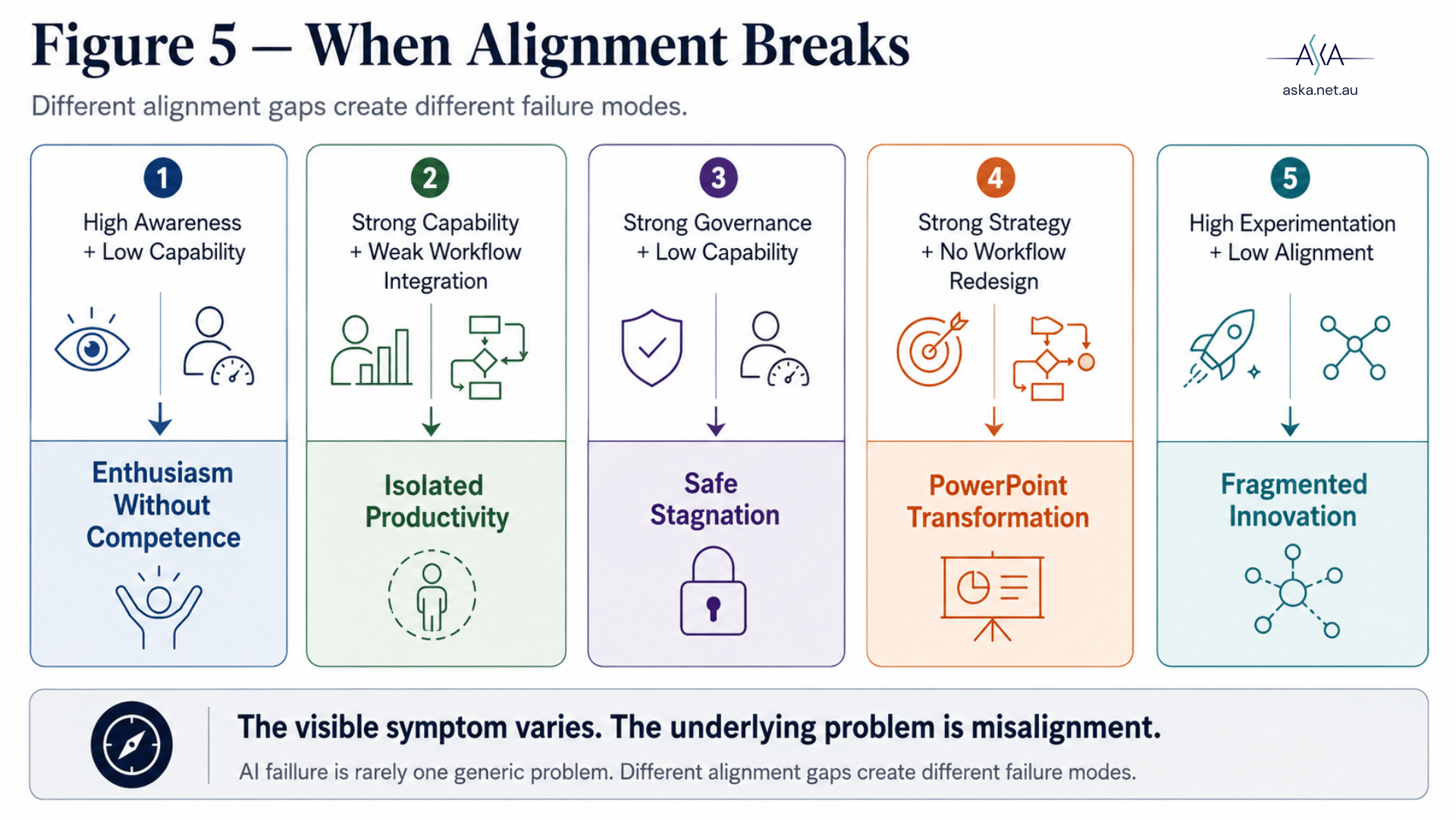
Consider the combinations:
- High awareness + low capability: enthusiasm without competence.
- Strong human capability + weak workflow integration: isolated productivity.
- Strong governance + no capability: safe stagnation.
- Strong strategy + no workflow redesign: PowerPoint transformation.
- High experimentation + weak alignment: fragmented innovation.
A technically brilliant AI system solving the wrong problem still solves the wrong problem. A powerful AI system inside a broken process may simply accelerate waste. Highly capable individuals working independently may become faster without making the organisation better. A successful pilot without a path to benefit realisation may remain an interesting demonstration.
The strongest AI does not necessarily create the strongest organisation. The best-aligned organisation may win.
Alignment becomes more important as AI becomes more capable
Until recently, most AI use in organisations was relatively contained. An individual generated a draft. A marketer created content. A developer received coding assistance. A team summarised a meeting. The consequences of misalignment were real, but often local.
Now the nature of AI is changing. The progression looks increasingly like this:
As systems become capable of acting across tools and workflows, the consequences of misalignment grow. The wrong answer is problematic. The wrong action at scale is potentially much more significant.
This is why the emergence of agentic AI does not reduce the need for human capability, workflow design, governance or strategic clarity. It increases it.
McKinsey’s most recent work describes organisations as still learning how to move from individual adoption towards enterprise-wide value capture, while BCG argues that AI is changing work faster than many companies are redesigning their operating models.
The danger is no longer simply failing to adopt AI. The greater danger may be scaling confusion, poor workflows, bad decisions and unclear accountability faster.
Do not wait for perfect alignment
None of this means an organisation should stop experimenting until it has developed a perfect strategy, redesigned every workflow, trained every employee and created flawless governance. That would be another failure mode.
The nature of AI is changing too rapidly for a traditional multi-year transformation programme designed entirely in advance. The answer is not to eliminate experimentation. It is to make experimentation more deliberate.
Start with:
Then learn. Improve. Repeat.
Transformation rarely begins with a perfect enterprise-wide AI strategy. It often begins with one important problem, one useful experiment and a disciplined commitment to learning.
But the experiment should not end with “Did the AI work?” It should ask: Did the work improve? And ultimately: Did we realise a meaningful benefit?
Move from productivity metrics to benefit realisation
Every AI initiative should be able to describe a clear chain: AI Capability → Change in Work → Improved Outcome → Realised Benefit.
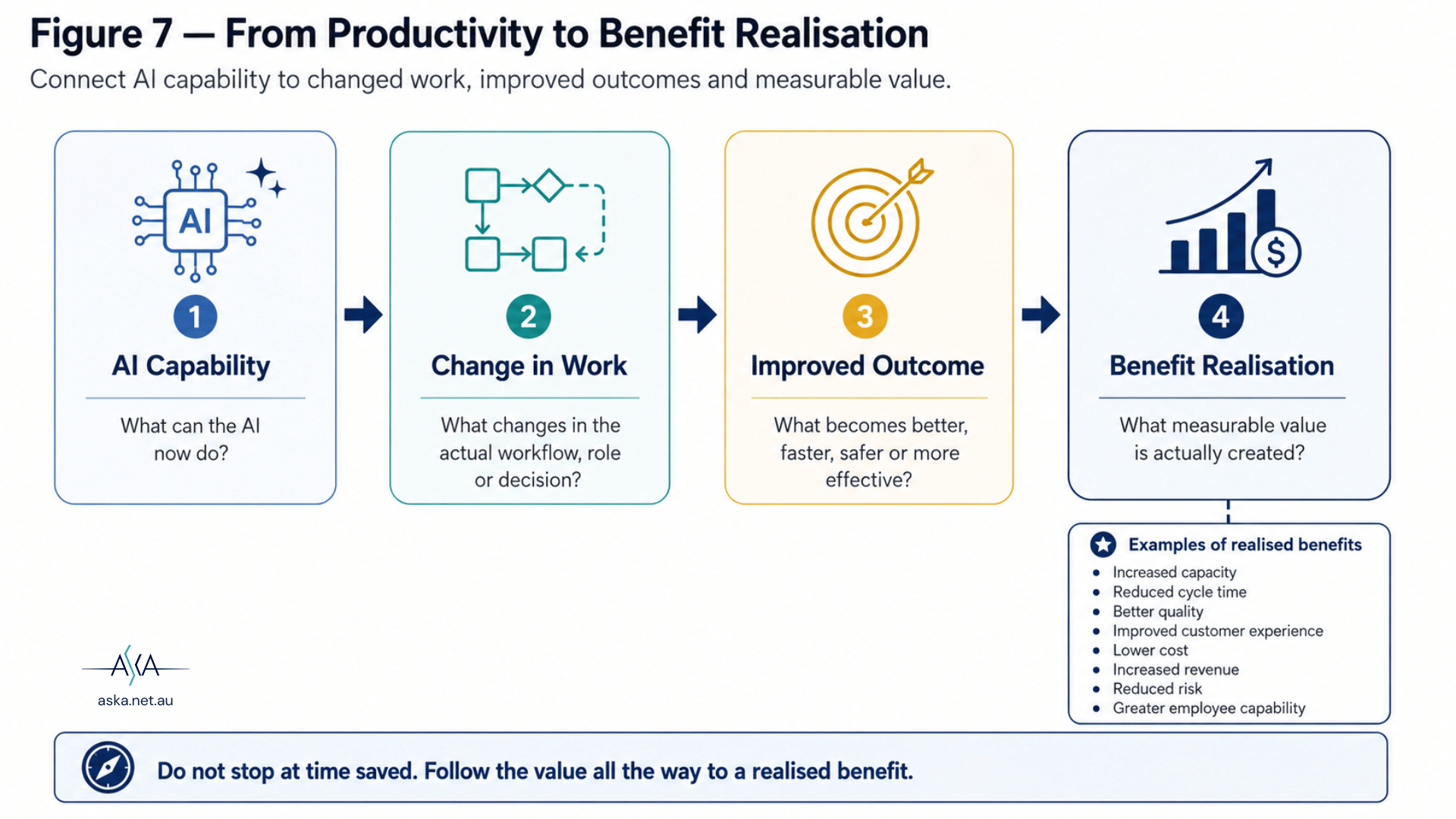
For example: an AI system summarises complex incoming documents (AI capability). Professionals spend less time extracting basic information and more time reviewing exceptions and applying judgement (change in work). Decisions are made faster with fewer delays (improved outcome). The organisation gains reduced cycle time, greater service capacity, better customer experience or lower operational cost (realised benefit).
The important point is that time saved is not the benefit. It is an intermediate result. The organisation still needs to decide what to do with the capacity created.
A useful test is to ask five questions:
- What important outcome are we trying to improve? Not simply: where can we use AI?
- Where exactly will the work change? Not simply: what feature will the tool provide?
- Who must develop a new capability? Not simply: who needs a licence?
- What must remain safe, trusted and accountable? Not simply: do we have an AI policy?
- What evidence will demonstrate that a real benefit was achieved? Not simply: how many people used the tool?
These questions move the conversation from adoption to value.
The bigger transformation journey
This alignment challenge is part of a much broader question I have been exploring across my work.
The Silent AI Revolution begins with the individual: how do people recognise what is changing and develop the capability to participate in an AI-enabled world?
Beyond Disruption asks a broader strategic question: how do we move beyond reacting to disruption and begin reimagining what should exist instead?
Aligning for Excellence focuses on the organisation: how do we align purpose, processes, people and systems around the outcomes that matter?
And my work on the future of healthcare explores the system-level question: how might we redesign an entire complex human ecosystem when intelligence is no longer the scarce resource it once was?
These are not separate conversations. They are different levels of the same transformation journey:
AI makes that journey more urgent. But AI alone cannot complete it.
Start by finding your weakest important link
The biggest AI alignment problem will not be the same for every organisation, or every initiative.
For one initiative, the problem may be strategic: nobody can clearly explain what meaningful outcome the AI is supposed to improve. For another, it may be workflow integration: the technology works, but the underlying process has not changed. For another, capability: employees have access to AI but lack the confidence or judgement to use it well. For another, governance: people either do not know the boundaries or are so constrained that they cannot learn. For another, awareness: different groups have fundamentally different understandings of why AI is being introduced.
This is why organisations should resist the temptation to fix everything at once. Instead, find the weakest important link. Then take focused action:
That is a much more practical starting point than another list of 100 possible AI use cases.
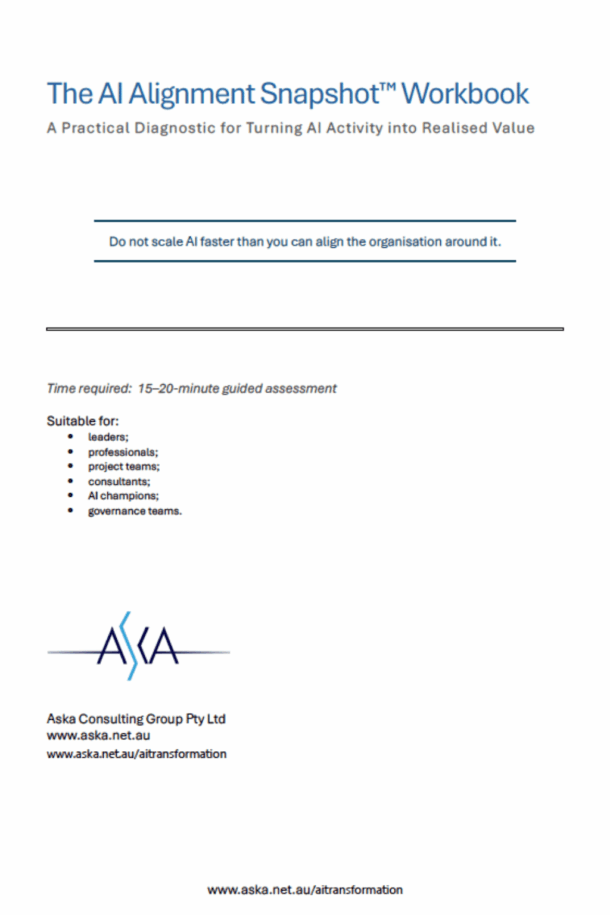
Use the AI Alignment Snapshot™ to turn reflection into focused action
To help leaders, professionals and teams apply these ideas to their own work, I have developed the AI Alignment Snapshot™, a short practical diagnostic designed to be completed in approximately 10 to 15 minutes.
Choose one real AI initiative, tool, pilot or opportunity. Then assess it across five dimensions:
- Strategic Alignment: do we know why we are doing this, what important outcome we want to improve and what value success would create?
- Workflow Integration: where exactly does AI change the real work, and have we reconsidered the workflow itself?
- Human Capability: can the people involved work effectively with AI, evaluate its outputs and apply appropriate judgement?
- Governance: can people move safely and responsibly without either uncontrolled risk or unnecessary paralysis?
- Organisational Awareness: do the people involved understand what is changing, why it matters and what they are collectively trying to achieve?
The purpose is not to generate a maturity score for its own sake. The score is merely the beginning. The real purpose is to identify your weakest important alignment gap and turn it into a focused action towards benefit realisation.
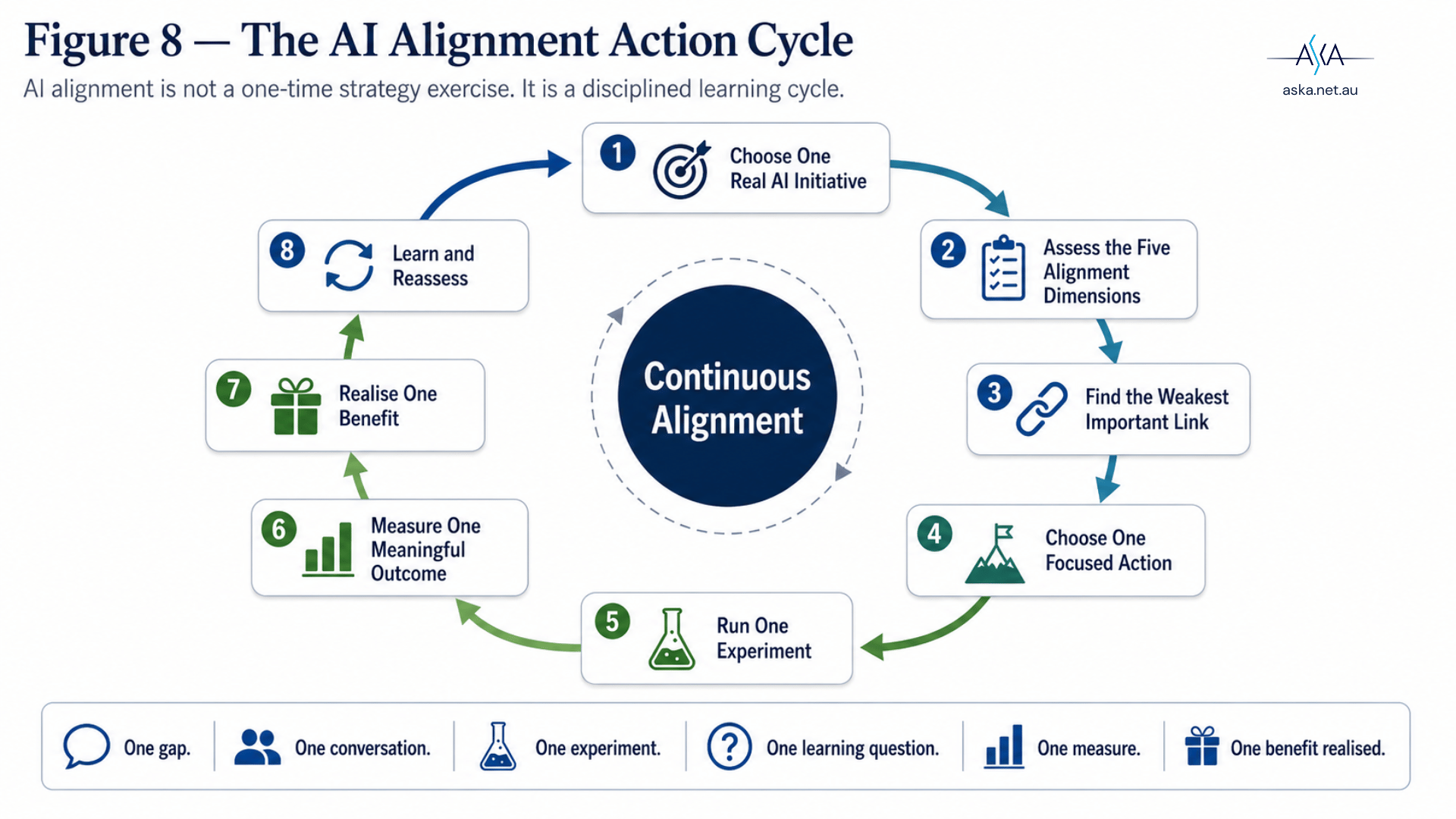
Choose one real AI initiative. Complete the diagnostic. Find the weakest important link. Then prepare one focused action that can move the initiative towards a meaningful, measurable benefit.
Do not begin by asking “How much faster can AI make us?” Begin by asking: What important outcome are we trying to improve? Then connect the chain: AI Capability → Better Work → Better Outcome → Benefit Realisation.
Because the real opportunity is not simply to produce more. It is to create more value. And that requires us to escape the productivity trap.
A final thought
For most of organisational history, intelligence was one of our scarcest resources. Expertise was difficult to acquire. Analysis took time. Knowledge was fragmented. Decisions depended heavily on access to experienced people.
That constraint is changing. Artificial intelligence is making certain forms of intelligence increasingly accessible, abundant and scalable. But access to intelligence does not automatically create wisdom. It does not automatically create better workflows. It does not create trust. It does not align people around purpose. It does not guarantee better decisions. And it certainly does not guarantee transformation.
Those capabilities still have to be designed, developed, governed and learned.
The organisations that succeed with AI will not necessarily be those that adopt the most tools, launch the most pilots or deploy the most agents. They will be those that learn how to align human capability, artificial intelligence, workflows, governance and purpose around meaningful outcomes.
We are all learning to introduce a fundamentally new form of capability into organisations that were never designed for it. The challenge is not to slow that capability down. The challenge is to build organisations capable of learning, adapting and aligning fast enough to use it well.
Do not scale AI faster than you can align the organisation around it.
Sources and further reading
The frameworks presented in this article, including the AI Alignment Gap, the AI Productivity Trap, the Five Dimensions of AI Alignment, the Alignment Multiplier, the Benefit Realisation Chain and the AI Alignment Action Cycle, were developed by the author. The sources below are cited as evidence of the management challenges they address, not as the origin of the frameworks.
- De Smet, Aaron, Drew Goldstein, Holly Price, and Tanguy Catlin. “From Adoption to Impact: Three Horizons of AI Transformation.” McKinsey Quarterly, July 8, 2026.
- Asaftei, Gabriel Morgan, Roger Roberts, Abby Sticha, and Cécile Prinsen. “State of AI Trust in 2026: Shifting to the Agentic Era.” McKinsey & Company, March 25, 2026.
- McKinsey & Company. “The State of Organizations 2026.” February 19, 2026.
- McKinsey & Company. “The State of AI: How Organizations Are Rewiring to Capture Value.” March 12, 2025.
- McKinsey & Company. “The State of AI in 2025: Agents, Innovation, and Transformation.” November 5, 2025.
- Boston Consulting Group. “Scaling AI Requires New Processes, Not Just New Tools.” January 20, 2026.
- Wittig, Marcus, Alfonso Abella, Olivier Bouffault, et al. “AI-First Enterprise Operations: Reinventing the Operating System of Work.” Boston Consulting Group, June 15, 2026.
- Boston Consulting Group. “AI at Work: Why Strategy Matters More Than Tools.” June 3, 2026.
- Boston Consulting Group. “AI Transformation Is a Workforce Transformation.” February 4, 2026.
- Gartner. “Why Half of GenAI Projects Fail—and How to Avoid the Common Mistakes.” January 26, 2026.
- Gartner. “Gartner Predicts Over 40% of Agentic AI Projects Will Be Canceled by End of 2027.” June 25, 2025.