
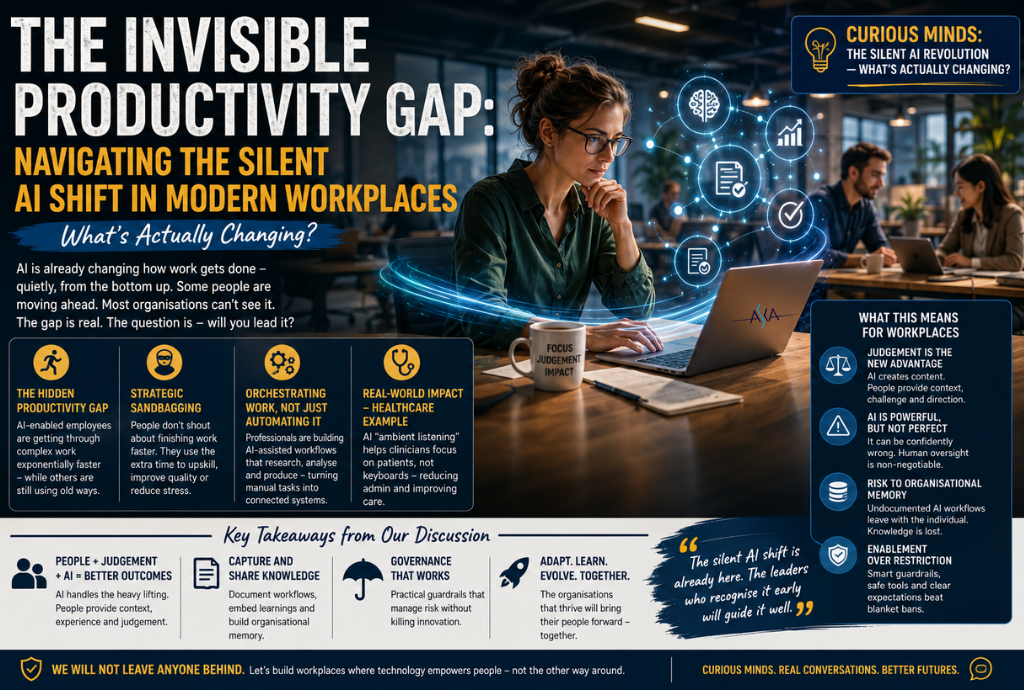
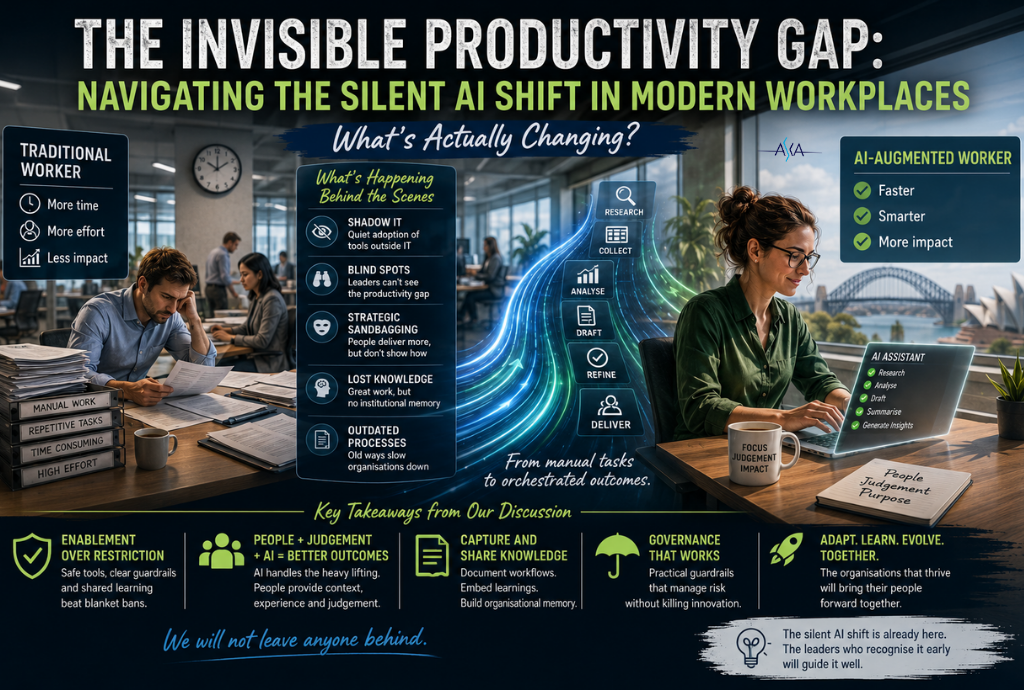
The Invisible Productivity Gap: Navigating the Silent AI Shift in Modern Workplaces
1. Introduction
As part of our first Meetup of Curious Minds: The Silent AI Revolution Series, we discussed: What’s Actually Changing?” During the session, we explored a simple but important question:
2. What is genuinely changing inside organisations today because of artificial intelligence?
What is genuinely changing inside organisations today because of artificial intelligence? i.e.
- Not future possibilities.
- Not science fiction.
- Not predictions about ten years from now.
- What is already happening now, quietly and inside workplaces today?
During the discussion, several themes emerged:
- AI adoption is increasingly happening from the bottom up
- Hidden productivity gaps are emerging inside organisations
- Individual capability is accelerating faster than institutional capability
- Human judgment is becoming more valuable, not less
- Organisations risk losing knowledge if AI-enabled workflows remain undocumented
- Governance models must evolve from gatekeeping towards enablement
This article is an extension of the discussions from the first “Curious Minds: The Silent AI Revolution” meetup session and explores what many leaders may already be seeing, but have not yet fully recognised.
Major technology shifts used to arrive with plenty of notice.
For example, when organisations moved from paper systems to digital platforms, rolled out enterprise software like ERP systems, or migrated to the cloud, everyone knew it was happening. There were company-wide emails, training sessions, project teams, implementation plans, and IT staff working overtime to make it all happen.
The organisation controlled how capability changed.
This wave of artificial intelligence is different.
As discussed during our first Curious Minds session, one defining characteristic of today’s AI transformation is that much of it is happening quietly. Capability within organisations is changing from the bottom up as employees adopt cloud-based AI tools on their own, often without waiting for official approval or structured rollouts.
Many organisations have not yet recognised how significant this shift is becoming.
That creates a leadership blind spot.
3. The Hidden Productivity Gap
2. The Shift from Disruption to Diffusion
Imagine an employee facing several hours of data reconciliation, report preparation, research work, or document drafting.
A few years ago, that work may have taken days.
Today, many professionals simply open a browser, use an AI tool, and complete the same work in a fraction of the time.
- No project approval.
- No system rollout.
- No formal training.
- Just quiet adoption.
Across workplaces, an emerging capability divide is forming between people who are learning to work alongside AI and those who continue to operate entirely through traditional methods.
Some employees are quietly building new ways of working that make them substantially more productive.
Leadership often cannot see it.
Part of the reason is what we discussed during the session as “strategic sandbagging.”
If someone completes a task in three hours that previously took three days, they do not necessarily tell their manager.
Often they use the extra time to:
- improve quality
- reduce stress
- learn new skills
- prepare better outputs
- create breathing room in demanding workloads
From management’s perspective, they simply appear highly capable.
The mechanism behind the improvement remains invisible.
4. Moving Beyond Automation
The change goes well beyond drafting emails or summarising meeting notes.
Many professionals are quietly becoming what could be described as “administrative orchestrators.”
Rather than manually completing every step themselves, they are building small systems around their work.
Research tools feed into analysis tools.
Meeting notes feed into action trackers.
Documents flow automatically into summaries and reporting structures.
A process that once involved 10 manual steps is increasingly becoming a connected workflow.
This capability multiplier is beginning to reshape industries.
Healthcare provides a good example.
For years, clinicians have faced growing administrative pressure. In many settings, doctors spend substantial time documenting information rather than focusing directly on patients.
New AI-enabled “ambient listening” technologies are beginning to shift that balance.
Rather than having clinicians type notes during consultations, systems can capture conversations, structure information, and prepare clinical documentation for review.
The clinician remains fully responsible.
Human judgement remains central.
But the administrative burden begins to reduce.
That changes how professionals spend their cognitive energy.
5. The New Professional Advantage
As AI becomes more capable, something important changes.
The value of professionals shifts.
People are increasingly not paid simply to create information:
- They are paid to evaluate it.
- To challenge it.
- To refine it.
- To apply judgment.
Today, AI can:
- draft reports.
- generate analysis.
- suggest recommendations.
But professionals provide context, experience, critical thinking, and domain expertise.
That matters because AI remains imperfect. AI systems do not “understand” information the way humans do. at least not yet fully, but they predict patterns.
Most of the time, those predictions are remarkably useful.
Sometimes they are wrong. Confidently wrong, and these include:
An invented medical citation.
An inaccurate assumption presented with complete confidence.
Many organisations are already discovering that AI outputs still require human verification.
The greatest professional advantage moving forward may not be how quickly someone can use AI.
It may be how effectively they can supervise it.
6. The Risk Organisations Cannot See
There is another challenge emerging.
Organisational memory.
Traditionally, productivity improvements became embedded in systems, training materials, and standard operating procedures.
Knowledge stayed inside the business.
But what happens when an employee quietly builds a highly effective AI-enabled workflow that exists only in their personal tools and undocumented prompts?
The organisation benefits from the outcome.
But it never captures the capability.
If that employee leaves, much of that improvement disappears with them.
The organisation returns to its previous baseline.
Businesses may believe they are becoming more productive.
In reality, they may simply be relying on hidden individual capability.
That creates risk.
7. Governance Still Matters, Yet So Does Enablement
Some organisations will respond by trying to block everything.
Restrict access.
Ban tools.
Add layers of approval.
Unfortunately, that approach often creates unintended consequences.
If people see genuine value, they tend to find workarounds.
Shadow systems emerge.
Personal accounts appear.
The activity moves underground rather than disappearing altogether.
The stronger response is enablement.
Create safe environments.
Build practical guardrails.
Provide approved pathways.
Make the secure approach the easiest approach.
In these situations, leadership shifts from acting purely as gatekeepers to becoming enablers of capability.
Only then can organisations begin to document workflows openly, embed learning, build governance, and safely introduce more advanced AI systems over time.
8. The Organisations That Will Thrive
The future advantage will not necessarily belong to organisations that buy the most technology.
It will belong to organisations that learn faster.
Adapt thoughtfully.
Build capability intentionally.
Capture knowledge systematically.
And bring their people forward together.
The silent AI shift is already happening.
The question is not whether organisations will adapt.
The question is whether leaders will recognise the change early enough to guide it well.
In this Session 1, we asked: “What’s Actually Changing?”
Join us in the next session, 2, we plan to explore: Is AI for Small Business, causing chaos or building capability?
Ready to Take the Next Step? Aligning for Excellence Starts with You.
The AI revolution is here—but transformation doesn’t have to be overwhelming. With the right tools, guidance, and support, you can turn uncertainty into opportunity.
Join the Community
Be part of a network of leaders and practitioners shaping the future of work and service delivery.
Let’s shape the future—intentionally, intelligently, and together.
#AILeadership #DigitalTransformation #FutureOfWork #AligningForExcellence #LeadershipDevelopment #SilentAIRevolution
Leave A Comment