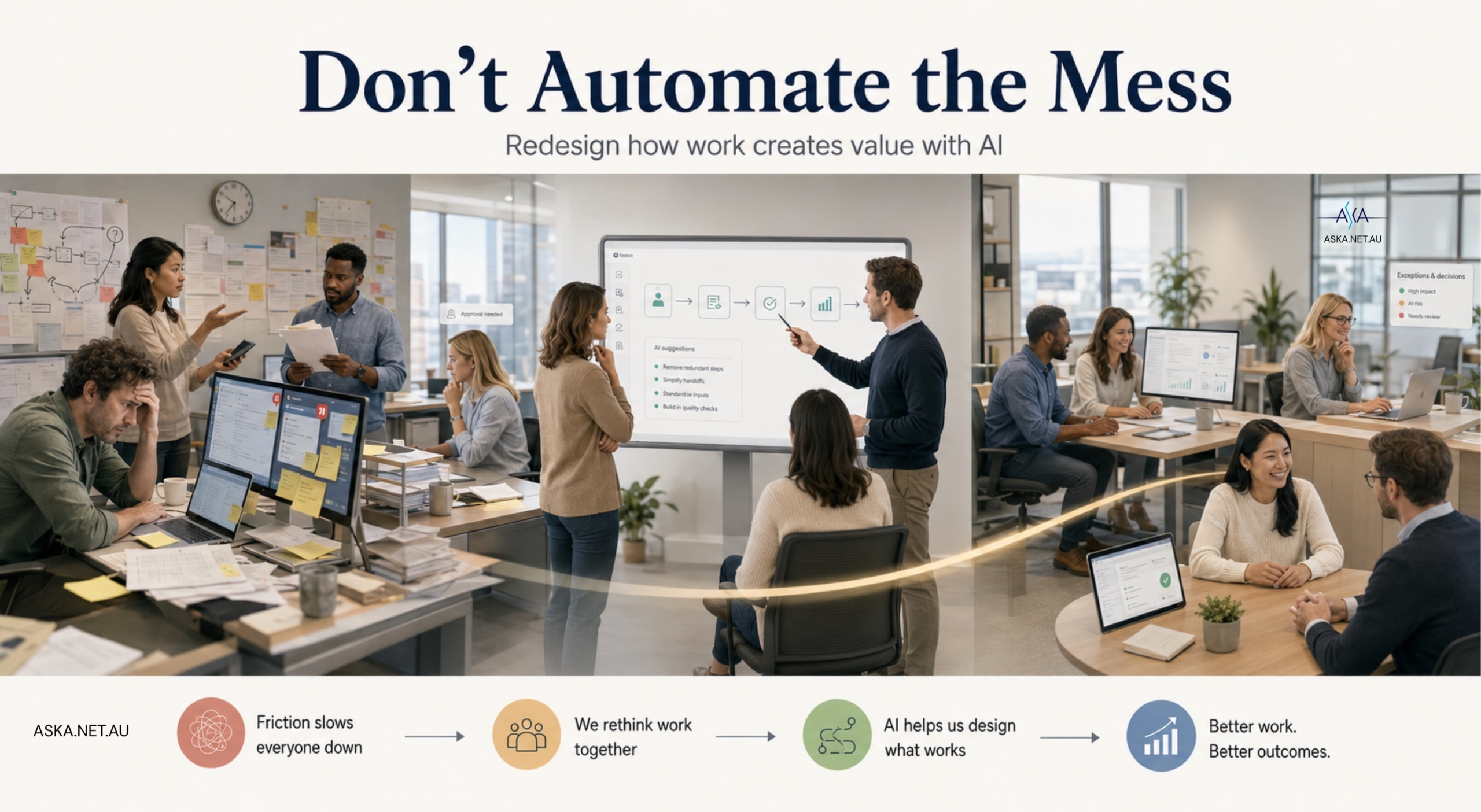
Don’t Automate the Mess: Redesign Work for the AI Era
Why organisations should redesign workflows before applying AI automation — start with the outcome, find the constraint, then decide what to eliminate, simplify, augment, automate or orchestrate.
Key Insight
— the six-question framework this essay builds toward. Grab it now, or read on and find it again at the end.
Artificial intelligence gives organisations a powerful new capability: the ability to interpret information, generate content, synthesise knowledge, predict outcomes, recommend actions and increasingly coordinate work.
The temptation is understandable: find an inefficient process, add AI, automate what can be automated and claim the time saved.
The problem is that many organisational workflows were never deliberately designed. They accumulated over time.
An approval step was added after a failure. A spreadsheet appeared because two systems did not talk to each other. Staff began copying information between applications. Email became the coordination layer. A checklist compensated for missing data. Another team added a review step. Frontline employees developed workarounds because the formal process did not fit reality.
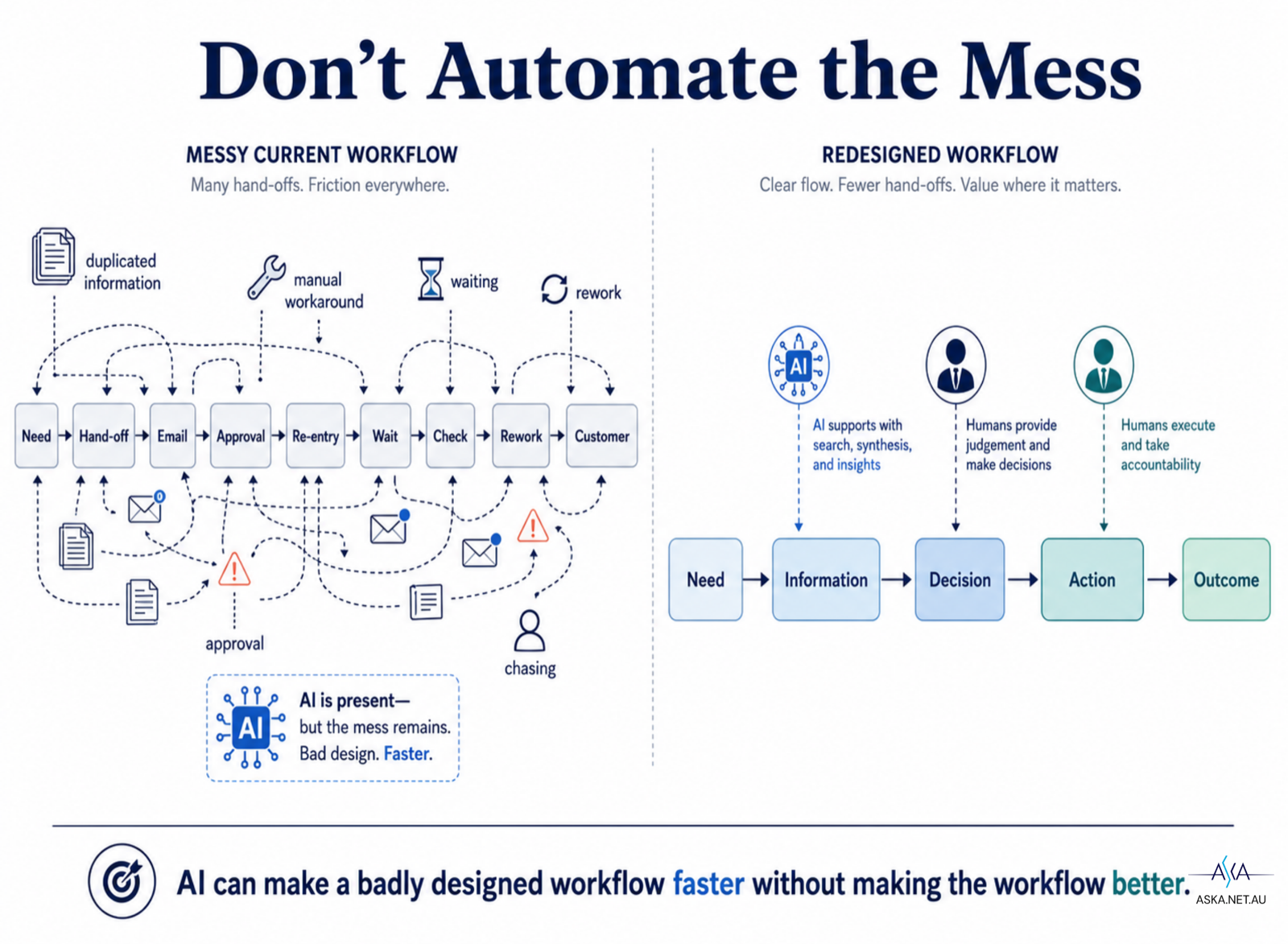
Years later, the workflow contains duplicate data entry, repeated checking, unnecessary hand-offs, waiting, rework and constant chasing.
Then AI arrives, and the instinctive response is: let’s automate it.
That may be exactly the wrong place to start.
Automating a poorly designed workflow often creates a faster version of the same problem. The organisation may process more, communicate more and generate more output without improving the outcome that matters.
The greater opportunity is not to automate yesterday’s work. It is to ask a more fundamental question:
Given what humans and AI can now do, how should the work be designed?
That is the shift leaders need to make: from automation as a technology project to workflow redesign as a management discipline.
AI has changed the design space of work
For decades, most organisational workflows rested on a reasonably stable division of labour.
People interpreted information, exercised judgement and communicated with other people. Software stored and moved information. Traditional automation performed predictable tasks based on predefined rules. When something unexpected happened, the process usually returned to a person.
AI changes those assumptions.
Modern AI systems can work with unstructured information. They can interpret documents, summarise conversations, compare alternatives, detect patterns, generate communications, monitor events and recommend actions. Increasingly, AI systems can also interact with software tools, initiate actions and coordinate multiple steps across workflows.
This does not mean everything should become autonomous. It means the set of capabilities available to workflow designers has expanded. And when the available capabilities change significantly, simply optimising the old process may no longer be enough.
The question shifts from:
What parts of this process can we automate?
to:
If we were designing this work today, knowing what humans and AI are each capable of, how would we create the outcome?
That shift — from automation to work redesign — is where much of the real value of AI may lie.
Start with the outcome, not the process
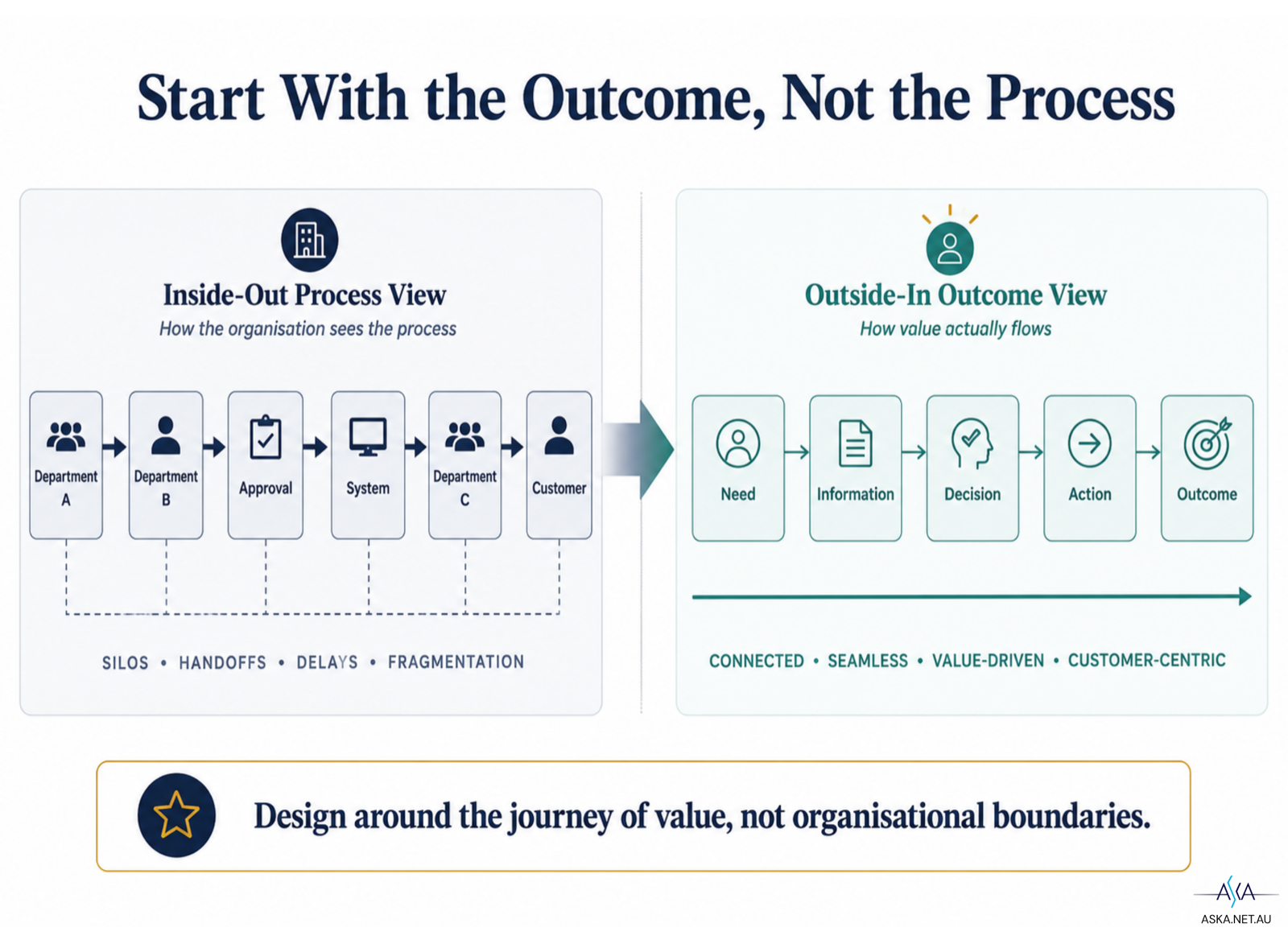
A workflow does not exist to perform tasks. It exists to create an outcome.
That distinction sounds obvious, but it changes the way we think about redesign.
Consider a specialist medical referral. A process description might say:
Receive referral → enter patient information → check documentation → seek missing information → clinical review → schedule appointment → notify patient.
But none of those tasks is the purpose of the workflow. The actual purpose may be:
Get the right patient to the right clinician, with the right information, safely and with as little unnecessary delay and uncertainty as possible.
Once that outcome becomes explicit, every existing step becomes open to question. Does information need to be re-entered? Does the same person need to check every case? Could missing information be detected earlier? Could routine coordination happen automatically? Could the clinician see only cases requiring clinical judgement? Could the patient receive proactive updates rather than calling to find out what is happening?
The same principle applies outside healthcare. Accounts payable does not exist to process invoices. It exists to ensure valid obligations are paid accurately, efficiently and with appropriate control. Customer service does not exist to close tickets. It exists to resolve customer needs effectively. Recruitment does not exist to move applicants through an applicant-tracking system. It exists to find and engage appropriate people for the organisation.
When organisations start with the existing process, they tend to optimise steps. When they start with the outcome, they can redesign the work.
Reveal the workflow that actually exists
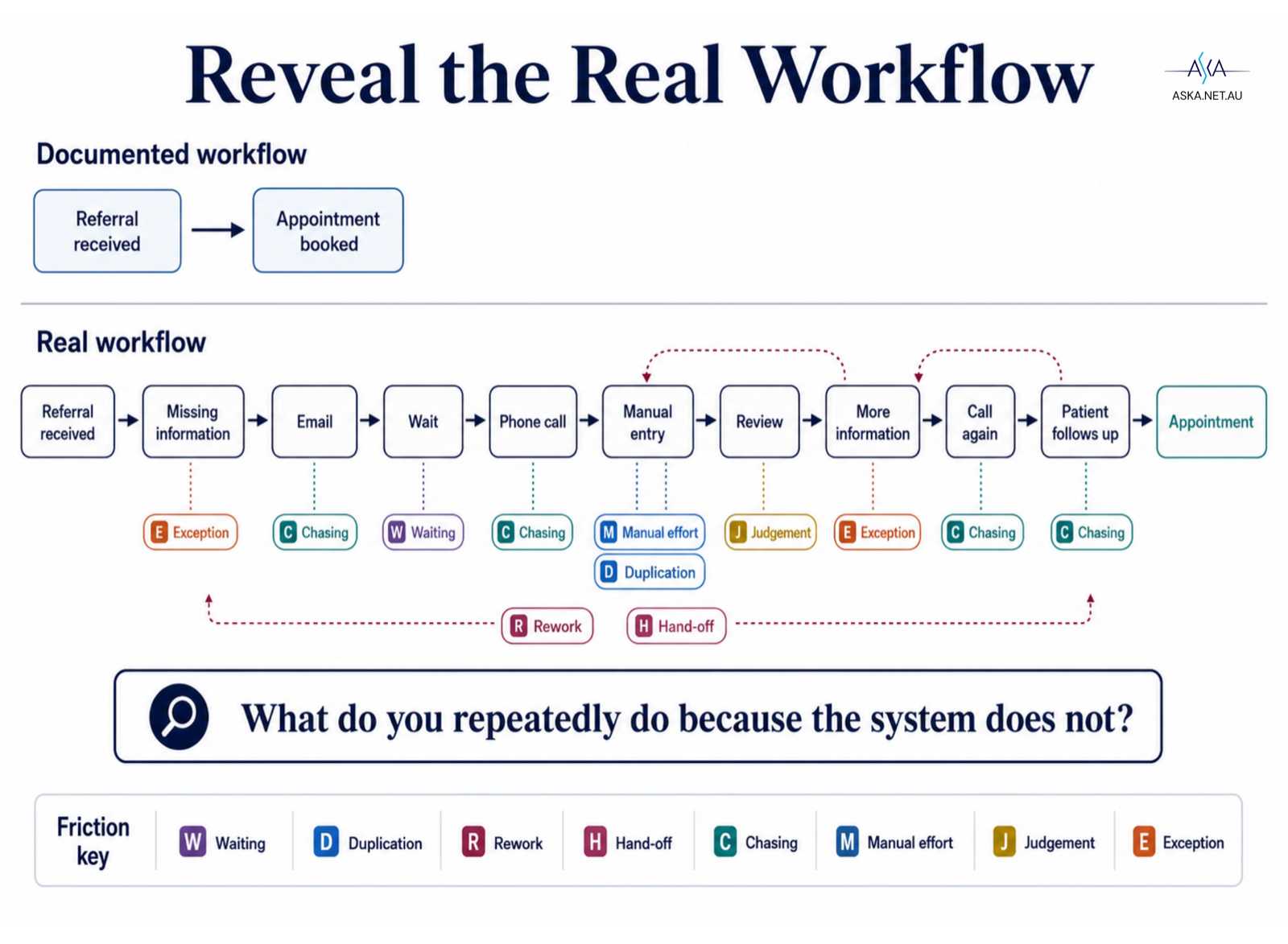
There is another problem. The documented process is often not the real process.
A procedure might show: Referral received → Appointment booked.
The lived workflow may actually be: Referral received → information missing → email sent → wait → phone call → information arrives → staff re-enter information → clinician reviews → more information required → staff call again → patient rings for an update → appointment eventually booked.
The difference between those two versions contains much of the redesign opportunity.
This is why frontline employees are indispensable to workflow redesign. They know which information is usually missing; which spreadsheet people really rely on; which approval causes delay; which field has to be entered twice; which customers call repeatedly; which rule everybody works around; and which part of the system nobody entirely trusts.
One of the most useful questions a leader can ask frontline staff is:
What do you repeatedly do because the system does not?
The answers are often revealing. “I remind everyone.” “I check my own spreadsheet.” “I copy the information into the other system.” “I ring people when something is missing.” “I compare the two reports because they never agree.” “I keep my own list so nothing gets lost.”
These are not merely signs of inefficiency. They are signals that capability is missing from the formal workflow.
Look for friction — but find the constraint
Once organisations begin examining real workflows, they often discover many problems at once: waiting, duplication, rework, manual entry, hand-offs, approvals, missing information, searching, chasing, exceptions.
The danger is to treat every problem as an equal priority. They rarely are.
Suppose AI reduces preparation of a document from three hours to 30 minutes. That sounds like a significant productivity gain. But the document then waits four days for an overloaded manager to approve it. The overall workflow barely improves.
This is the difference between local productivity and system performance. Making one activity dramatically faster does not necessarily make the journey from need to outcome faster.
A better set of questions is:
- Where does work wait longest?
- Where does work repeatedly return for correction?
- Where does information disappear or arrive incomplete?
- Where does a scarce person or resource become overloaded?
- What most prevents the intended outcome?
The goal is not to make every task marginally more efficient. It is to identify the constraint that most limits the flow of value through the system.
Redesign before you automate
Once the outcome, real workflow and constraint are understood, AI becomes far more useful. A practical sequence is:
This is not a maturity ladder. Not every activity should move through all five stages. It is a decision sequence. Before automating something, first ask whether it should exist.
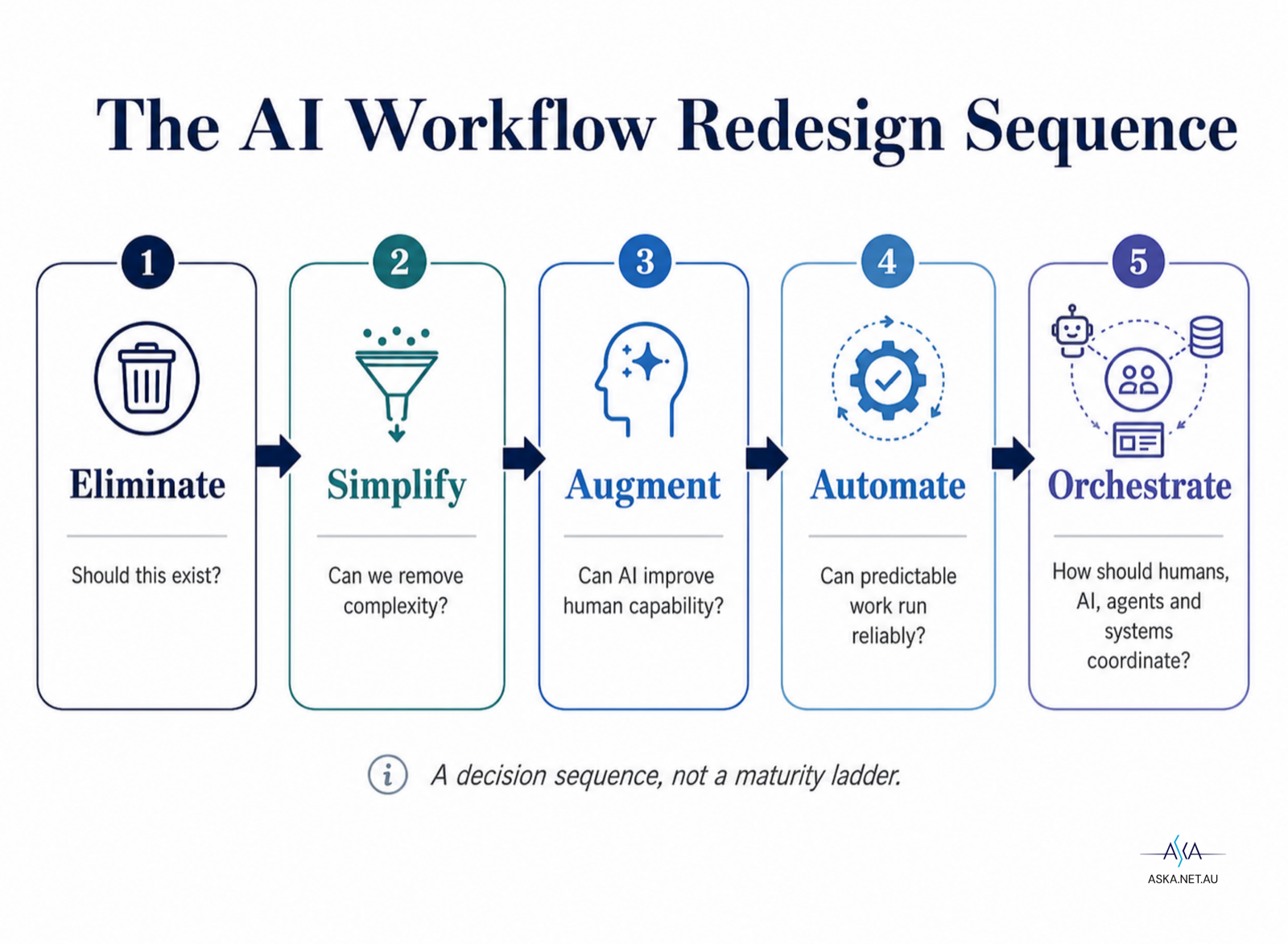
1. Eliminate. Does this activity need to happen at all? Some work survives because of historical decisions, outdated system limitations or habits. A report may still be produced even though nobody uses it. Two teams may verify the same information. An approval may remain because of a problem that was solved years ago. AI can make an unnecessary task extremely efficient. It remains unnecessary. Sometimes the highest-value automation is simply: stop doing the work.
2. Simplify. If the work is necessary, can the workflow be made simpler? Could information be collected once instead of three times? Could two hand-offs become one? Could every case stop requiring approval, with only exceptions reviewed? Could a decision happen earlier? Could customers or patients provide information directly? Complexity is expensive to automate and even more expensive to maintain.
3. Augment. Where can AI make human work better? This is especially important where judgement still matters. AI may find relevant information, summarise history, compare alternatives, detect anomalies, draft communications, identify missing information, highlight patterns, or prepare a recommendation. The human remains responsible for the work, but reaches the important part of it with greater capability.
4. Automate. Where can work happen reliably without repeated human intervention? Good candidates generally have predictable inputs, clear boundaries, reasonably stable conditions, measurable outcomes and manageable exceptions. Automation can remove enormous administrative burden. But the more uncertainty, judgement or consequence involved, the more carefully organisations should design the human role.
5. Orchestrate. The emerging opportunity goes beyond automating isolated tasks. Orchestration asks: how should humans, AI systems, agents, information and software work together across the complete journey? Instead of automating one task, the organisation redesigns the flow from need to outcome. Information may trigger an AI assessment. Missing data may be gathered automatically. Routine cases may progress. Exceptions may be identified. A human may enter only when judgement, accountability or negotiation is required. Communication may occur automatically at the appropriate point.
The objective is not autonomous AI for its own sake. The objective is coordinated flow.
Four patterns of AI-enabled work
It is useful to distinguish how deeply AI has entered the workflow.
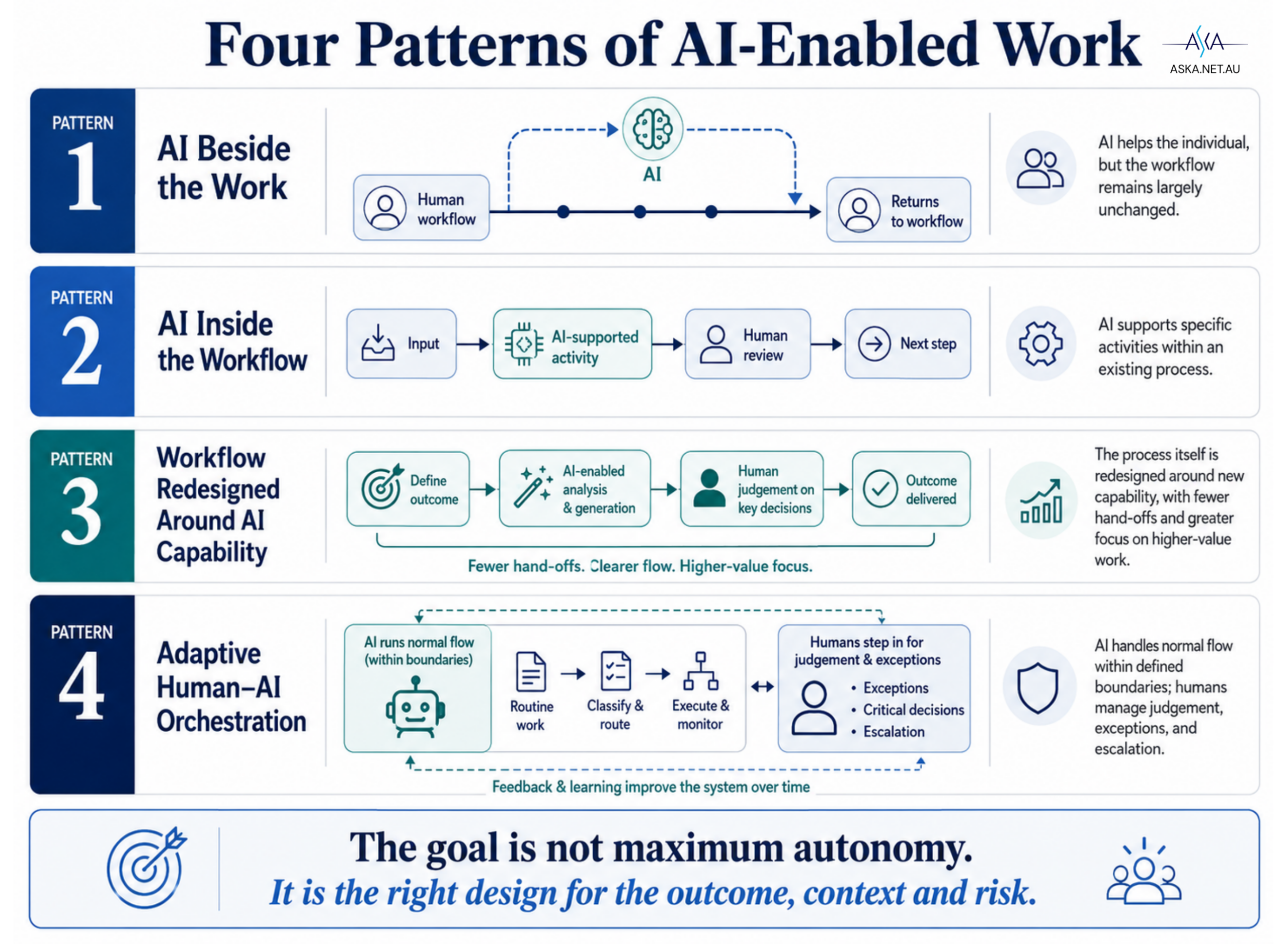
Pattern 1: AI beside the work. A professional performs the existing workflow, temporarily leaves it to use an AI tool, then brings the output back — “draft this report.” This can generate meaningful individual productivity. But the workflow itself barely changes.
Pattern 2: AI inside the workflow. AI becomes part of a particular process step. An incoming document may be automatically extracted, structured and summarised before a human reviews it. Now the workflow changes, but its overall architecture may remain familiar.
Pattern 3: Workflow redesigned around AI capability. The organisation asks: if this capability had always existed, would we design the workflow this way? Perhaps routine cases no longer require manual coordination. Information is checked at entry. A decision occurs earlier. Professionals focus on exceptions rather than processing every case. This is where AI begins to change the architecture of work.
Pattern 4: Adaptive human–AI orchestration. At a more advanced level, workflows can adapt according to context. Routine activity progresses automatically. AI operates within defined boundaries. Human judgement is engaged when required. Exceptions trigger different pathways. The system learns from outcomes.
But the goal is not to reach Pattern 4 everywhere. The right design depends on the outcome, context, consequence and risk. Maximum autonomy is not the same as maximum value.
Design complementary capability
The debate about AI and work is often framed as: human or AI? That is rarely the most useful design question.
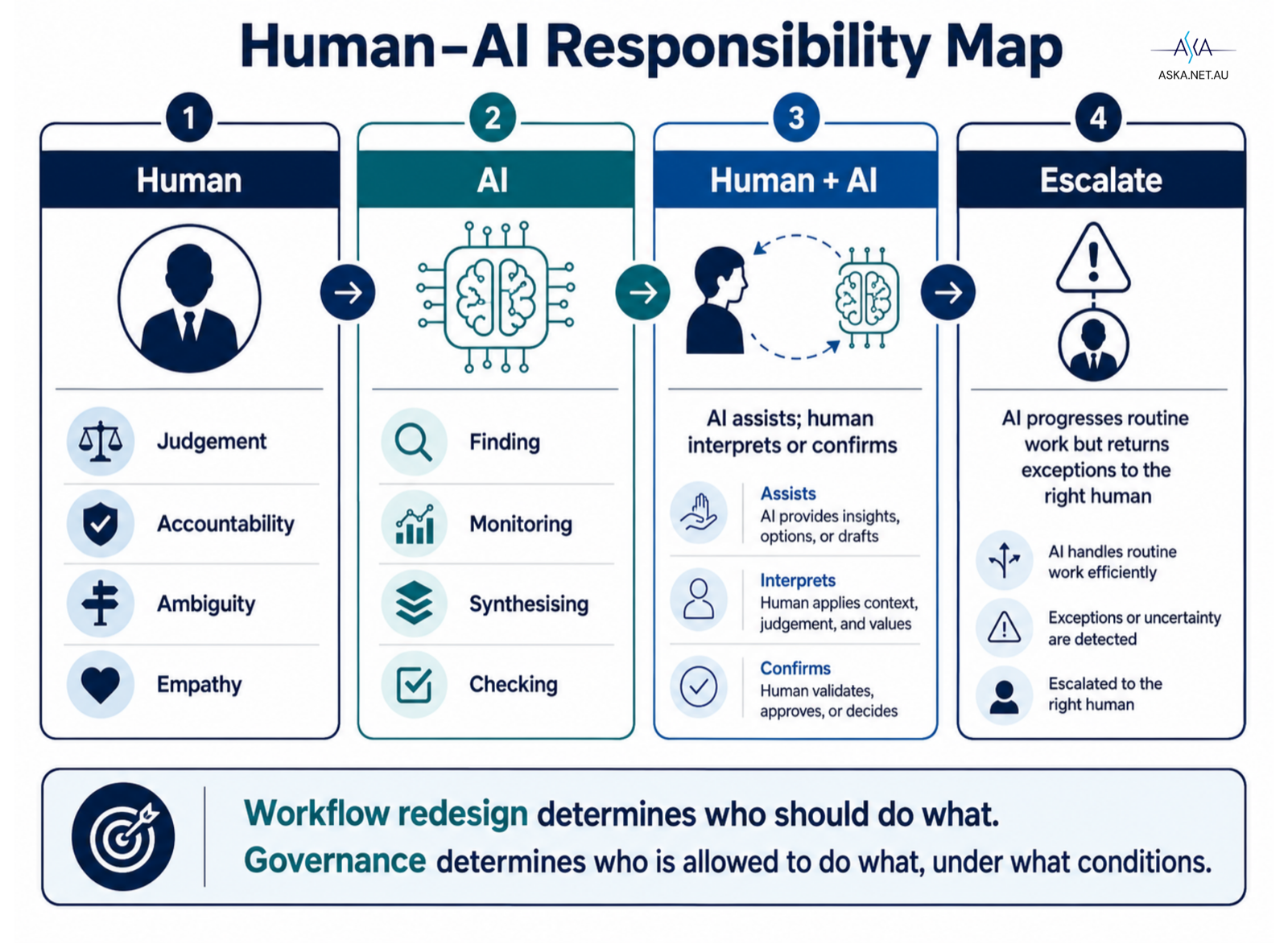
The better questions are: What should humans do? What should AI do? What should they do together? When should control return to a human?
Human contribution is often especially important where work involves accountability, empathy, ambiguous circumstances, competing priorities, values, negotiation, relationships, contextual judgement and unexpected situations.
AI may add particular value where work involves finding, monitoring, matching, checking, synthesis, drafting, pattern detection, prediction and coordination.
These are not absolute boundaries. AI capabilities will continue to evolve, and the right allocation will depend on the particular context. The principle is more durable:
Design the workflow around complementary capability rather than assuming either humans or AI should perform everything they technically can.
Design for exceptions, not just the happy path
Traditional process maps often describe what happens when everything works. Real organisations spend an enormous amount of time dealing with what happens when it does not. Information is incomplete. A customer’s situation is unusual. A supplier fails. A patient deteriorates. Two policies conflict. A system is unavailable. A recommendation lacks confidence. A decision carries unusually high consequences.
An effective AI-enabled workflow therefore needs four paths:
Ask: What can flow routinely? Which cases can progress reliably? What variation can AI handle? Where can AI adapt within known boundaries? What becomes an exception? When does the normal logic no longer apply? What triggers escalation? When must a specific person or team take control?
This is particularly important as AI begins to move from generating information to taking actions.
Exceptions are not outside the workflow. They are part of the workflow — and should be designed accordingly.
The real target is flow, not automation
At its simplest, an organisational workflow moves something through five stages:
Value is often lost in the spaces between those stages. The information does not arrive. The decision waits. The action goes to the wrong person. Responsibility becomes unclear. The customer waits while departments coordinate internally. The same information is requested twice. People make decisions that add little value because the process requires them.
Workflow redesign should therefore seek to reduce waiting, duplication, rework, searching, chasing, unnecessary hand-offs, low-value decisions and unnecessary approvals — and increase quality, responsiveness, reliability, visibility, coordination, capacity, and the amount of human attention available for work that genuinely requires it.
AI may be one of the most important tools available to achieve this. But AI is not the objective. Better flow is the objective.
Beware the productivity trap
This brings us to one of the most important mistakes organisations can make with AI.
Suppose AI makes a task significantly faster. That creates capacity. But what happens to that capacity? There are two very different paths.
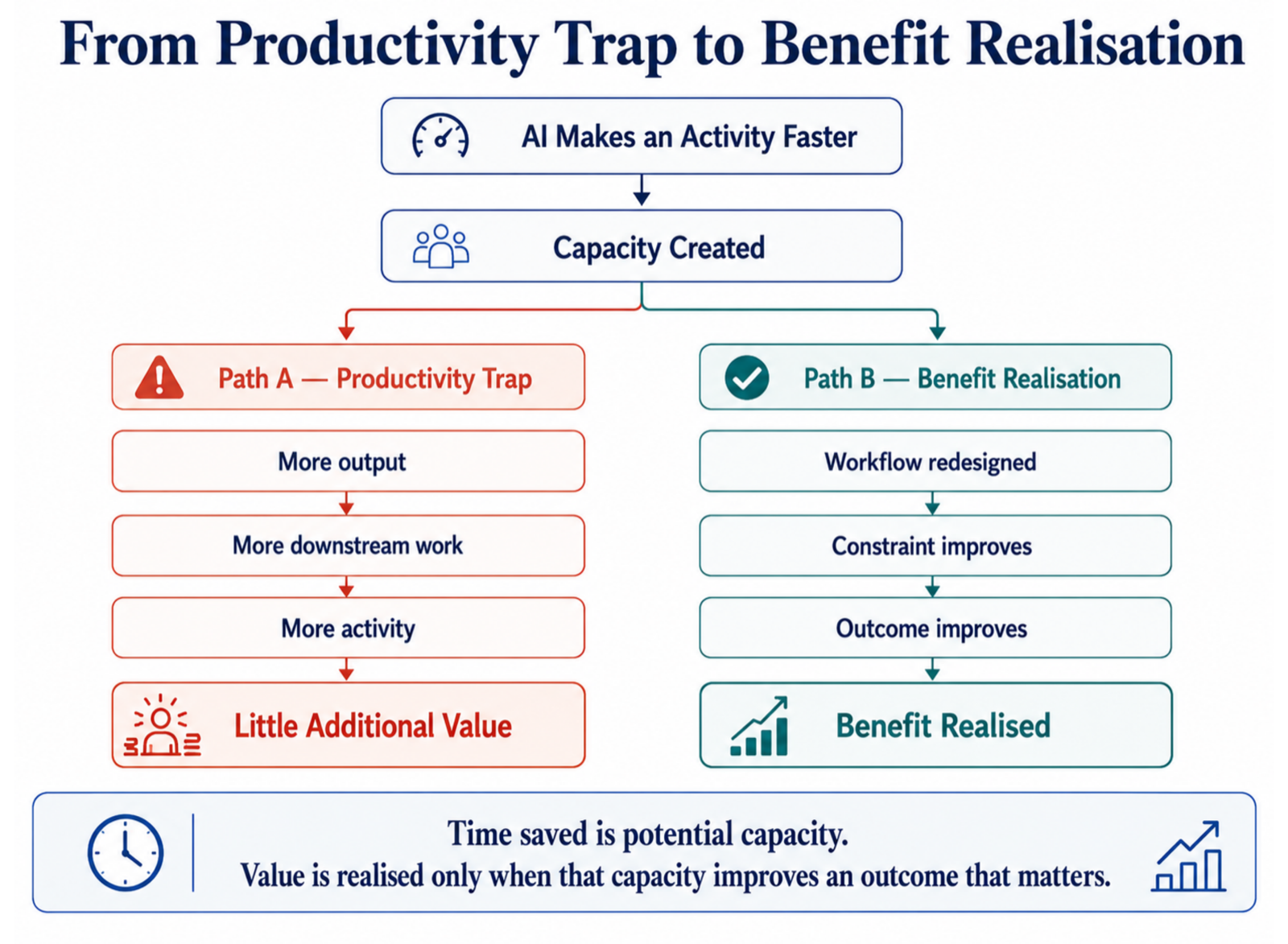
Path A: the productivity trap. AI makes a task faster. Capacity is created. Employees produce more output. That output creates more work elsewhere. The organisation becomes busier without significantly improving the outcome.
A marketing team generates more content — someone must review it. A consulting team creates more analyses — executives receive more documents to read. Developers generate more code — someone must test and maintain it. Professionals send more communication — everyone else receives more information.
The organisation has become more productive by one measure. It may not have become more effective.
Path B: benefit realisation. AI makes a task faster. Capacity is created. The workflow is redesigned. A genuine constraint improves. The outcome improves. A measurable benefit is realised.
The distinction is critical. Time saved is potential capacity. It is not automatically value. The management question is: what changed because the time was saved?
Follow the value all the way through
A useful AI initiative should be able to describe a clear chain:
Imagine AI can extract and summarise incoming information. That is a capability. If the AI simply produces summaries that nobody uses differently, the value may be limited.
But suppose the workflow changes. Professionals no longer spend time extracting basic information. They review prepared information and focus on exceptions. That may lead to faster decisions. Faster decisions may reduce overall cycle time. Reduced cycle time may increase capacity, improve customer experience or lower operating costs. Now there is a value chain.
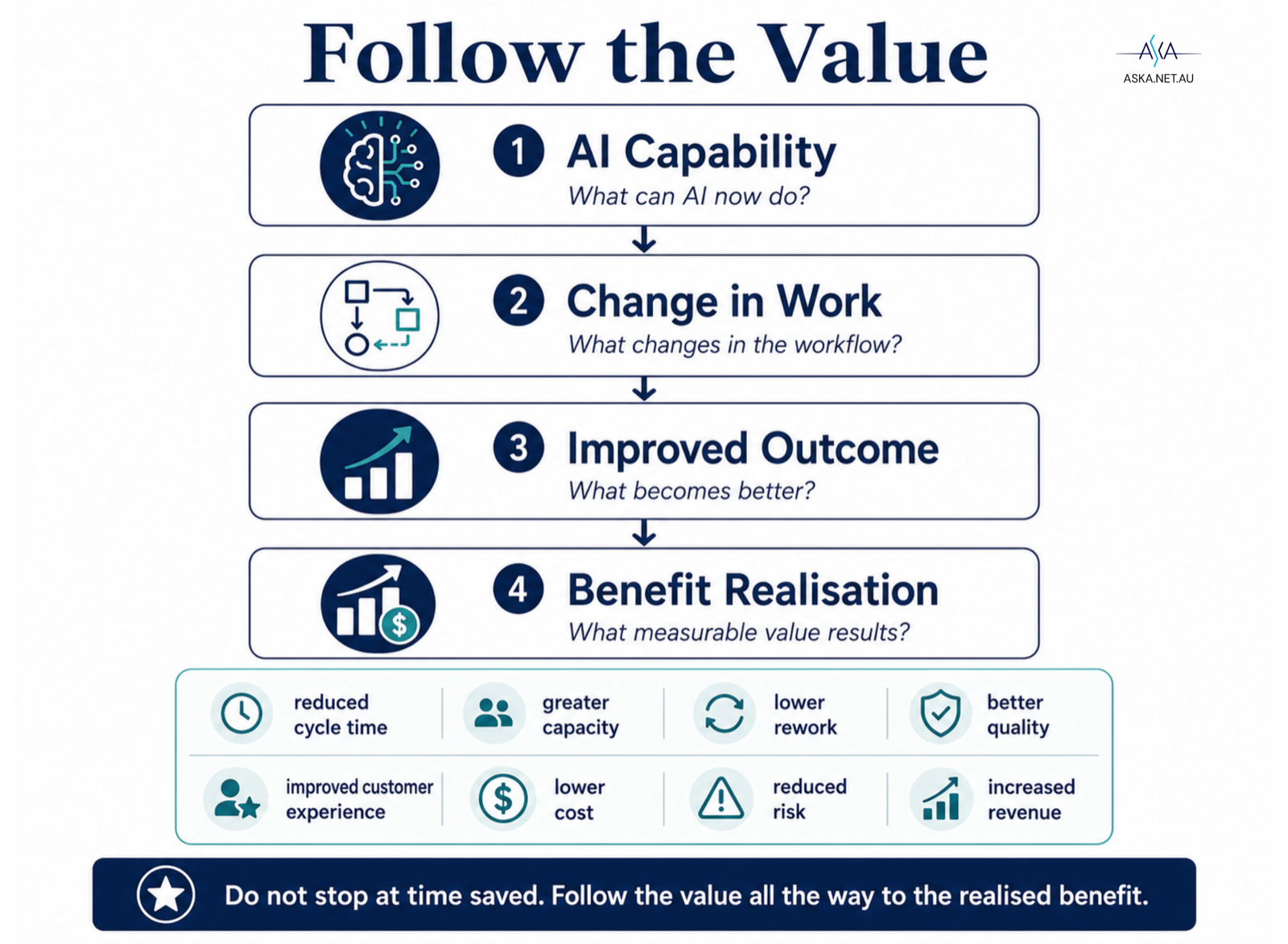
This is why organisations should measure more than hours saved, tasks automated, AI licences, usage rates or prompt volume. Those measures tell us something about adoption. They do not tell us whether the workflow became better.
Also measure cycle time, throughput, quality, errors, rework, customer effort, employee effort, cost, revenue, risk, and ultimately the outcome the workflow exists to create.
Do not stop at: did the AI work? Ask: did the work improve? And then: did that improvement create a benefit that mattered?
A practical way to redesign one workflow
Organisations do not need to redesign everything at once. A better starting point is one workflow that frustrates employees, repeatedly causes delays, consumes significant effort, creates poor customer experience, or appears to contain a meaningful constraint.
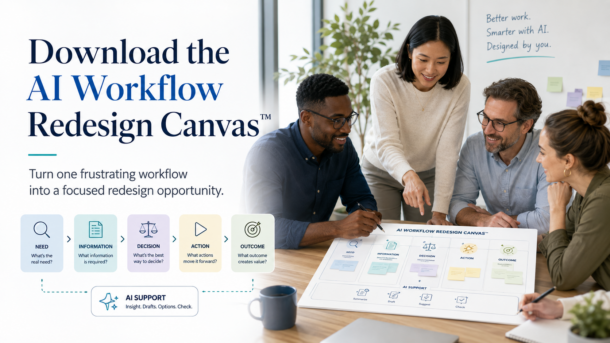
The AI Workflow Redesign Canvas™ uses six questions:
- Outcome. What are we actually trying to achieve? Define the outcome from the perspective of the person or organisation receiving the value.
- Reality. How does the work really happen today? Map the lived workflow — not the formal process. Look for waiting, duplication, rework, hand-offs, chasing, manual effort, judgement and exceptions.
- Constraint. What most limits the outcome? Identify the most important bottleneck rather than trying to improve everything.
- Redesign. Ask whether important activities should be eliminated, simplified, augmented, automated or orchestrated.
- Responsibility. For the redesigned workflow, decide: what should humans do? What should AI do? What should they do together? What should trigger escalation?
- Benefit. What meaningful outcome should improve, and how will we know? Choose one or two measures. Then ask: where will the capacity created by AI go?
That final question is essential if organisations want to escape the productivity trap.
The aim is not a perfect future-state process diagram. The aim is one better workflow, one useful experiment and evidence that the change improves the outcome.
Start small — but redesign seriously
AI is evolving too quickly for organisations to wait for perfect certainty before redesigning work. Nor should leaders launch enterprise-wide transformations before they understand what works.
A more practical approach is:
Then learn. Adjust. Expand.
This approach creates something more valuable than automation. It creates organisational learning about how humans and AI should work together.
Workflow redesign eventually becomes a governance question
There is one final consequence of redesigning work around AI.
As AI moves deeper into workflows, the organisation must decide how much authority the technology should have. Can AI draft? Recommend? Prioritise? Initiate? Communicate externally? Modify a record? Approve? Spend money? Decide? Act?
These are not merely technology questions. They are questions of decision rights. The fact that an AI system can perform an action does not tell us whether it should be permitted to perform it.
The answer may depend on risk, context, confidence, consequence, reversibility, and the availability of appropriate human oversight.
And then there is the exception question. What happens when AI is uncertain? When information is missing? When circumstances fall outside its competence? When goals conflict? When an action may have serious consequences? Who takes control? Who remains accountable? How is failure detected? How is the action contained?
At that point, workflow design and governance can no longer be separated.
Workflow redesign determines what AI could do. Governance determines what AI should be allowed to do — and under what conditions.
Good governance should therefore not sit outside the workflow as a policy document. Increasingly, it will need to be designed into the work itself.
Don’t automate the work as it exists
AI gives organisations a rare opportunity to rethink work from first principles. But much of that opportunity will be lost if we simply use intelligent technology to preserve yesterday’s processes.
Before automating, understand the outcome. Before accelerating, reveal how the work actually happens. Before fixing every inefficiency, find the constraint. Before introducing sophisticated AI, eliminate unnecessary work and simplify what remains. Before handing activities to AI, deliberately design the relationship between human and machine capability. Before declaring success, follow the value from AI capability through changed work to a meaningful organisational outcome. And as AI begins to participate more deeply in workflows, make boundaries, escalation and accountability part of the design — not an afterthought.
The central management question is no longer: where can we put AI?
It is: given the capabilities now available, what is the best way to create the outcome we need?
That is a much more demanding question. It is also where the real opportunity lies.
Conclusion: redesign work around the outcome you need
Do not automate the work as it exists. Redesign the work around the outcome you need.
Put the idea into practice
To make this practical, choose one workflow that frustrates you or your team and work through the AI Workflow Redesign Canvas™:
and use it to articulate your thinking clearly — moving from the outcome you want, through the reality of today’s work, to the constraint, redesign choices, responsibilities and benefits that matter most.
Then turn the diagnosis into one focused 30-day experiment: one workflow, one constraint, one redesign, one experiment, one benefit.
The objective is not simply to find something AI can automate. It is to discover a better way for work to create value.