
AI Readiness Is a Judgement, Not a Badge
AI readiness is not a badge earned through adoption, training or pilots. It is a situated management judgement about a specific AI use, and a capability the organisation must be able to renew.
Key Insight
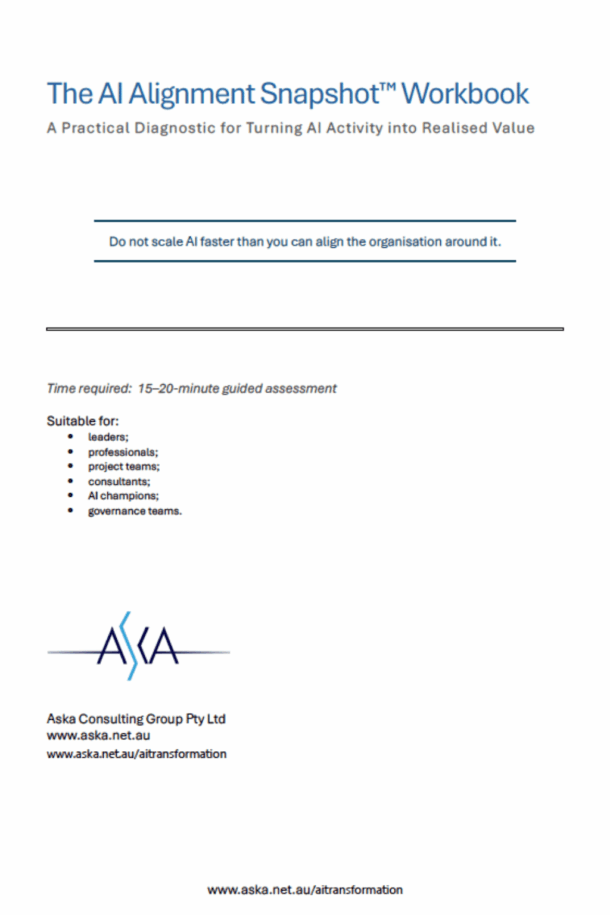
It is the exercise this essay builds toward: name one real AI use, then work through purpose, context, consequence, evidence, uncertainty and renewal triggers. Take it now, or find it again at the end.
“Are we AI-ready?”
It is a clean question. It sounds like the question a board should ask before approving investment, a chief executive should ask before scaling deployment, or a manager should ask before letting a team rely on a new tool. It is also dangerously incomplete.
Consider a simple illustration. In one part of the organisation, AI summarises internal meeting notes for human review. The output is checked before it is shared. The consequence of error is low, the workflow is familiar, and the people involved understand the context well enough to correct mistakes. Now take the same organisation, in the same broad AI environment, considering an AI agent that can change a customer record, trigger a follow-up action or start an operational step. The technology may be just as impressive and the vendor may be the same. The organisation may already have training, governance principles and enthusiastic users. But the readiness question has changed.
The issue is not whether the organisation owns AI. It is not whether people are experimenting. It is not even whether one use has gone well. The issue is whether the organisation is prepared for this use, in this workflow, with these consequences, under these conditions.
Adoption is visible and easy to count. Organisational capability is harder to see, because it sits in workflows, human judgement, governance, evidence, learning routines and the value the work exists to serve. That gap between what is countable and what matters is where readiness claims tend to go wrong.
So the first better question is blunt: ready for what?
AI readiness is situated
AI readiness is not a universal organisational state. It is situated.
An organisation may be ready for a bounded internal productivity use and unready for a customer-facing, clinical, legal, financial or operationally embedded one. It may be ready to let AI draft a summary for human review and unready to let AI act on its behalf. It may be ready in one workflow and unready in another, even when the same broad technology is involved.
The same organisation can be ready for one AI use and unready for another.
That does not make readiness vague. It makes it practical. A useful readiness judgement has to specify purpose, context, consequence level, evidence and point in time. Without those elements, “AI-ready” becomes a slogan that hides radically different risk and capability requirements.
The stronger management question is:
Ready for what purpose, in what context, at what consequence level, with what evidence, at this point in time, and can we keep that readiness current?
Those are not five readiness dimensions to be scored. They are the parts of a better question. They force the organisation to name the work, the people affected, the value being served, the seriousness of getting it wrong, the evidence that would justify proceeding and the conditions under which the answer holds.
Adoption, maturity and readiness answer different questions
One reason readiness becomes confused is that it is often blended with adoption or maturity.
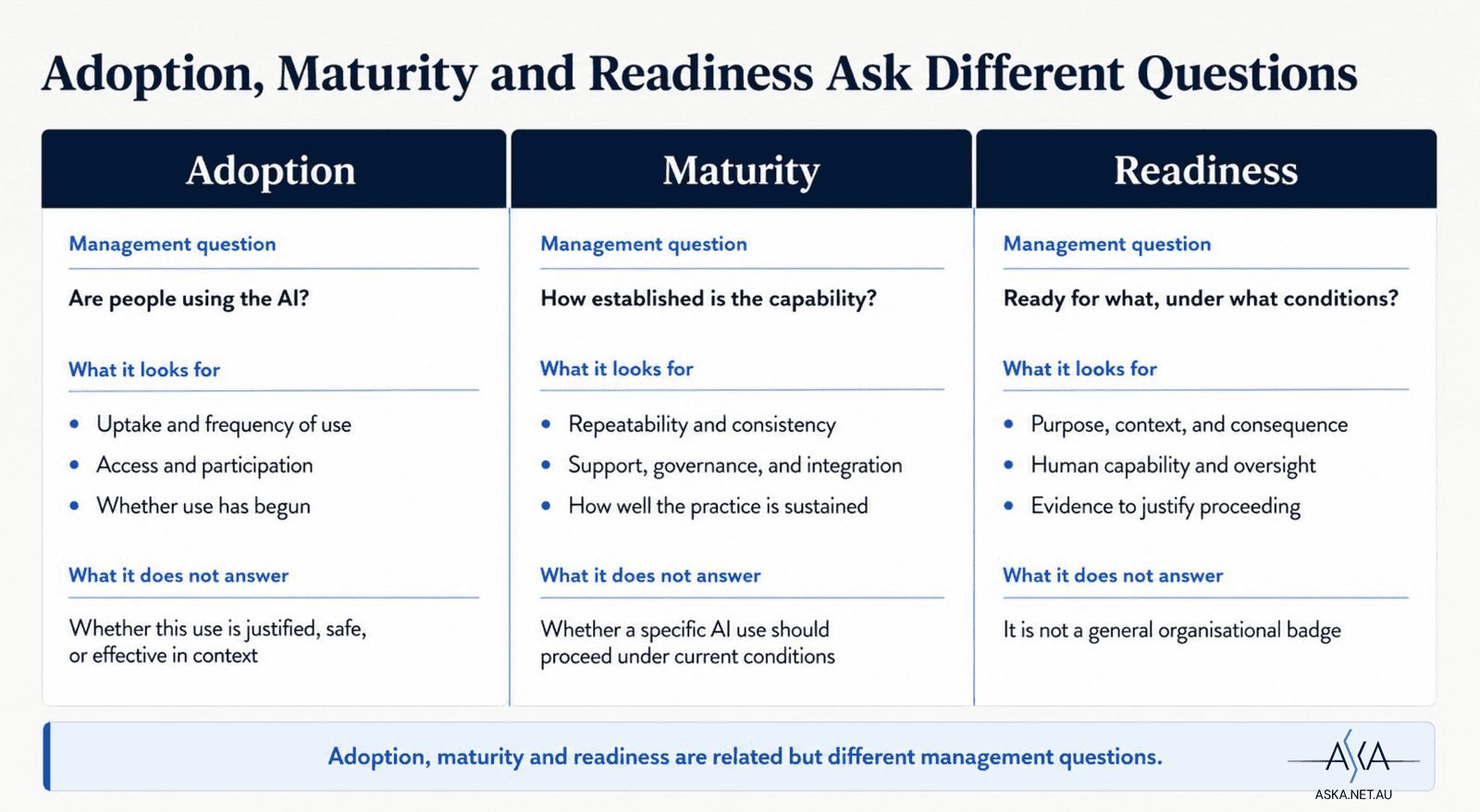
Adoption asks: are we using AI? That question is useful. It reveals exposure, experimentation, access and momentum. But adoption does not tell you whether a particular AI-enabled change is responsible, effective or worth scaling. A high-usage tool can still produce weak work, create hidden rework or shift burden onto the people the organisation is meant to serve.
Maturity asks: what capability have we developed, and how might it progress? That question is also useful. Maturity thinking helps organisations baseline capability, identify gaps, build roadmaps, prioritise investment and create a shared language for improvement. It becomes weak only when it is treated as a substitute for a specific readiness judgement. A generally mature organisation can still be unready for a high-consequence AI use. A less mature organisation may be ready enough for a bounded, low-consequence use if the purpose, controls, evidence and human role are clear.
Readiness asks: are we prepared for this purpose and context?
Adoption, maturity and readiness are different management questions. They are not stages. The point is not to graduate from adoption to maturity to readiness. The point is to use the right question for the decision in front of you. Done well, the distinction keeps leaders from mistaking visible AI activity for justified AI action.
A successful pilot is not organisational capability
The same discipline applies to pilots.
A successful pilot is useful evidence. It may show that an AI use is technically feasible, useful to a team, acceptable to users or effective under bounded conditions. A good pilot teaches the organisation something.
But a successful pilot does not automatically prove repeatable organisational capability.
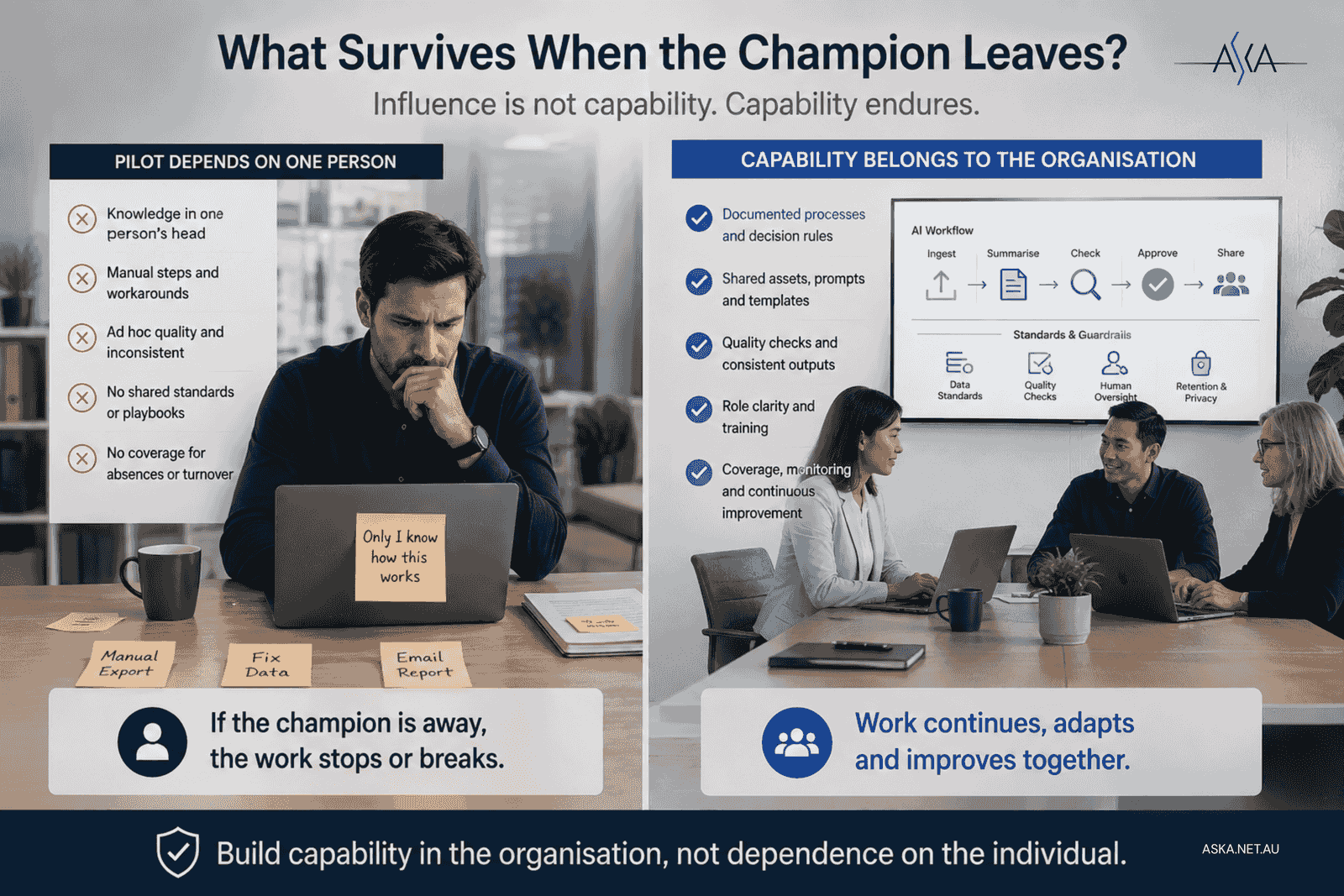
Many pilots work because they are protected. They rely on an exceptional champion, unusual support from a central team, hand-picked users, informal escalation, extra attention, a narrow workflow, or a short period when everyone is watching closely. Those conditions do not invalidate the pilot. They define what the pilot actually proved.
The more demanding question is: if the original champion left tomorrow, could the organisation still do this well?
If the answer is no, the organisation may have evidence of local success without evidence of organisational capability. The pilot showed that one team, in one context, with one set of supports, could make AI useful. The next question is what the pilot taught the organisation to do repeatedly. Alignment, workflow redesign, governance, responsibility, decision rights, evidence and learning all shape whether AI creates value. Readiness depends on whether the organisation can perform those disciplines again, across real AI uses, without depending on luck, heroics or protected conditions.
Capability must serve value
Capability only matters if it serves something worth serving. Served value means meaningful improvement for the people, groups or legitimate purpose the work exists to serve.
The practical question is: who is meant to be better off if this AI use succeeds, and how would we know?
That beneficiary may be a customer, patient, client, employee, professional, team, community or legitimate organisational purpose. The answer does not have to reduce everything to financial return. Internal efficiency can be valuable when it improves reliability, frees capacity, reduces error or strengthens the work. But internal activity is not automatically served value.
More usage is not necessarily more value. Faster work is not necessarily better work. Lower cost can be real improvement, but it can also mask burden shifted onto customers, patients, employees or downstream teams.
AI capability has to change work, improve outcomes and produce a realised benefit. The readiness judgement therefore has to keep the value question close. If the organisation cannot say who should be better off and how it would know, it is not making a readiness judgement. It is making an activity claim.
The humans are part of the readiness judgement
AI readiness is often discussed as though the technology is the main object of preparation. In most consequential uses, the human role is part of the readiness condition.
The question is: what does a person need to be able to notice, judge or do for this AI use to remain responsible and effective?
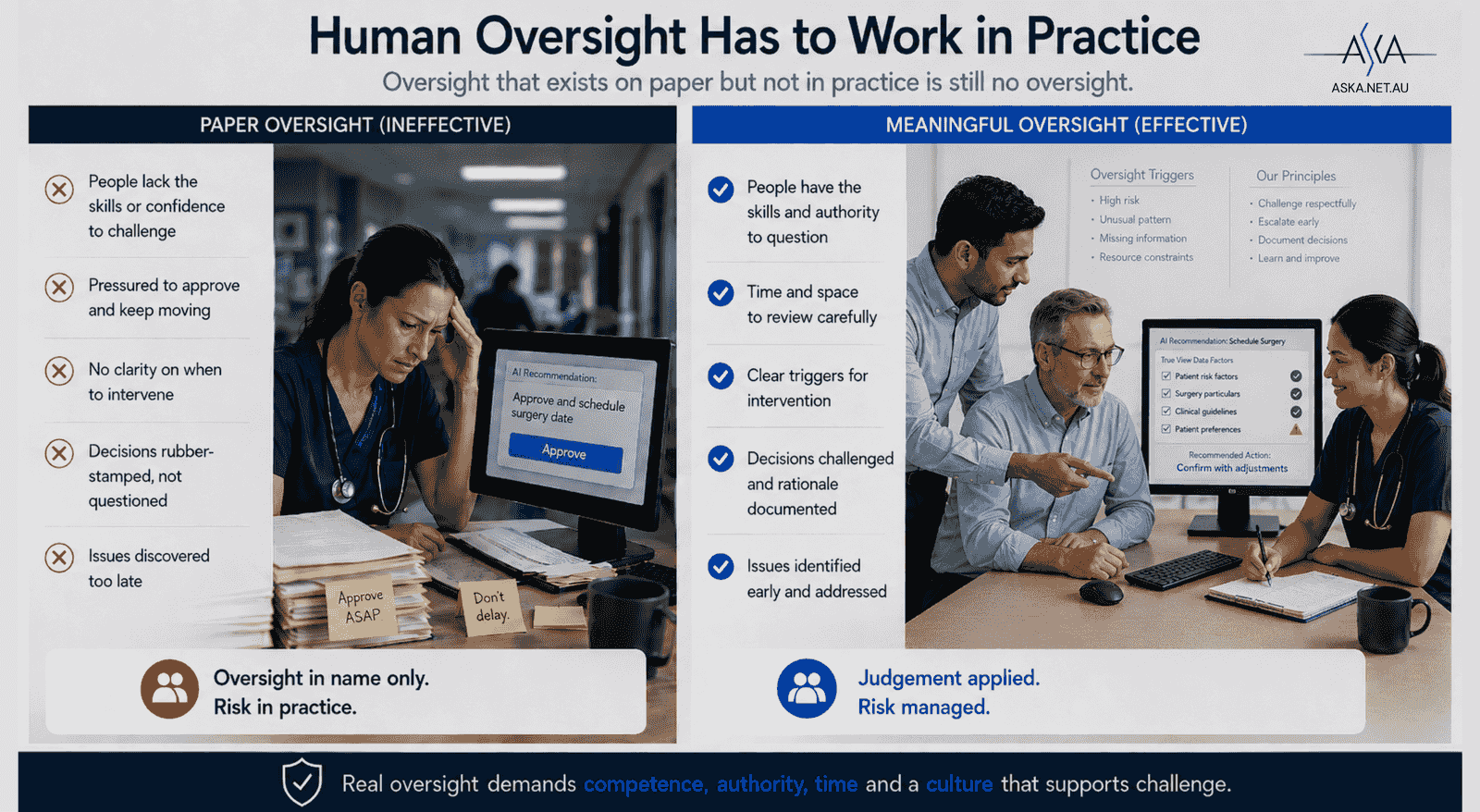
Depending on the work, people may need to frame the task, check source material, recognise exceptions, challenge outputs, escalate uncertainty, explain a decision, preserve a relationship, override a recommendation, or know when an AI output should not be trusted. In some settings the human is not a reviewer at the end. The human is part of the system that makes the AI use responsible.
Training supports readiness. It does not prove readiness. Training completion may show exposure, build confidence and be necessary for basic use. But it does not, by itself, show that people can exercise judgement in the real workflow, under time pressure, with incomplete information, competing incentives, or a plausible AI output that happens to be wrong. Human-factors and automation-bias research is consistent on this point: oversight has to be demonstrated in behaviour, not assumed from a role on an organisation chart.
Two examples show the range. In Moffatt v Air Canada (2024), the airline’s website chatbot gave a customer inaccurate information about a bereavement fare. The British Columbia Civil Resolution Tribunal held the airline liable for negligent misrepresentation and rejected the argument that the chatbot was a separate entity responsible for its own words. When an organisation lets AI speak or act on its behalf, accountability does not move to the tool, so the human and organisational role around it is part of what has to be ready. Morgan Stanley’s adviser tooling shows the constructive version. Its AI @ Morgan Stanley Debrief generates meeting notes and drafts a follow-up email, but the adviser decides whether that email is sent, while an internal meeting note can be saved without individual sign-off. The human role was designed task by task rather than asserted in general.
For readiness, the lesson is simple: if the human role matters to safe and effective performance, then human capability is evidence, not decoration. The organisation has to be able to define meaningful human roles, allocate authority deliberately, support judgement, create real escalation routes, and make oversight possible in the work as it is actually done.
Readiness must be evidenced
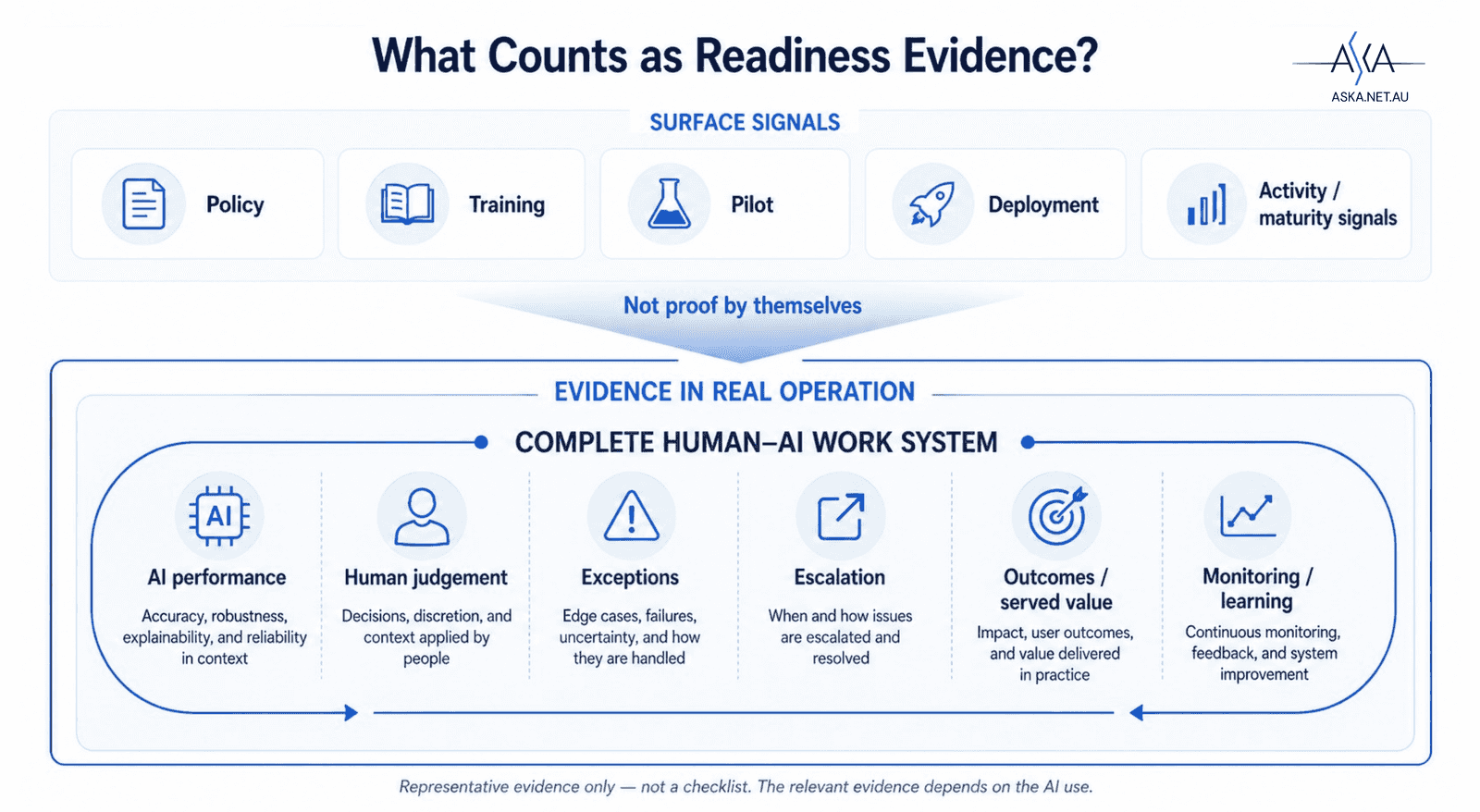
This is the hinge of the argument.
Readiness is not established by declaration. It is not established by a policy being approved, a governance committee existing, staff completing training, a pilot looking promising, or a maturity score moving upward. Those may be useful signals. None of them is sufficient on its own.
The central evidence question is: what evidence would justify saying we are ready enough for this use, under these conditions?
The answer has to distinguish two claims. The first is that the AI component performs. This may require evidence about accuracy, reliability, robustness, security, source grounding, bias, failure modes, drift, explainability or behaviour under expected use. For a low-consequence drafting aid, the evidence may be light. For an AI use that affects customers, patients, legal obligations, financial outcomes or operational action, the evidence burden rises.
The second claim is that the complete human–AI work system performs responsibly and effectively. That is a different and often harder claim. It asks whether the AI component works inside the actual workflow: whether people understand their role, whether hand-offs work, whether exceptions are detected, whether escalation is real, whether boundaries hold, whether data and source quality are sufficient, whether monitoring notices deterioration, whether the work creates served value, and whether learning changes future decisions.
Evidence should be proportionate, not exhaustive. Proportionate evidence is evidence strong enough for the decision being made. It varies with context, consequence, novelty, reversibility, scale, beneficiary exposure and uncertainty. A small internal trial does not need the assurance appropriate to a customer-facing agent or a clinical decision-support tool. But low burden is not the same as no evidence. Even a bounded use should be clear about what it is relying on and what it does not yet know.
This is where many AI programmes get stuck between two weak extremes. One is evidence theatre: long documents, dashboards and governance rituals that do not change decisions. The other is evidence avoidance: moving from excitement to rollout because the tool is available and the first demonstration looked good. The stronger position is decision-useful evidence. If the evidence does not change what the organisation will proceed with, constrain, redesign, monitor, scale or stop, it is probably not readiness evidence. It is reporting.
Established guidance points the same way. Frameworks such as ISO/IEC 42001 and the NIST AI Risk Management Framework are built around evidence, evaluation and operating context rather than technology claims alone, and the UK guidance on AI assurance makes the same case. Representative evidence might cover AI component performance, workflow performance, human judgement, exception handling, escalation, boundary reliability, served value, monitoring and learning. These are examples, not a checklist. The relevant evidence depends on the AI use.
A credible readiness judgement therefore says not only “we believe this will work”, but “here is what would justify that belief, here is what remains uncertain, and here is what would make us revisit the judgement.”
A readiness judgement has an expiry condition
Readiness is renewable. Yesterday’s readiness judgement may still be useful evidence, but it is not a permanent licence.
The reason is straightforward. AI capability changes, workflows change, data conditions change, user groups change, regulation changes, risk changes, and the value the work is meant to serve can change. A judgement that was sensible under one set of conditions can become stale when those conditions shift.
This does not mean every AI use needs constant ritual reassessment. Renewal is triggered by material change: a model update, expanded authority, new workflow integration, a different user population, a changed data source, larger scale, higher consequence, a new regulatory expectation, or a changed served-value requirement. The useful logic is simple:
It is not a lifecycle or a cycle. It is a discipline of remembering that readiness is time-bound.
Klarna is a useful example. In February 2024 the company reported that its AI customer-service assistant was handling around two-thirds of its service chats within a month, with resolution time falling from 11 minutes to under two. By September 2025 it told Reuters it had moved too far toward AI-led cost reduction, was rebuilding human capacity, and had course-corrected toward service quality and growth. This does not prove the initiative failed. It shows that early efficiency evidence does not settle the operating design permanently. Conditions changed, and the readiness judgement had to change with them.
The narrower version happens inside a single tool. An organisation might be ready for AI-drafted correspondence while humans review every output, and unready for the same tool to initiate follow-up actions, update records or communicate externally without a different evidence base and boundary design. The product name does not change. The readiness question does.
What actually scales is organisational capability
When organisations talk about scaling AI, they often mean scaling technology: more licences, more users, more deployments, more pilots, broader availability. Those can matter. But they are not the whole scaling problem.
The harder question is what happens when an AI use moves beyond the first team, the first champion or the first protected setting. Does the organisation know how to redesign the work? Can it preserve served value? Can people perform the required judgement? Can boundaries and escalation hold? Can evidence be gathered and used? Can learning transfer without forcing every local context into one template?
The capability that needs to scale is the repeatable organisational capability to use AI responsibly and effectively across changing contexts.
That does not mean every use must become enterprise-wide. Some AI uses should stay local by design. For an intentionally local use, the question is what must become reliable and repeatable within that local context. The danger is not locality. The danger is treating local success as proof of organisational readiness without understanding what made it work.
If five other teams wanted to do something similar, what would need to become organisational rather than local? The answer usually involves shared standards, reusable methods, access to expertise, evidence expectations, governance boundaries, learning transfer and local workflow ownership.
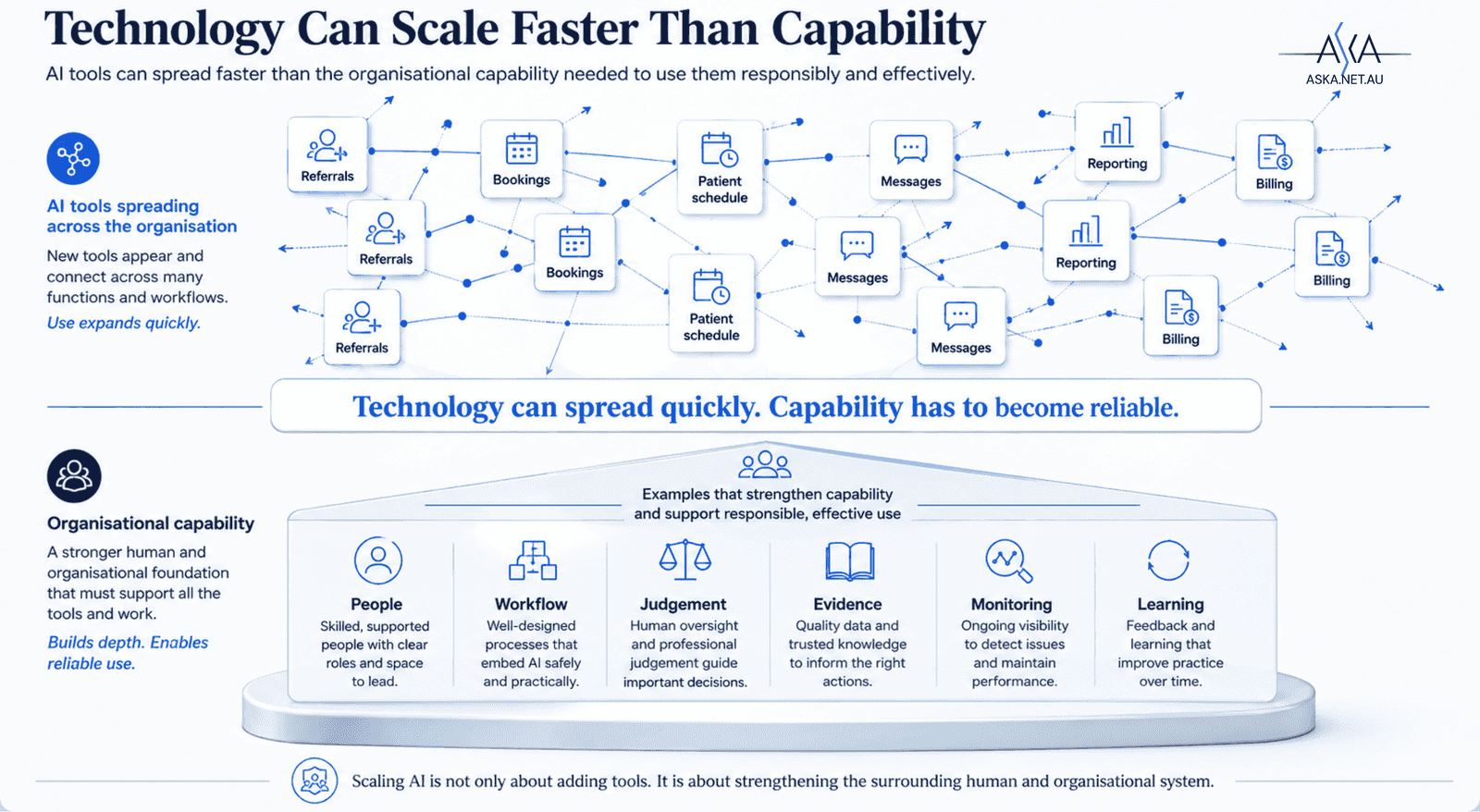
The readiness point is narrow but important: technology can scale faster than organisational capability, and when it does, risk and disappointment scale with it.
The management task: make a readiness judgement
The practical management task is to make a better judgement for one real AI use.
For one real AI use in the organisation, what would justify saying we are ready enough to proceed, under what conditions, and what would make us revisit that judgement later? A good judgement is specific enough to be useful. It names the AI use, the purpose, the context, the consequence, the people affected, the capability required, the evidence available, the uncertainty that remains, and the material change that would make the answer stale.
Managers do not need an elaborate scoring system to begin. They need disciplined questions. What exactly is the AI expected to do? What value is it meant to serve? What has to be reliable and repeatable rather than dependent on a champion or a workaround? What do people need to notice, judge or do? What evidence exists, and what evidence is missing? What uncertainty would be irresponsible to ignore? What change would trigger reconsideration? What is the next practical action that would improve the quality of the judgement?
These questions do not have to be worked through in a fixed sequence. Together, they support a better management judgement. One way to make that judgement inspectable is to write it as a single sentence:
For [specific AI use], our current judgement is that we are ________, provided ________. The evidence supporting that judgement is ________. We are still uncertain about ________. We would revisit the judgement if ________. Our next action is ________.
The value is not the wording. The value is that the sentence forces the organisation to name conditions, evidence, uncertainty, renewal triggers and action. It turns readiness from a vague assurance into a decision that can be challenged.
An AI-ready organisation is one that keeps making the judgement
An AI-ready organisation is not the one using the most AI. It is one capable of using AI responsibly and effectively for defined purposes and contexts, demonstrating that capability through evidence, and renewing it as AI, work, risk and served value change.
That is a more demanding standard than adoption. It asks leaders to look past licences, tools, pilots and training, and to examine the whole system around AI: the work, the people, the value, the governance, the evidence and the learning. It is also a more useful standard. It lets organisations act where they are ready enough, prepare where important conditions are missing, constrain use where risk is too high, and revisit decisions when circumstances change.
The closing question for any leadership team is this: what must our organisation become capable of doing repeatedly, so that we can use AI responsibly and effectively as the technology, the work, the risks and the value we seek continue to change?
AI readiness is not a badge an organisation earns. It is a judgement it has to be capable of making and renewing.
Put the idea into practice
Start with one real AI use, not the whole AI agenda. Name what the AI will do, where it will operate, who could be affected and what consequence matters. Then ask what value the use is meant to serve and what evidence would justify proceeding under current conditions. Look past the AI component: consider whether people can perform the required judgement, whether the workflow can absorb the change, whether escalation and boundaries work, and whether the organisation would still perform well without the original champion or the protected pilot setting. Write the judgement in plain language, including conditions, evidence, uncertainty, renewal triggers and one next action. The immediate goal is not to prove that the organisation is permanently ready. It is to make one readiness judgement well enough that the organisation can act, learn or pause responsibly.
 takes one real AI use end to end: purpose, context, consequence, human role, evidence, uncertainty, renewal trigger and next action, then the readiness sentence, so the judgement can be put in front of others and challenged.
Next in the series: AI Use Cases That Actually Deliver ROI, on moving from AI activity to measurable business value.
Sources and further reading
The frameworks presented in this article, including situated AI readiness, the readiness judgement and its renewal trigger, and the readiness sentence scaffold, were developed by the author. The sources below are cited as evidence of the management challenges they address, not as the origin of the frameworks.
- Brynjolfsson, E., and L. M. Hitt. “Beyond Computation: Information Technology, Organizational Transformation and Business Performance.” Journal of Economic Perspectives 14, no. 4 (2000): 23–48.
- Duarte, and McDermott. “Factors Influencing Readiness for Artificial Intelligence: A Systematic Literature Review.” 2024.
- Goddard, K., A. Roudsari, and J. C. Wyatt. “Automation Bias: A Systematic Review of Frequency, Effect Mediators, and Mitigators.” Journal of the American Medical Informatics Association 19, no. 1 (2012): 121–127.
- International Organization for Standardization and International Electrotechnical Commission. ISO/IEC 42001:2023 Artificial Intelligence Management Systems. Geneva: ISO, 2023.
- Jöhnk, J., M. Weissert, and K. Wyrtki. “Ready or Not, AI Comes: An Interview Study of Organizational AI Readiness Factors.” Business and Information Systems Engineering 63 (2021): 5–20.
- Klarna. “Klarna AI Assistant Handles Two-Thirds of Customer Service Chats in Its First Month.” Press release, February 27, 2024.
- Moffatt v. Air Canada, 2024 BCCRT 149, British Columbia Civil Resolution Tribunal, February 14, 2024.
- Morgan Stanley. “Morgan Stanley Wealth Management Announces Latest Game-Changing Addition to Suite of GenAI Tools.” Press release, June 26, 2024.
- Mukherjee, S., and E. Wang. “Sweden’s Klarna Shifts AI Focus from Cost Cuts to Growth.” Reuters, September 10, 2025.
- National Institute of Standards and Technology. Artificial Intelligence Risk Management Framework (AI RMF 1.0). NIST AI 100-1. Gaithersburg, MD: NIST, 2023.
- Parasuraman, R., and D. H. Manzey. “Complacency and Bias in Human Use of Automation: An Attentional Integration.” Human Factors 52, no. 3 (2010): 381–410.
- Teece, D. J. “Explicating Dynamic Capabilities: The Nature and Microfoundations of (Sustainable) Enterprise Performance.” Strategic Management Journal 28, no. 13 (2007): 1319–1350.
- UK Department for Science, Innovation and Technology. Introduction to AI Assurance. London: DSIT, 2024.
- Weiner, B. J. “A Theory of Organizational Readiness for Change.” Implementation Science 4 (2009): article 67.
- Woods, et al. “Assessing the Effectiveness of AI Education and Training for Healthcare Workers.” 2026.
This article is for general management and governance discussion only. It does not constitute legal, regulatory, clinical or professional advice.